
Why Okachimachi matters.
Okachimachi is a densely layered commercial district where Okachimachi's mercantile character meets Edo-period artisan traditions, postwar market culture and one of Japan's deepest concentrations of jewelry production and trade.
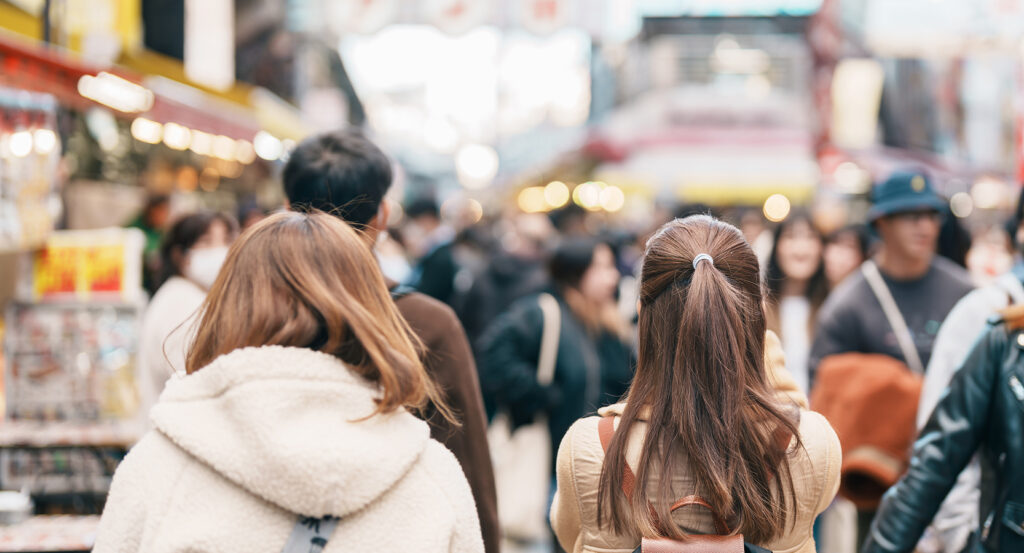
Set along the railway corridor near Kasuga-dori and just steps from Okachimachi Station, the district occupies the southern edge of Ueno, where elevated tracks, compact side streets and major commercial avenues compress several distinct forms of Tokyo commerce into a remarkably tight area. Ameyoko pushes north beneath and beside the railway through a dense succession of food, clothing and specialty shops, with 400 businesses concentrated across 500 meters between Okachimachi and Ueno. Streets east of the station shift toward jewelry wholesalers, stone dealers and specialist workshops, exposing an industrial-commercial layer less immediately visible than the market crowds. South toward Akihabara, the railway viaduct becomes another commercial spine as craft businesses occupy the arches and connect Okachimachi's inherited artisan culture with contemporary design. The result is a district whose intensity comes from overlapping systems of trade, placing street markets, jewelry workshops, wholesalers and independent makers within a few minutes of one another.
What defines Okachimachi.
Okachimachi is best known for preserving the name and commercial afterlife of an Edo district occupied by okachi, lower-ranking Tokugawa retainers attached to the shogun's service. The shogunate assigned residences north of Edo Castle to groups including Osakite-gumi, Shoinban-gumi and Okachigumi as part of the capital's northern defenses. Much of the surrounding territory consisted of warrior estates and temple land without formal neighborhood names, leaving popular place names to provide geographic orientation. Okachimachi appeared on Edo-period maps without functioning as an official administrative designation. Financial pressures on the lower-ranking retainers encouraged household sidelines, and morning-glory cultivation became one local activity associated with their residential plots. The Meiji government formally adopted Okachimachi as a place name in 1872, giving administrative status to terminology rooted in the Tokugawa social order. Railway development later fixed that historical name into metropolitan geography when Okachimachi Station opened on November 1, 1925 during completion of the elevated connection between Ueno and Tokyo and the beginning of circular Yamanote Line operation. The old town name disappeared from official addresses during the 1964 reorganization, yet the station preserved it and allowed Okachimachi to remain the dominant name for the surrounding commercial district. A designation born from the residential geography of Tokugawa retainers survived the disappearance of the administrative neighborhood itself through transportation, commerce and continued public use.
Jewelry gave that inherited artisan geography an unusually specialized modern economy. Edo-period proximity to Kan'ei-ji, Senso-ji and numerous smaller religious institutions supported craftsmen producing decorative metalwork for Buddhist fittings and silverware, and nearby entertainment districts generated demand for ornaments such as kanzashi and obi clasps. Ring manufacturing expanded during the middle Meiji period, followed by mold-based production techniques that increased the district's jewelry output. A different commercial network emerged after the Pacific War when American servicemen traded watches and accessories around Ueno's open-air markets, with businesses in Ueno and Okachimachi developing repair and intermediary functions behind those transactions. Eleven watch wholesalers formed the Naka-Okachimachi Wholesalers Federation in 1956, strengthening the concentration of related businesses. Dealer exchanges for watches and jewelry began in spring 1964, creating recurring trade among specialists and reinforcing Okachimachi's position within the industry. Cutting, setting, plating, engraving, wholesaling and retail subsequently accumulated within walking distance, allowing separate specialist businesses to participate in successive stages of jewelry production and sale. Jewelry Town Okachimachi now characterizes the area as one of Japan's largest specialized jewelry districts, carrying an artisan lineage rooted in Edo decorative trades into a tightly concentrated contemporary industry.
How Okachimachi fits.
Okachimachi works as the anchor for a Ueno and Yushima route through three nearby sites that connect the district's commercial intensity with Tokugawa religious geography, an older landscape modeled on Kyoto and a center of learning patronized by shoguns and scholars.
Begin at Shinobazu Pond, a surviving body of water that originated from a former inlet of Tokyo Bay and became part of an elaborate symbolic geography after Kan'ei-ji was established during the early Tokugawa period. The temple received the mountain name Toeizan in reference to Mount Hiei, and Shinobazu Pond was associated with Lake Biwa; an island modeled on Chikubujima was created within the water and supplied with Bentendo, embedding the Ueno landscape within a deliberate recreation of sacred geography from the Kyoto region. Summer lotus growth later became one of the pond's celebrated features, and teahouses around its edge served lotus-leaf rice as the waters became a recurring subject for writers and artists. Continue to Yushima Tenmangu, whose religious history extends through several successive phases of eastern Tokyo's development. The shrine places its foundation in 458, with Ameno-tajikaraono-mikoto as its original deity, then added Sugawara no Michizane in 1355 after petitions from local residents established the association with the scholar-statesman later revered as a deity of learning. Ota Dokan rebuilt the shrine in 1478, Tokugawa Ieyasu granted it five koku of vermilion-seal land after entering Edo in 1590 and fifth shogun Tokugawa Tsunayoshi became another important patron. Scholars including Arai Hakuseki and Hayashi Razan visited its plum blossoms during the Edo period, linking religious devotion, scholarship and seasonal culture on the high ground overlooking the commercial districts below. Conclude at 2k540 AKI-OKA ARTISAN, where the railway infrastructure separating Okachimachi from Akihabara became a platform for a contemporary revival of the area's craft associations. The name combines its position 2.540 kilometers from Tokyo Station with AKI-OKA, joining Akihabara and Okachimachi, and ARTISAN, the French term for a craftsperson. 50 shops, studios, galleries and cafes occupy the space beneath the JR tracks, with businesses devoted to fields including leatherwork, woodcraft and jewelry and numerous units combining production with direct sales. Its location draws particular force from the surrounding district, where traditional craftspeople once worked and jewelry and leather businesses remain concentrated. The progression moves from Shinobazu Pond's Tokugawa reconstruction of sacred Kyoto geography through Yushima Tenmangu's long association with worship and scholarship into 2k540 AKI-OKA ARTISAN's contemporary concentration of working makers, placing Okachimachi within a district where religious patronage, craftsmanship and commerce have repeatedly generated new forms of urban culture.
Where your story begins.
Foresyte Travel reveals places that feel extraordinary long before you arrive.
Enjoy editorial crafted for luxury travelers.
Foresyte may earn a commission when you book.

















































































































