Why Ontario Street matters.
Ontario Street is a polished corridor where River North's commercial energy, architectural ambition, transportation heritage, and Chicago's enduring culture of urban reinvention converge within one of the city's most recognizable downtown districts.
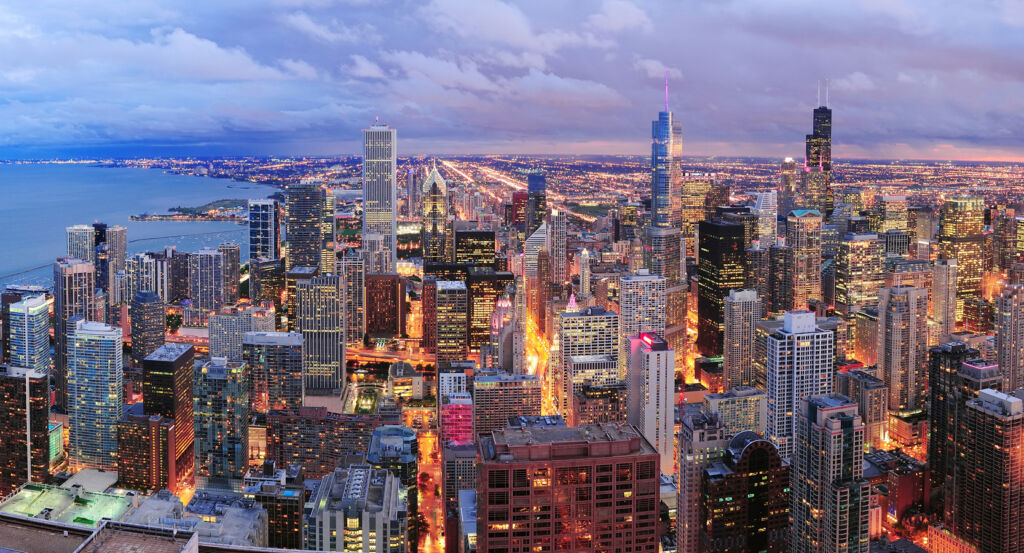
Running through River North between Streeterville and the West Loop, Ontario Street links historic warehouse blocks, riverfront infrastructure, contemporary high-rises, hospitality destinations, and long-established commercial properties that collectively trace more than a century of downtown development. The corridor reflects successive waves of industrial commerce, automotive infrastructure, residential investment, and adaptive redevelopment that transformed the Near North Side into one of Chicago's most active urban environments. Historic masonry buildings stand alongside modern towers without obscuring the district's commercial origins, creating a streetscape where multiple eras remain clearly visible. The result is a corridor distinguished by architectural continuity, economic vitality, and a central role in Chicago's downtown evolution.
What defines Ontario Street.
Ontario Street is best known for extending across River North through an area transformed after the Great Chicago Fire of 1871, when extensive rebuilding introduced fire-resistant masonry construction, expanded wholesale commerce, and established the neighborhood as one of the city's principal warehouse districts. During the late nineteenth and early twentieth centuries, furniture manufacturers, printing companies, food wholesalers, and commercial warehouses clustered along the corridor, supported by nearby rail freight facilities and bridges spanning the North Branch of the Chicago River. Completion of the Ohio Street feeder ramps and their connection to the Kennedy Expressway during the 1960s positioned Ontario Street as a major downtown gateway, fundamentally reshaping east-west automobile circulation while reinforcing its commercial importance. Continuing redevelopment throughout the late twentieth century introduced residential towers, hotels, and office buildings while preserving substantial portions of River North's historic industrial streetscape through adaptive reuse and landmark-sensitive investment.
Preservation initiatives gained lasting momentum when the East Superior Street District received Chicago Landmark designation in 1989, protecting a collection of late nineteenth-century commercial buildings that reinforce the architectural character surrounding Ontario Street. Nearby, the Montgomery Ward Catalog House, completed in 1908 by architects Schmidt, Garden & Martin, demonstrated early reinforced-concrete warehouse engineering that influenced commercial building design throughout the United States. Expansion of the River North Gallery District during the 1970s and 1980s introduced hundreds of galleries into former warehouses, establishing one of North America's largest concentrations of contemporary art spaces through adaptive reuse. Together, the East Superior Street District, the Montgomery Ward Catalog House, Schmidt, Garden & Martin, and the River North Gallery District demonstrate how preservation, engineering innovation, and cultural investment collectively reshaped Ontario Street while preserving its commercial identity.
How Ontario Street fits.
Ontario Street works as an exploration of River North's commercial heritage, architectural evolution, and contemporary culture.
Begin at Chicago Water Tower, where one of the few prominent structures to survive the Great Chicago Fire introduces the resilience that shaped the surrounding district before following Ontario Street westward. Continue to Museum of Contemporary Art Chicago, whose internationally recognized exhibitions expand the neighborhood's longstanding relationship with design, creativity, and cultural innovation. Conclude at Ward (A. Montgomery) Park, where riverfront landscapes and views of the Chicago River provide a fitting finale reflecting the corridor's enduring relationship with commerce, engineering, and urban renewal. The progression moves naturally from rebuilding after catastrophe to contemporary artistic expression before concluding beside the river that helped shape Chicago's commercial ascent.
Where your story begins.
Foresyte Travel reveals places that feel extraordinary long before you arrive.
Enjoy editorial crafted for luxury travelers.
Foresyte may earn a commission when you book.