Why Osaka Castle matters.
Osaka Castle is an expansive Japanese fortress where Chūō Ward's historical character meets Toyotomi Hideyoshi's campaign to unify Japan, the collapse of his ruling dynasty and an extraordinary architectural succession spanning four centuries.
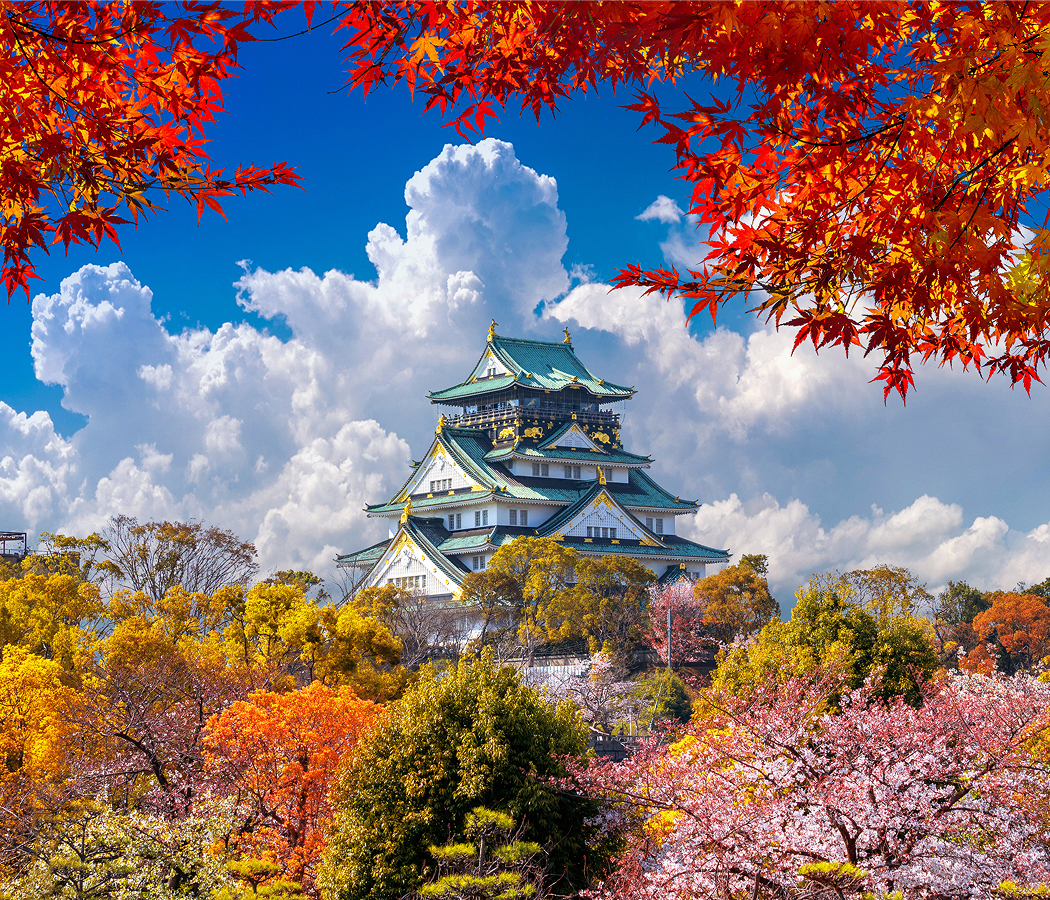
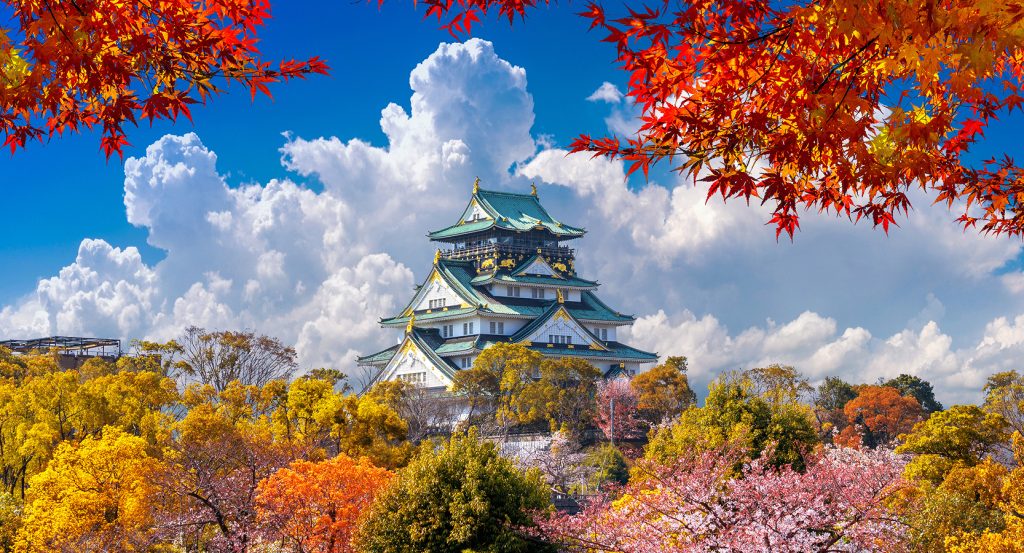
Rising above Osaka Castle Park near the Ōkawa River, Osaka Castle occupies an elevated fortified precinct between Ōtemae, Morinomiya and Kyōbashi, with Tanimachi, Osaka Business Park and the broad avenues surrounding the former imperial arsenal framing its position in Central Osaka. Immense granite walls rise above concentric moats, supporting a five-tiered white castle tower whose green copper roofs, gilded ornaments and projecting gables create an imposing silhouette against the modern skyline. Approaching through fortified gates and successive stone-lined passages reveals the immense scale of the defensive complex, with steep embankments and carefully controlled entrances separating the outer grounds from the central keep. Inside, eight exhibition floors preserve historical objects associated with Japan's age of unification, culminating in an observation gallery overlooking the castle grounds and surrounding city. The result is a fortress whose surviving seventeenth-century defenses and reconstructed central tower preserve the architectural ambitions, political struggles and successive rebuilding campaigns that shaped Osaka's most consequential historical site.
What defines Osaka Castle.
Osaka Castle is best known for Toyotomi Hideyoshi's transformation of a fortified Buddhist religious center into the political headquarters of his campaign to unify Japan, followed by the castle's destruction, Tokugawa reconstruction and twentieth-century revival through an extraordinary civic fundraising effort. The site originated within the Ishiyama Honganji temple complex, established in 1496 by the Buddhist leader Rennyo and subsequently developed into a powerful religious stronghold. Oda Nobunaga besieged the fortified settlement between 1570 and 1580, eventually forcing its surrender after a decade of resistance from the influential Ikkō-ikki movement. Following Nobunaga's death in 1582, Hideyoshi emerged as the leading contender for control of Japan and began constructing Osaka Castle in 1583 on the former temple grounds. His immense fortress incorporated elaborate stone defenses, gilded architectural decoration and a central keep designed to proclaim the authority of an emerging national ruler. Hideyoshi completed the principal tower in 1585 and continued expanding the complex through successive defensive enclosures as his military campaigns consolidated control over the country. His death in 1598 left the succession to his young son Hideyori, whose position deteriorated as Tokugawa Ieyasu established a rival political order following the Battle of Sekigahara in 1600. The confrontation culminated in the Winter Siege of Osaka in 1614, when Tokugawa forces surrounded the fortress but failed to capture its defenders. Negotiated peace brought the filling of defensive moats, weakening the castle before renewed hostilities erupted during the Summer Siege of 1615. Tokugawa forces overwhelmed the remaining defenders, and Hideyori died alongside his mother Yodo-dono as flames consumed the fortress, extinguishing the Toyotomi dynasty's political ambitions. The second Tokugawa shogun, Hidetada, ordered a comprehensive reconstruction beginning in 1620, burying substantial portions of Hideyoshi's original defenses beneath enormous quantities of earth and newly assembled stonework. Regional daimyō supplied labor and granite blocks for the project, leaving distinctive quarry marks and family symbols across the surviving walls. Tadao Ikeda directed construction of the fortified approach behind Sakuramon Gate in 1624, incorporating the 108-ton Takoishi, an immense granite slab transported from Bizen whose exposed surface approaches sixty square meters. The rebuilt castle acquired another central tower, but lightning destroyed the structure in 1665 and left the fortress without a keep for more than two centuries. Military upheaval during the Meiji Restoration brought further destruction in 1868, after which the surviving complex became an important military installation. Mayor Hajime Seki championed restoration of the central tower during the early twentieth century, securing public contributions that financed a modern steel-and-concrete reconstruction completed in 1931. The project recreated the appearance of Hideyoshi's original tower above the Tokugawa-period foundations, producing a building whose architecture deliberately combined two different historical chapters. Allied bombing damaged parts of the military complex during World War II, but the reconstructed keep survived and reopened to the public in 1949. A major restoration completed in 1997 renewed the tower's exterior, decorative goldwork and structural components, preserving the 1931 reconstruction through another generation. Archaeological investigations subsequently revealed portions of Hideyoshi's original walls beneath the Tokugawa fortifications, culminating in the 2025 opening of the Toyotomi Stone Wall Museum, where visitors descend underground to examine masonry concealed for four centuries. Osaka Castle's significance rests on this extraordinary sequence of religious warfare, national unification, dynastic collapse, military reconstruction and civic preservation, with successive layers of masonry preserving the political ambitions of competing rulers beneath one of Japan's most recognizable architectural monuments.
Where your story begins.
Foresyte Travel reveals places that feel extraordinary long before you arrive.
Enjoy editorial crafted for luxury travelers.