
Why La Villette matters.
La Villette is Paris' largest cultural park where La Villette's visionary urban planning, contemporary architecture, science, music, and public space create one of Europe's most influential cultural districts.
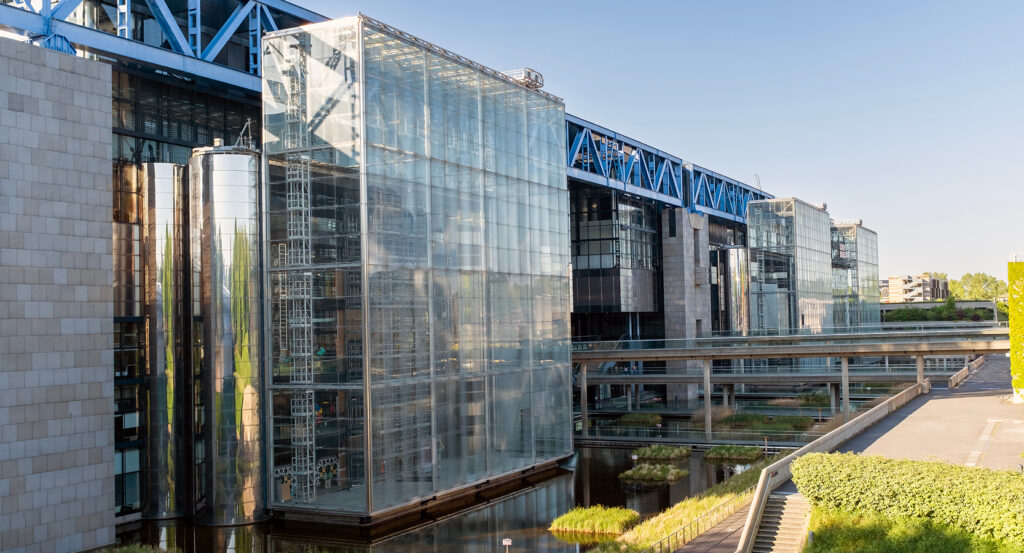
Set along Canal de l'Ourcq between Porte de Pantin and Porte de la Villette near Cité des Sciences et de l'Industrie and just steps from Philharmonie de Paris, this expansive park combines bold contemporary architecture, landscaped gardens, open lawns, museums, concert halls, canals, playgrounds, and cultural venues within one of the world's most ambitious urban regeneration projects. Distinctive red architectural follies, broad pedestrian promenades, waterfront landscapes, and dynamic public spaces establish an environment where recreation, culture, and design intersect on a grand scale. Every section reflects a bold reimagining of industrial land into one of Europe's leading civic landscapes. The result is a destination defined by architectural innovation, cultural vitality, and one of Paris' most remarkable public parks.
What defines La Villette.
La Villette is best known for transforming the former Paris slaughterhouses and livestock market, which operated from 1867 until 1974, into one of the twentieth century's most influential examples of urban regeneration. Following an international design competition won by architect Bernard Tschumi in 1982, the 55-hectare (136-acre) site became the largest landscaped park in Paris, introducing a revolutionary architectural concept that organized the landscape through a grid of 35 bright-red steel follies functioning as visual landmarks, circulation points, and cultural facilities distributed across the park. Officially inaugurated in 1987, La Villette combines internationally significant institutions including the Cité des Sciences et de l'Industrie, among Europe's largest science museums, the Philharmonie de Paris, designed by Jean Nouvel and opened in 2015, Zénith Paris, Grande Halle de la Villette, the Conservatoire National Supérieur de Musique et de Danse de Paris, and multiple theaters, exhibition halls, cinemas, and performance venues. Tschumi's groundbreaking design rejected traditional formal park layouts in favor of an innovative structure where architecture, landscape, movement, and cultural programming interact continuously across gardens, canals, event lawns, and public squares. Throughout the year La Villette hosts internationally recognized festivals, open-air cinema screenings, major concerts, art exhibitions, and cultural events that attract millions of visitors while reinforcing its position as one of Europe's foremost centers for science, music, architecture, and contemporary culture. Its extraordinary synthesis of landscape architecture, adaptive reuse, and cultural infrastructure has established La Villette as one of the defining urban design achievements of the modern era.
The landscape composition integrates expansive lawns, thematic gardens, canal-front promenades, grand cultural buildings, pedestrian bridges, and Bernard Tschumi's iconic red follies into a unified civic environment that encourages continual exploration. Carefully structured circulation, flexible event spaces, and bold architectural interventions allow recreation, education, performance, and public life to coexist across one of Paris' most ambitious contemporary landscapes. Seasonal festivals, outdoor exhibitions, concerts, and continually evolving cultural programming reinforce the park's character as a living cultural district. Every element demonstrates how architecture, landscape design, adaptive reuse, and cultural planning combine to create one of the world's most influential public spaces.
How La Villette fits.
La Villette works as the cultural centerpiece of an exploration through northeastern Paris.
Begin at Cité des Sciences et de l'Industrie, where one of Europe's largest science museums establishes the district's commitment to innovation before continuing to La Villette. Continue to Philharmonie de Paris, whose landmark architecture and internationally acclaimed performances naturally extend the park's extraordinary cultural identity. Conclude along Canal de l'Ourcq, where waterside promenades, cafés, and contemporary public spaces provide a memorable finale celebrating the remarkable urban transformation that defines modern La Villette. The progression moves naturally from scientific discovery to one of Europe's great cultural parks before concluding along one of Paris' most energetic canals, revealing why La Villette remains among the world's defining examples of contemporary urban design.
Where your story begins.
Foresyte Travel reveals places that feel extraordinary long before you arrive.
Experience premium editorial crafted for luxury travelers.
Foresyte Travel may earn a commission when you book through the link on this page.














































































































