
Why Parc des Buttes-Chaumont matters.
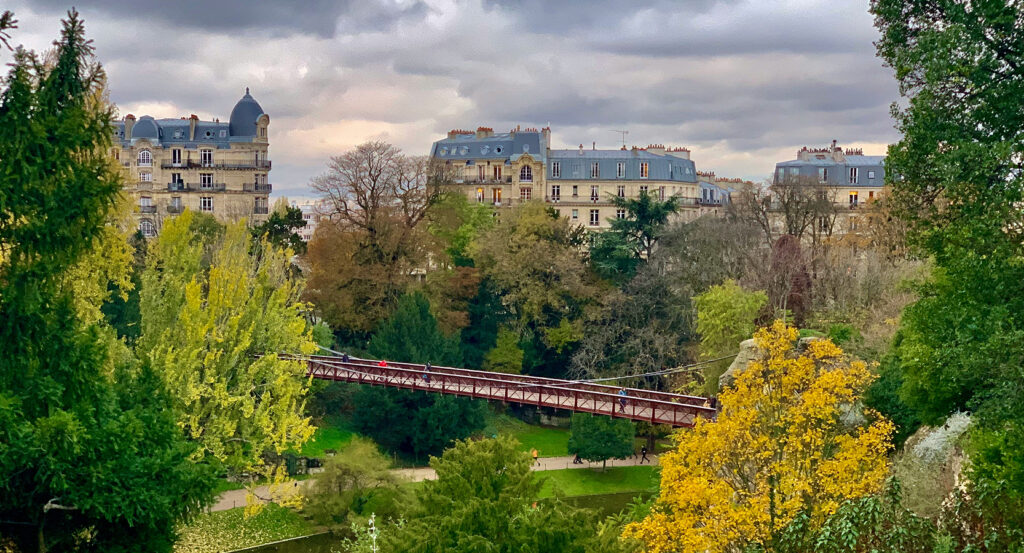
Parc des Buttes-Chaumont is a theatrical landscape park where the 19th Arrondissement's steep northeastern character meets an engineered world of cliffs, water, bridges and woodland created from an exhausted gypsum quarry.
Set along Rue Botzaris near Rue de Crimée and just steps from Avenue Simon Bolivar, the park occupies a steep 25-hectare enclosure where wooded slopes, curving paths and high ground rise above the dense apartment streets of Belleville and the Quartier d'Amérique. A lake encircles the Île du Belvédère, whose sheer artificial cliffs lift Gabriel Davioud's Temple de la Sibylle above the surrounding tree canopy. Paths climb and descend through lawns, groves and exposed rock faces before bridges carry the circulation across deep changes in elevation. The neighboring streets remain close to the park boundary, yet its excavated basin and irregular terrain conceal much of the surrounding city once the paths descend toward the lake. The result is an immersive piece of Second Empire landscape engineering whose exaggerated topography turns a former extraction site into one of Paris's most spatially dramatic public parks.
What defines Parc des Buttes-Chaumont.
Parc des Buttes-Chaumont is best known for converting an immense gypsum quarry into a wholly constructed landscape under Napoleon III, Baron Haussmann and engineer Jean-Charles Adolphe Alphand. Quarrying intensified after the French Revolution and carved the hill into three superimposed galleries reaching 45 meters in height, with extracted gypsum exported as far as the United States before operations ended in 1860. The territory also accommodated refuse, animal carcasses and processing of waste into fertilizer when it still stood beyond the Paris boundary. Napoleon III selected the exhausted quarry for conversion into a public garden, the state acquired the terrain in 1863 and construction began in 1864 under Alphand. Jean-Pierre Barillet-Deschamps directed planting, Édouard André participated in the landscape work, Gabriel Davioud designed architectural components and Eugène Belgrand contributed the hydraulic expertise behind the water system. One thousand workers, one hundred horses, 450 wagons moving over 39 kilometers of temporary track and two steam engines participated in the three-year undertaking. Dynamite reshaped the rock as crews moved 800,000 cubic meters during earthworks and introduced 200,000 cubic meters of soil, followed by 130,000 cubic meters of topsoil and 2,000 cubic meters of planting earth. The remaining quarry mass became the Île du Belvédère, artificial rockwork recreated coastal cliffs and a former quarry entrance became a cavern beneath a 32-meter waterfall. Parc des Buttes-Chaumont opened on April 1, 1867 during the Exposition Universelle, converting the physical consequences of extraction into a public landscape built through some of the Second Empire's most ambitious engineering.
The park's circulation and architecture extended that engineering experiment through structures designed to make extreme changes of elevation part of the composition. Davioud placed the Temple de la Sibylle on the summit of the Île du Belvédère, drawing from the ancient temple at Tivoli for an eight-column rotunda combining Ionic and Corinthian elements above a Jura-stone base. Two bridges connected the island across the lake, joining a suspended crossing with a masonry bridge on the opposite side and turning the isolated quarry remnant into the park's principal belvedere. Davioud also designed entrance lodges and three restaurant pavilions positioned to command distinct views, including the Pavillon du Chemin de Fer above the railway cutting. The Petite Ceinture had already introduced heavy transport infrastructure into the terrain, with its tunnel head dating from 1852 to 1854 and a 1,150-meter tunnel extending beneath the hillside toward Rue des Couronnes. Alphand's team absorbed that railway into the composition, allowing trains to pass through a landscape whose apparent cliffs, groves and ravines concealed both industrial geology and contemporary infrastructure. The lake, streams and cascade completed the illusion through a hydraulic network supplied from the Canal de l'Ourcq. Parc des Buttes-Chaumont emerged through this fusion of railway construction, hydraulic engineering, artificial rockwork and architectural staging, turning movement through radically altered ground into the central mechanism of the park.
How Parc des Buttes-Chaumont fits.
Parc des Buttes-Chaumont works as the anchor for a daytime exploration through the surrounding heights using three nearby sites that move from a German Protestant foundation transformed by Russian émigrés through an unusual workers' housing district into the surviving railway infrastructure of Second Empire Paris.
Begin at Église Saint-Serge-de-Radonège, where a German Protestant mission acquired a hill near the park and completed a church in 1861. The parish remained active until 1914, after which the French state requisitioned the property and placed it at auction as part of postwar settlements. The Russian Orthodox archdiocese acquired the complex in 1924 for a new parish and theological institute serving the émigré community established in Paris after the Russian Revolution. Dmitri Stelletsky subsequently transformed the former Protestant interior through iconostases and an extensive painted program completed during the 1920s, covering walls and ceilings with Orthodox imagery and converting a nineteenth-century German religious compound into a major center of Russian Orthodox life in France. Continue through Quartier de la Mouzaïa, whose narrow pedestrian villas developed across quarry ground that imposed unusual restrictions on construction. Agreements reached between the City of Paris and private developers in 1889 helped establish the architectural consistency of the district, where small houses and gardens filled lanes inaccessible to ordinary vehicular traffic. Geological instability beneath the former extraction territory discouraged heavier construction and preserved a scale sharply different from the apartment blocks surrounding the district. The name recalls Mouzaïa in Algeria, carrying nineteenth-century French imperial geography into a residential quarter whose built form arose from the physical limitations of Parisian quarrying. Conclude at Petite Ceinture du 19e, part of the 32-kilometer orbital railway built under the Second Empire to connect the capital's separate terminal networks and move freight. Passenger service on the northern section ended in 1934, after which vegetation colonized ballast, retaining walls and abandoned railway ground. Sections in the 19th Arrondissement have since reopened as pedestrian landscapes, including a 7,280-square-meter extension between Rue Petit, André Danjon and Avenue Jean Jaurès opened on April 21, 2026. Railway masonry, woodland growth and surviving track infrastructure now connect the industrial geography surrounding Buttes-Chaumont with the canal territory farther north. The progression moves from Stelletsky's transformation of a German Protestant church for Russian Orthodoxy through housing constrained by former quarry ground into the repurposed railway that once threaded through the same industrialized northeastern terrain, extending the park's history of physical reinvention across the surrounding district.
Where your story begins.
Foresyte Travel reveals places that feel extraordinary long before you arrive.
Experience premium editorial crafted for luxury travelers.
Foresyte Travel may earn a commission when you book through the link on this page.














































































































