
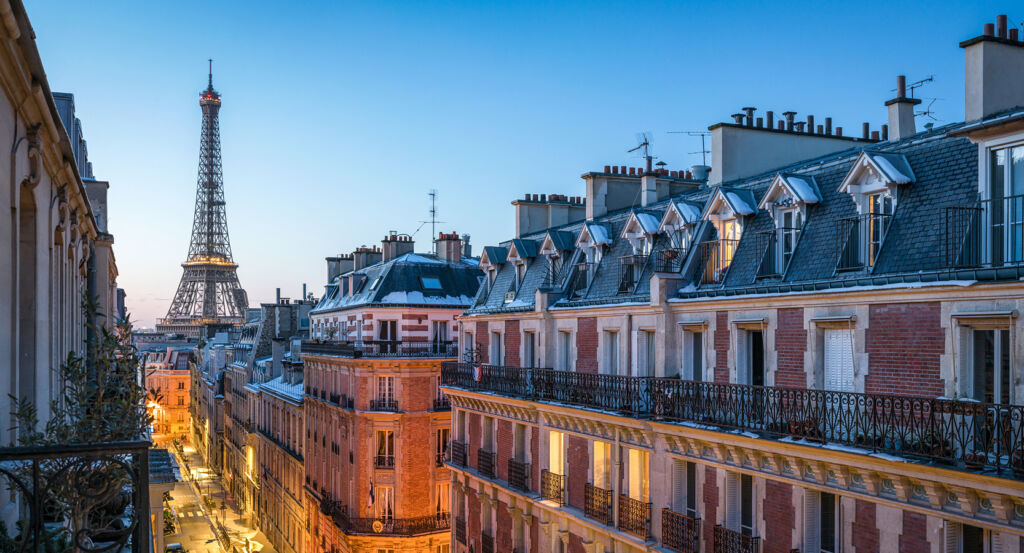
Why you should experience Pavillon Faubourg Saint-Germain & Spa in Paris, France.
Pavillon Faubourg Saint-Germain & Spa is a literary boutique hotel where Saint-Thomas-d'Aquin's cultivated Left Bank character, centuries of artistic exchange, intellectual inheritance and discreet Parisian elegance converge inside an address once inhabited by James Joyce.
Set along Rue du Pré-aux-Clercs near Rue de l'Université and just steps from Église Saint-Thomas-d'Aquin, the hotel unites three historic buildings numbered 1, 3 and 5 into a 47-room retreat whose 2021 transformation preserved their individual identities while connecting them behind interiors conceived by Didier Benderli of Kerylos Intérieurs. The property's April 2022 rebirth organized those addresses almost theatrically, placing Les Parisiens at number 1, Bar James Joyce at number 3 and the hotel with Spa des Prés at number 5. Benderli's layered interiors move through fine fabrics, tailored furniture and residential proportions, while vaulted stone beneath the hotel conceals a pool, hammam and treatment rooms where a twentieth-century cabaret once operated. The result is a hotel where literature, design, gastronomy and surviving layers of Parisian cultural history become parts of the same Saint-Germain story.
What you should know about Pavillon Faubourg Saint-Germain & Spa.
Pavillon Faubourg Saint-Germain & Spa is best known for reopening in April 2022 after a complete 2021 renovation that joined three buildings at 1, 3 and 5 Rue du Pré-aux-Clercs, an address whose documented history reaches to 1642, when Louis XIII authorized Jean Tambonneau, president of the Chambre des Comptes, to construct a noble residence on the Pré-aux-Clercs. The 47-room hotel was redesigned by Didier Benderli of Kerylos Intérieurs, whose intervention preserved the individuality of the three structures while connecting their interiors, with accommodation categories now extending from Classic, Superior and Deluxe rooms through Junior Suites, family rooms, the James Joyce Suite and the Ulysse Suite. Literary history is unusually tangible at number 1, where James Joyce lived while completing Ulysses and wrote on October 29, 1921 that he had finished the novel's “Ithaca” episode and the writing of the book itself, a connection now carried into the James Joyce Suite, Ulysse Suite and Bar James Joyce. Beneath the hotel, Spa des Prés occupies vaulted cellars formerly used by Quod Libet, the twentieth-century cabaret where Léo Ferré began his career, preserving historic stonework and a protected staircase alongside a deep pool with water jets, hammam, two massage cabins, fitness room and meditation and yoga room operated in partnership with CODAGE Paris. The transformation consequently preserved a remarkable continuum from Louis XIII and Jean Tambonneau through Joyce and Ferré to Benderli's twenty-first-century reinvention, embedding the five-star hotel inside nearly four centuries of cultural history.
Chef Thibault Sombardier extends that literary narrative through Les Parisiens, the hotel's neo-brasserie named in deliberate homage to Joyce's Dubliners and developed with Executive Chef Matthieu Pirola around Sombardier's modern interpretation of French haute-bistronomy, seasonal produce and an eclectic cellar spanning biodynamic domaines, parcel-specific cuvées, major French appellations and grower Champagnes. Bar James Joyce develops the same literary character through an English-club-inspired room where house mixologist Clément Lepage creates signature cocktails and live-music evenings reconnect the hotel with the performance culture once established below ground at Quod Libet. Kerylos Intérieurs carries the narrative into the Ulysse Suite, where Didier Benderli used solid-oak herringbone parquet, mouldings, stretched-fabric panels recalling traditional boiserie and contemporary furniture to reinterpret the Parisian apartment through Joyce's continuing presence at the address. Together, Thibault Sombardier, Matthieu Pirola, Clément Lepage and Didier Benderli transform the hotel's Joyce connection from historical anecdote into a coherent contemporary program spanning cuisine, cocktails, interiors and hospitality.
How to fold Pavillon Faubourg Saint-Germain & Spa into your trip.
Pavillon Faubourg Saint-Germain & Spa works as the anchor for an afternoon tracing the artistic and intellectual institutions that made the Left Bank synonymous with cultural Paris.
Begin at Musée d'Orsay, where Victor Laloux's former railway station, begun in 1898 and inaugurated for the 1900 Exposition Universelle, combines a metal structure with a grand coffered vault and now frames collections devoted to art from 1848 to 1914. Continue to Musée national Eugène-Delacroix, occupying the apartment and garden studio Eugène Delacroix moved into in 1857 while completing the nearby Saint-Sulpice murals, creating an intimate encounter with the nineteenth-century artistic world that preceded Saint-Germain's twentieth-century literary mythology. Conclude at Institut de France, where Louis Le Vau's former Collège des Quatre-Nations, completed in 1688 from Cardinal Mazarin's bequest, has housed the Institut and its five academies since Napoleon transferred the institution there in 1805. The progression moves from modern art through an artist's private studio into the institutional heart of French intellectual life, creating a cultural arc that makes Pavillon Faubourg Saint-Germain & Spa's own history of writers, musicians and creative reinvention feel inseparable from the Left Bank.
Where your story begins.
Foresyte Travel reveals places that feel extraordinary long before you arrive.
Experience premium editorial crafted for luxury travelers.














































































































