
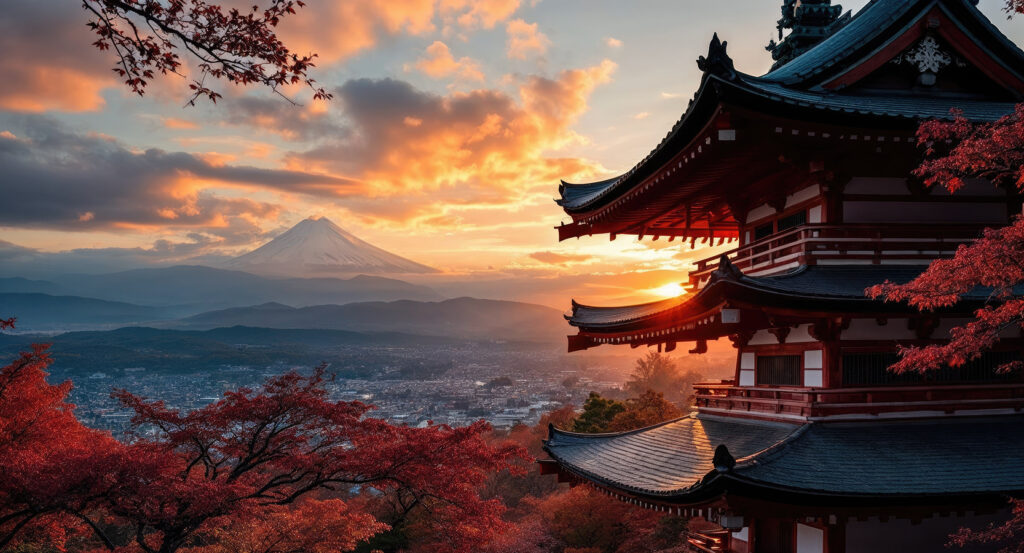
Why Philosopher's Path matters.
Philosopher's Path is a contemplative canal-side corridor where Sakyo Ward's eastern foothills meet the intellectual legacy of Kyoto University, the landscape traditions of Japanese Buddhism and a century of cultural life shaped by walking beneath flowering cherry trees.
Following the eastern bank of a narrow canal between the northern approaches to Ginkaku-ji and the vicinity of Nyakuoji Shrine, the pedestrian corridor occupies the lower slopes of Higashiyama, where residential lanes, small bridges and wooded temple properties connect the historic neighborhoods of northern and eastern Kyoto. Stone paving follows the water beneath overhanging cherry branches, creating a sheltered passage through the surrounding residential district. Low bridges cross the canal at intervals, connecting the walkway with gardens, cafés and narrow neighborhood streets. The gentle gradient preserves an intimate relationship between the waterway and the adjoining hillside. The result is a distinctive walking route whose cultivated landscape, philosophical associations and understated residential surroundings preserve an important dimension of Kyoto's intellectual and religious heritage.
What defines Philosopher's Path.
Philosopher's Path is best known for its association with Nishida Kitarō, the influential Japanese philosopher whose walks along the canal became closely connected with the development of modern Japanese thought. The route follows a branch of the Lake Biwa Canal system, an ambitious engineering undertaking conceived during the Meiji period to restore Kyoto's economic prospects after the imperial capital moved to Tokyo in 1868. Construction of the principal canal began in 1885 under the direction of engineer Tanabe Sakurō, who had recently completed his studies at the Imperial College of Engineering. The project transported water from Lake Biwa through tunnels and waterways crossing the mountains east of Kyoto. Its first major section opened in 1890, supplying water for transportation, irrigation and industrial development. Hydroelectric generation followed at the Keage power station in 1891, contributing to Kyoto's early adoption of electric infrastructure. The canal system subsequently supported additional branches distributing water through the eastern districts of the city. The waterway adjoining Philosopher's Path became part of this broader network of municipal engineering and landscape management. Nishida Kitarō joined Kyoto Imperial University in 1910, establishing an academic career that profoundly influenced twentieth-century Japanese philosophy. His 1911 book An Inquiry into the Good introduced his influential treatment of pure experience and became a foundational work of modern Japanese philosophical thought. Nishida's teaching and scholarship contributed to the intellectual movement subsequently known as the Kyoto School, which engaged with Western philosophy through Buddhist and East Asian intellectual traditions. His association with walks through the eastern hills connected the surrounding landscape with his habits of contemplation and intellectual reflection. The route eventually acquired the name Tetsugaku no Michi, or Philosopher's Path, commemorating this relationship between the philosopher and the canal-side setting. Cherry trees planted along the waterway strengthened its seasonal appeal and established the flowering corridor that attracts walkers each spring. The path subsequently became an important pedestrian connection between historic religious districts, preserving the canal's practical infrastructure within a landscape associated with philosophical inquiry and Kyoto's cultivated natural environment.
How Philosopher's Path fits.
Philosopher's Path works as the contemplative centerpiece for a Kyoto outing connecting the city's Zen Buddhist architecture, its historic hillside sanctuaries and the artistic patronage that shaped eastern Kyoto's religious landscape.
Begin at Ginkaku-ji, the Zen Buddhist temple developed from the retirement estate of Ashikaga Yoshimasa, the eighth Ashikaga shogun. Construction of the Higashiyama residence began in 1482, creating a setting associated with the artistic practices that came to define Higashiyama culture. Following Yoshimasa's death in 1490, the property became a Buddhist temple. Its Silver Pavilion preserves an important example of late medieval Japanese architecture, and the surrounding gardens incorporate carefully arranged sand, moss and wooded slopes. The temple's cultural significance extends into traditions of tea preparation, flower arrangement and residential design associated with the period. Continue to Hōnen-in, the secluded Buddhist temple established in 1680 on the wooded eastern slopes of Kyoto. Its entrance passes through a thatched gate and a pair of carefully maintained sand mounds known as Byakusadan, which form part of the approach to the temple precinct. Moss-covered grounds and substantial trees establish a quiet setting beneath the surrounding hillside. The temple's religious association with Hōnen, the founder of Japanese Pure Land Buddhism, connects its landscape with an important movement in medieval Japanese religious history. Seasonal openings provide access to additional buildings and garden areas. Conclude at Eikan-dō, formally Zenrin-ji, the Buddhist temple founded in 853 and subsequently associated with the Jōdo-shū tradition. Its religious history became closely connected with the monk Eikan, whose devotion to Amida Buddha contributed to the temple's distinctive practices. The celebrated Mikaeri Amida statue depicts Amida turning his head backward, an unusual sculptural representation associated with a traditional account of Eikan's religious experience. The temple's hillside buildings, covered corridors and landscaped pond establish a carefully composed architectural setting. Its maple trees make the precinct particularly significant during Kyoto's autumn foliage season. The progression moves from Ginkaku-ji's late medieval artistic patronage through Hōnen-in's secluded Buddhist landscape and culminates at Eikan-dō's distinctive religious sculpture and temple gardens, connecting Philosopher's Path with the spiritual and cultural heritage of eastern Kyoto.
Where your story begins.
Foresyte Travel reveals places that feel extraordinary long before you arrive.
Enjoy editorial crafted for luxury travelers.

















































































































