
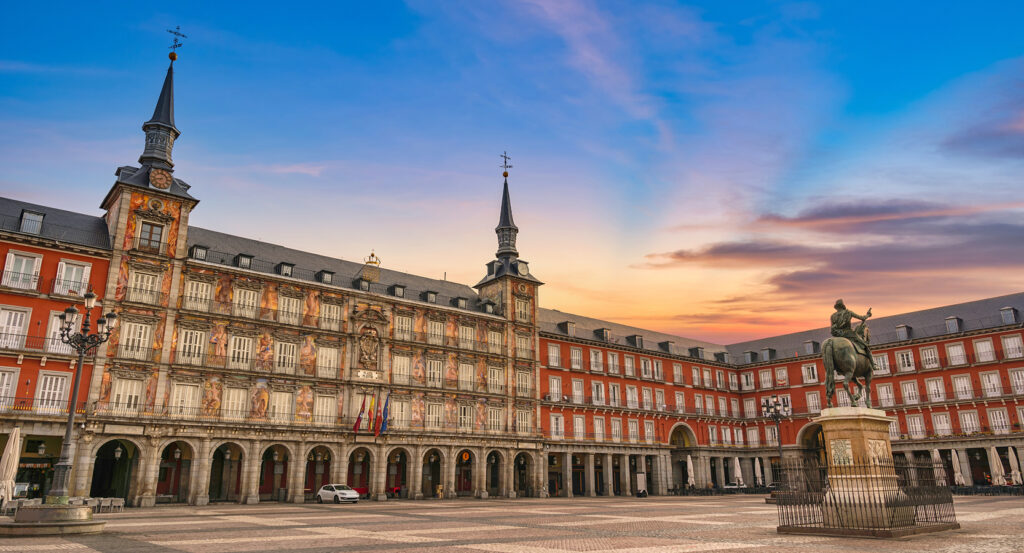
Why you should experience Estatua de Felipe III in Madrid, Spain.
At the center of Madrid's Plaza Mayor stands Estatua de Felipe III, or Statue of Philip III, a solitary monarch in bronze who has watched Madrid evolve for four centuries.
Bathed in sunlight by day and lamplight by night, the statue anchors the square's vast symmetry, its presence both quiet and commanding. The king sits astride his horse with a posture of timeless authority, the folds of his cloak frozen mid-motion, his steed caught between stillness and stride. Around him, the plaza hums with life, cafés clinking, musicians playing, children darting across cobblestones, but he remains unmoved, a sentinel of the city's memory. From every angle, the bronze catches the changing light differently, shifting from gold to shadow to deep burnished green. Few monuments manage to embody a city's dignity as effortlessly as this one; it is less a statue than a heartbeat cast in metal.
What you should know about Estatua de Felipe III.
The statue is older than the plaza it commands.
Commissioned by the king himself in 1608, the sculpture was crafted in Florence by two of Europe's greatest masters: Giambologna, the celebrated Italian sculptor of Mannerist grace, and his apprentice Pietro Tacca, who completed the work after Giambologna's death. Cast in bronze with astonishing precision, it was shipped to Spain as a diplomatic gift from the Grand Duke of Tuscany, symbolizing the alliance between the Spanish crown and the Italian courts. Yet it didn't take its place in Plaza Mayor until 1848, centuries after its creation, a deliberate act to restore royal presence to Madrid's civic heart. During the Napoleonic occupation, the statue was hidden to prevent its melting down for artillery, and it survived several of the fires that ravaged the plaza. One of its most macabre legends surfaced in the 1930s, when restoration workers discovered hundreds of bird bones trapped inside the hollow bronze horse, a mystery solved when the tailpipe vent was opened and flocks could no longer fly in but never out. Few visitors realize that the statue's balance is entirely self-supporting: the horse's rear hooves and tail form a single stabilizing triangle, a feat of Renaissance engineering that allows the entire figure to stand without external support. What began as royal propaganda has become something far more enduring, an emblem of Madrid itself, captured in silhouette against its ever-changing sky.
How to fold Estatua de Felipe III into your trip.
Approach the monument from the northern side of Plaza Mayor, letting the colonnades frame your view as you step into the open light.
Stand at the statue's base around midday, when the bronze glows brightest and the palace-like façades of the square reflect across its polished surfaces. Circle the sculpture slowly, each angle reveals new details: the reins coiled with tension, the king's calm expression, the minute tooling of armor and harness. In the evening, return when lanterns spill amber light across the cobblestones; the horse's shadow stretches long and regal, merging with the square's rhythm of laughter and footsteps. If you're a photographer, the best vantage is from the arcades beneath the Casa de la Panadería, from there, the statue aligns perfectly with the frescoed façade behind it, uniting art and authority in a single frame. Afterward, linger at a nearby terrace with a glass of Rioja and watch Madrid carry on around its eternal rider. Estatua de Felipe III is more than the plaza's centerpiece, it is its compass, the silent witness to centuries of power, fire, and celebration, still holding the city's gaze steady.
Where your story begins.
Foresyte Travel reveals places that feel extraordinary long before you arrive.
Experience premium editorial crafted for luxury travelers.














































































































