
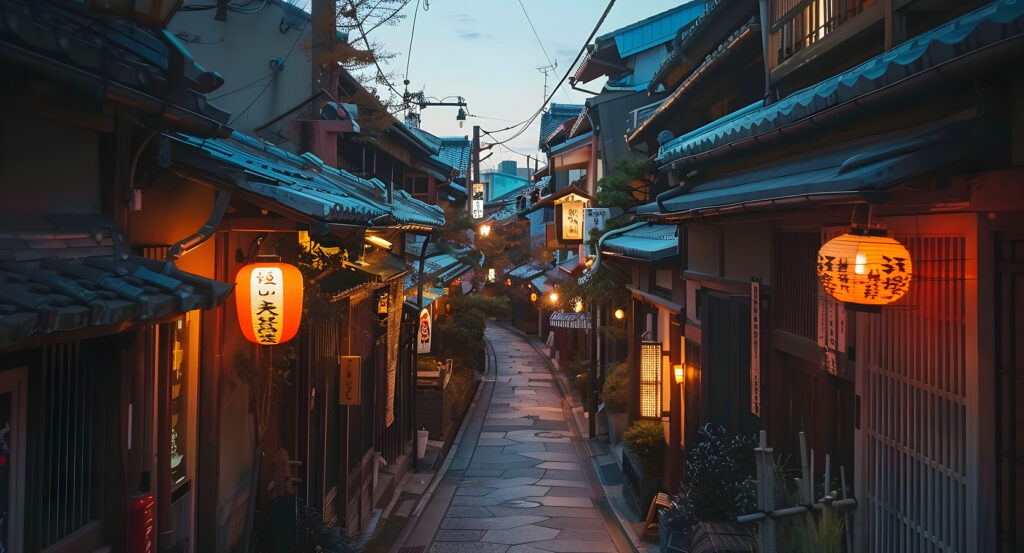
Why Kamo River matters.
Kamo River is Kyoto's open-air meditation, a ribbon of life stretching along the water that has reflected the city for over a thousand years.
Here, time slows to match the pace of the river itself. On one side, narrow lanes rise toward the city's wooden townhouses and glowing paper lanterns; on the other, water drifts past stepping stones, egrets, and ripples of sunset light. Locals stroll hand in hand, cyclists glide by, and musicians gather under bridges, their songs carrying softly through the evening air. In spring, the cherry blossoms line the banks like drifting clouds; in summer, fireflies flicker over the surface at dusk. Autumn brings the scent of dry leaves and distant bonfires; winter, the clear silence of cold air and sky. Every step feels like a conversation, between movement and pause, between the living city and its eternal reflection.
What defines Kamo River.
Kamo River - Kamogawa, meaning “Duck River”, has shaped Kyoto's life and character since the Heian period.
The promenade, running from Demachiyanagi in the north to Shijo and beyond in the south, follows a path that has been walked since the city's founding in 794. Historically, it was both a water source and a social stage, where aristocrats once viewed fire festivals, poets composed verses, and commoners gathered to cool off during humid summers. The modern promenade was developed during the Meiji era, when embankments were reinforced and the pathways formalized, creating a civic corridor that blended recreation with reverence. Few realize that Kyoto's famous noryoyuka dining decks in Pontocho were an extension of this same riverside culture, a centuries-old custom of enjoying food, art, and conversation near flowing water. The river's carefully engineered stepping stones, arranged in whimsical patterns including turtles and plovers, were added in the 20th century to encourage play and movement between the banks. Despite its tranquility, the promenade is also a feat of engineering: the Kamo's flow is managed by a subtle system of weirs that maintain shallow depth, allowing for reflection. At sunrise, monks from nearby temples still come to walk its edges, chanting softly beneath bridges whose design dates back to Edo times. Kamo River is not just geography, it's Kyoto's mirror, and the promenade is the frame.
How Kamo River fits.
To experience Kamo River is to let Kyoto breathe through you.
Start near Sanjo Bridge at twilight, the city's pulse softens here, and the light turns the water to liquid gold. Walk north toward Demachiyanagi, where the two tributaries meet and the view opens to mountains in the distance. Pause often: sit on the stone ledges, watch the reflections of passing lanterns, or simply listen to the sound of the current. If you're visiting in summer, stroll beneath the elevated noryoyuka terraces of Pontocho, their laughter and music spilling gently down to the riverbank. In spring, bring a small picnic beneath the blooming cherry trees near Nijo Bridge; in autumn, come just before dusk when the air glows amber and the river looks painted. At night, couples sit quietly along the embankments, small silhouettes against the shimmer of streetlights, perfectly spaced, perfectly still. Whether you walk a few hundred meters or follow it for miles, Kamo River restores balance. It reminds you that Kyoto's true beauty isn't hidden in temples or towers, but flowing quietly in plain sight.
Where your story begins.
Foresyte Travel reveals places that feel extraordinary long before you arrive.
Enjoy editorial crafted for luxury travelers.
Foresyte may earn a commission when you book.

















































































































