
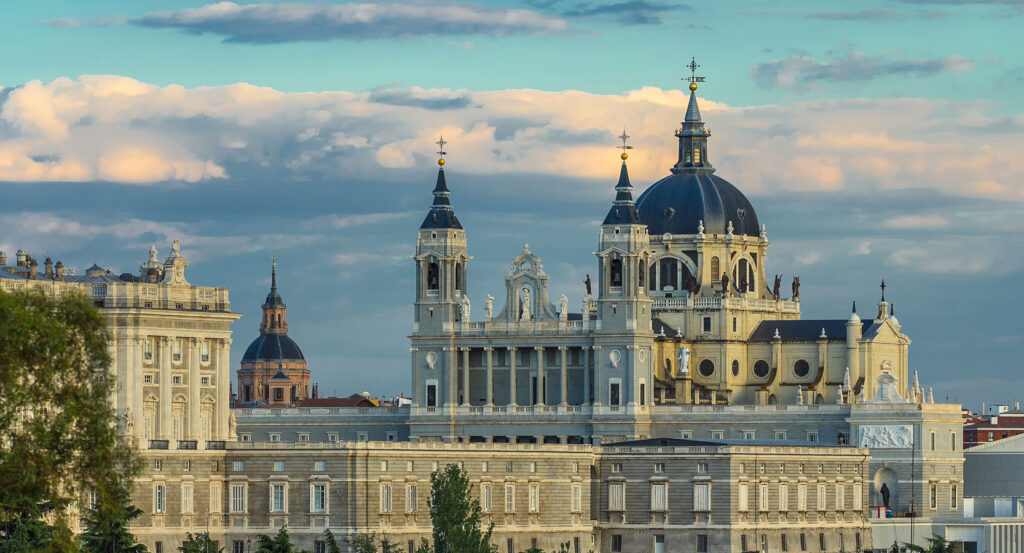
Why Museo Nacional del Prado matters.
Museo Nacional del Prado is a nineteenth-century royal art museum where Jerónimos' cultural heritage meets the collecting traditions of the Spanish monarchy, the painting of the European Renaissance and Baroque periods and the institutional development of Madrid's national art collections.
Standing along the Paseo del Prado between Plaza de Cánovas del Castillo and the southern approaches to Plaza de la Lealtad, the museum occupies a neoclassical building within Madrid's historic cultural district, where a sequence of stone façades, expansive entrances and landscaped approaches connects its galleries with the surrounding boulevards. The principal building extends along a north-south axis, with a central entrance framed by Doric columns and sculptural decoration. Granite and limestone surfaces distinguish its exterior construction, preserving the architectural proportions associated with late eighteenth-century Spanish neoclassicism. Interior galleries connect historic exhibition rooms with later additions developed to accommodate the museum's expanding collections. The result is a national art institution whose architectural organization and royal collections preserve the development of European painting within the cultural institutions of the Spanish capital.
What defines Museo Nacional del Prado.
Museo Nacional del Prado is best known for its collections of Spanish and European painting, particularly works assembled through the patronage of the Habsburg and Bourbon monarchies. The institution's architectural origins extend to the reign of Charles III, who commissioned Juan de Villanueva to design a building for the Royal Cabinet of Natural History in 1785. Villanueva developed a neoclassical composition incorporating a central basilica-like hall, substantial galleries and entrances organized around the building's principal axis. Construction continued through the final decades of the eighteenth century, although the building's intended scientific functions were disrupted by political instability and military conflict. During the Napoleonic occupation of Spain, the unfinished structure suffered damage and deterioration associated with its military use. Following the restoration of Ferdinand VII, Queen Maria Isabel of Braganza supported the establishment of a public museum devoted to the royal painting collections. The institution opened in 1819 as the Royal Museum of Painting, displaying works drawn principally from the Spanish Crown's holdings. Its early galleries contained paintings by Diego Velázquez, Francisco Goya, Titian and other artists whose works had entered the royal collections through commissions, purchases and diplomatic exchanges. During the nineteenth century, the museum expanded its holdings through acquisitions and the incorporation of paintings from dissolved religious institutions. The nationalization of royal collections following the revolution of 1868 strengthened its status as a public institution associated with the Spanish state. In 1872, the collections of the Museo de la Trinidad were incorporated into the Prado, substantially increasing its holdings of Spanish religious painting. The museum continued to expand during the twentieth century, adapting its exhibition spaces and conservation facilities to the requirements of a major national collection. During the Spanish Civil War, important artworks were evacuated from Madrid to protect them from bombardment and military destruction. The paintings traveled through Valencia and Catalonia before reaching Geneva, where they were safeguarded under international supervision. Following the war, the collections returned to Madrid, restoring the museum's principal holdings. A major expansion designed by Rafael Moneo opened in 2007, incorporating the restored cloister of the former San Jerónimo el Real monastery into a complex of galleries and institutional facilities.
Diego Velázquez's Las Meninas, painted in 1656, occupies a central position within the Prado's Spanish Golden Age collections through its representation of the court of Philip IV. The composition depicts Infanta Margaret Theresa surrounded by attendants, with Velázquez portraying himself at work beside a substantial canvas. A mirror on the rear wall contains the reflected figures of the king and queen, establishing a complex relationship between the depicted court and the viewer's position. The painting's handling of light, spatial depth and portraiture contributed to its importance within the history of European art. Francisco Goya's The Third of May 1808 develops a different historical subject through its depiction of executions following the uprising against French occupation. The illuminated central figure and the arrangement of soldiers create a composition centered on the human consequences of political repression. Goya's Black Paintings, transferred from the walls of his former residence, extend the collection into the artist's later treatment of fear, conflict and human behavior. Hieronymus Bosch's The Garden of Earthly Delights occupies a principal position within the museum's early Netherlandish holdings. Its triptych format incorporates an elaborate sequence of religious imagery, fantastical figures and densely arranged scenes associated with creation, temptation and punishment. Titian's Charles V at Mühlberg connects Venetian portraiture with Habsburg imperial authority through an equestrian representation of the emperor following his victory in 1547. Peter Paul Rubens's The Three Graces demonstrates the development of Flemish Baroque painting through its treatment of the human figure, color and classical mythology. Rogier van der Weyden's The Descent from the Cross preserves an earlier Northern European tradition through its compressed composition, sculptural figures and devotional subject. The Prado's galleries organize these works through historical and artistic relationships, connecting royal patronage, religious painting, portraiture and the development of European artistic techniques across successive centuries.
How Museo Nacional del Prado fits.
Museo Nacional del Prado works as the royal painting centerpiece for a Madrid outing connecting Spain's national art collections with the architectural institutions, historical monuments and cultural landscape of the Paseo del Prado.
Begin at Museo Nacional Thyssen-Bornemisza, the art museum occupying the Palacio de Villahermosa along the Paseo del Prado. The collection originated through the acquisitions of Heinrich Thyssen-Bornemisza and his son Hans Heinrich, whose holdings developed into a substantial private collection of European painting. The Spanish state acquired the principal collection in 1993, establishing a permanent public institution within Madrid's museum district. Its galleries contain works extending from medieval Italian painting through Renaissance portraiture, Dutch Golden Age art, Impressionism and twentieth-century modernism. The collection's chronological organization connects artistic developments across several European traditions. Continue to Palacio de Cibeles, the former Palace of Communications constructed during the early twentieth century as Madrid's principal postal and telecommunications headquarters. Architects Antonio Palacios and Joaquín Otamendi designed the building, which opened in 1919. Its exterior combines substantial stone construction with sculptural ornament, towers and a prominent central façade overlooking Plaza de Cibeles. The building subsequently became the seat of Madrid's municipal government, incorporating exhibition spaces and public cultural facilities. Its architectural scale preserves the importance of communications infrastructure within the modernization of the Spanish capital. Conclude at CaixaForum Madrid, the cultural institution occupying the converted Central Eléctrica del Mediodía power station. The original industrial building was constructed in 1900, and architects Herzog & de Meuron directed its transformation into an exhibition center that opened in 2008. The project retained substantial portions of the brick exterior and introduced a raised architectural volume above the surrounding pavement. A vertical garden designed by Patrick Blanc occupies an adjoining wall, incorporating extensive planting into the urban setting. The institution's exhibitions encompass visual art, photography, design and cultural history, connecting the former industrial property with contemporary cultural programming. The progression moves from European collecting traditions through Madrid's early twentieth-century civic architecture and culminates at CaixaForum's converted industrial building, connecting Museo Nacional del Prado with the cultural development of the surrounding district.
Where your story begins.
Foresyte Travel reveals places that feel extraordinary long before you arrive.
Enjoy editorial crafted for luxury travelers.
Foresyte may earn a commission when you book.














































































































