
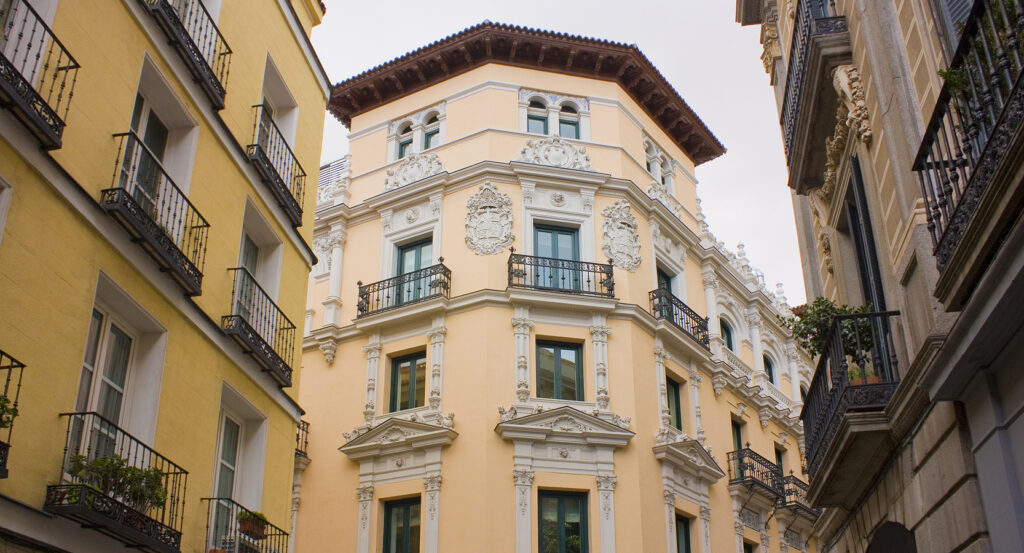
Why Thyssen-Bornemisza National Museum matters.
Thyssen-Bornemisza National Museum is a celebrated art museum where Jerónimos' cultural heritage, private collecting, architectural renewal, and seven centuries of European painting preserve one of the world's most comprehensive surveys of Western art.
Set along Paseo del Prado near Plaza de Neptuno and just steps from Museo Nacional del Prado, this distinguished museum unfolds through elegant galleries, restored palace interiors, naturally illuminated exhibition spaces, conservation facilities, and thoughtfully arranged collections where medieval panel paintings, Renaissance masterpieces, Impressionism, Expressionism, Pop Art, and twentieth-century abstraction trace the evolution of European and American art. Refined architectural proportions, restrained gallery design, and carefully sequenced exhibitions allow each period to unfold naturally from one room to the next. Scholarship, collecting, and artistic achievement define every gallery.
What defines Thyssen-Bornemisza National Museum.
Thyssen-Bornemisza National Museum is best known for opening in 1992 after the Spanish government acquired the core of Baron Hans Heinrich Thyssen-Bornemisza's internationally acclaimed private collection, transforming the restored eighteenth-century Villahermosa Palace into a national museum preserving 1,000 paintings that collectively span the thirteenth through twentieth centuries while filling major historical gaps in Spain's public art collections. The collection originated with Baron Heinrich Thyssen-Bornemisza during the 1920s before successive generations expanded its breadth, culminating in Hans Heinrich Thyssen-Bornemisza assembling one of the twentieth century's finest private collections through acquisitions representing every major period of Western painting. Architect Rafael Moneo directed the palace's extensive adaptation into a museum, preserving the building's historic character while introducing contemporary gallery spaces optimized for conservation, circulation, and natural viewing conditions. Visitors encounter works by Duccio, Jan van Eyck, Albrecht Dürer, Hans Holbein the Younger, Caravaggio, Peter Paul Rubens, Canaletto, Francisco de Goya, Claude Monet, Edgar Degas, Vincent van Gogh, Paul Cézanne, Wassily Kandinsky, Pablo Picasso, Edward Hopper, Salvador Dalí, Roy Lichtenstein, Jackson Pollock, and Mark Rothko, creating one of the few museums where the development of European and American painting can be followed chronologically under one roof. In 2004, the museum expanded further after Carmen Thyssen-Bornemisza placed hundreds of additional works on long-term loan, strengthening holdings in nineteenth-century landscape painting, Impressionism, German Expressionism, and modern Spanish art. Research departments, conservation laboratories, technical imaging, provenance investigations, archival collections, and international exhibition partnerships continue advancing scholarship surrounding one of Europe's most important museum collections.
Villahermosa Palace provides a measured architectural structure that allows successive artistic movements to unfold with exceptional clarity, guiding visitors from medieval devotional painting through Renaissance humanism, Dutch realism, Romanticism, Impressionism, the historical avant-garde, and postwar abstraction. Carefully proportioned galleries, restrained architectural interventions, and thoughtfully sequenced installations encourage close comparison between artists, schools, and centuries, revealing stylistic transitions rarely experienced within a single institution. More than three decades after opening as a national museum, the collection continues strengthening Madrid's internationally respected Golden Triangle of Art through acquisitions, exhibitions, scholarly research, and public access to one of Europe's finest privately assembled collections.
How Thyssen-Bornemisza National Museum fits.
Thyssen-Bornemisza National Museum works as the centerpiece of an exploration through Jerónimos' museum district.
Begin at Museo Nacional del Prado, where Spain's royal collections establish the historical foundation before exploring Thyssen-Bornemisza National Museum. Continue to Museo Nacional Centro de Arte Reina Sofía, whose modern and contemporary masterpieces extend the artistic journey into the twentieth century. Conclude at El Retiro Park, where landscaped gardens, broad promenades, and tranquil lakes provide a memorable finale celebrating another defining aspect of Madrid's cultural landscape. The progression moves naturally from Old Masters to modern movements before concluding through one of the city's most celebrated public spaces, revealing why Jerónimos remains the cultural heart of Madrid.
Where your story begins.
Foresyte Travel reveals places that feel extraordinary long before you arrive.
Enjoy editorial crafted for luxury travelers.
Foresyte may earn a commission when you book.














































































































