
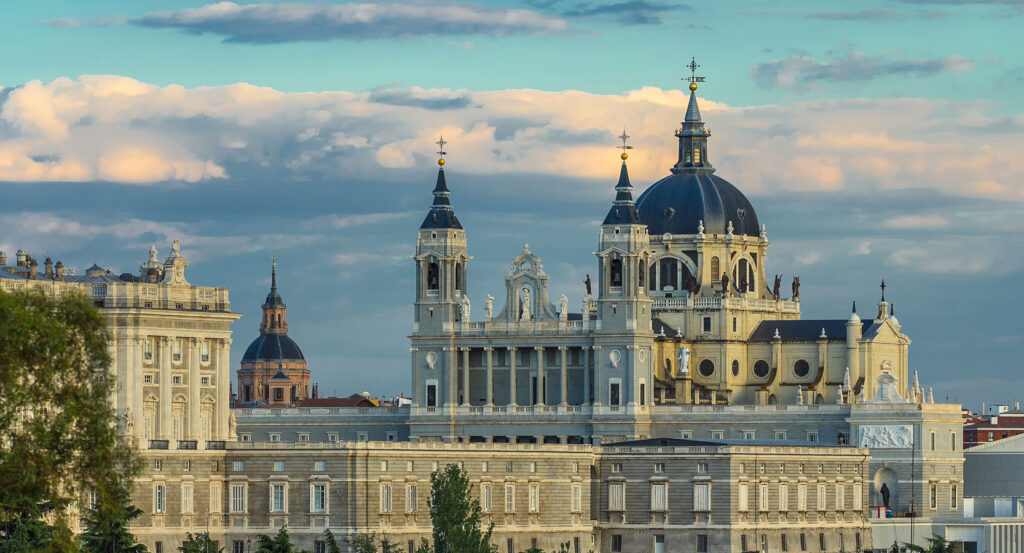
Why Museo Nacional Centro de Arte Reina Sofía matters.
Museo Nacional Centro de Arte Reina Sofía is a twentieth-century art museum where Lavapiés' cultural heritage meets the Spanish avant-garde, the artistic consequences of the Civil War and the development of modern and contemporary art through Spain's national collections.
Standing beside Plaza del Emperador Carlos V at the southern end of Madrid's principal museum district, the institution occupies a former hospital complex between Calle de Santa Isabel and Ronda de Atocha, where an eighteenth-century masonry building connects with a twenty-first-century extension organized around public courtyards. Glass elevator towers rise along the historic building's exterior, providing access to galleries distributed across its upper floors. The adjoining extension incorporates red metal surfaces, covered public areas and exhibition spaces arranged around an open central court. Broad entrances connect the museum with the pedestrian routes surrounding Atocha. The result is a national art institution whose architecture preserves the conversion of a royal hospital into a museum devoted to modern and contemporary artistic production.
What defines Museo Nacional Centro de Arte Reina Sofía.
Museo Nacional Centro de Arte Reina Sofía is best known for housing Pablo Picasso's Guernica and for preserving Spain's principal national collection of twentieth-century and contemporary art. The institution occupies the former Hospital General de Madrid, whose development originated in eighteenth-century efforts to reorganize medical care within the Spanish capital. Ferdinand VI supported the construction of a consolidated hospital complex, and architect José de Hermosilla prepared an ambitious architectural project. Francesco Sabatini subsequently directed substantial portions of the building campaign, producing the surviving neoclassical structure. The hospital operated for generations as an important medical institution, accommodating patients and clinical services within its extensive wards and courtyards. Changes in healthcare administration during the twentieth century eventually brought its original medical functions to an end. The Spanish government subsequently pursued the building's conversion into a cultural institution, preserving its architectural fabric through restoration and adaptation. The Centro de Arte Reina Sofía opened in 1986, initially functioning as an exhibition center devoted to modern artistic production. The institution received national museum status in 1988, creating the administrative foundation for a permanent collection of twentieth-century Spanish art. In 1992, the museum inaugurated its permanent collection and incorporated major works transferred from the Museo Español de Arte Contemporáneo. Picasso's Guernica entered the Reina Sofía that year after its earlier installation at the Casón del Buen Retiro, consolidating the museum's importance within the interpretation of Spanish modernism. The painting had returned to Spain in 1981 following decades at the Museum of Modern Art in New York, where it had remained under arrangements associated with Picasso's opposition to Franco's dictatorship. The museum subsequently expanded its collection and exhibition activities through acquisitions, loans and international collaborations. French architect Jean Nouvel designed a substantial extension that opened in 2005, adding galleries, an auditorium, a library and public spaces to the historic complex. The expansion strengthened the museum's institutional capacity and established a distinct architectural relationship between the former hospital and its contemporary facilities.
Pablo Picasso's Guernica, painted in 1937, occupies the central historical position within the Reina Sofía's collections through its response to the bombing of the Basque town during the Spanish Civil War. Commissioned for the Spanish Republic's pavilion at the Paris International Exposition, the painting developed into a major artistic statement associated with the destruction of civilian communities during wartime. Its expansive black, white and gray composition incorporates fractured human and animal figures arranged across a compressed interior space. The central horse, fallen warrior and grieving mother establish a sequence of figures connected through angular forms and concentrated contrasts of light and shadow. Preparatory drawings and related works reveal Picasso's development of the composition through successive changes in scale, gesture and arrangement. Salvador Dalí's paintings extend the collection into Surrealism through precisely rendered objects, altered spatial relationships and imagery associated with dreams and psychological association. Joan Miró's works develop a different approach to abstraction through simplified figures, colored forms and symbolic arrangements. The museum's holdings also encompass artists associated with the Spanish avant-garde, including Juan Gris, whose Cubist compositions examine the construction of pictorial space through geometric forms. International works connect these Spanish developments with artistic movements across Europe and the Americas. The galleries incorporate photography, film, sculpture and installation art, extending the institution's historical scope beyond painting. Temporary exhibitions examine artistic movements, individual careers and the political circumstances surrounding cultural production during the twentieth and twenty-first centuries. The Sabatini Building's former hospital rooms accommodate substantial exhibition sequences, with long corridors connecting galleries across successive floors. Jean Nouvel's extension provides larger spaces for contemporary installations and public programs, establishing architectural conditions suited to works of differing scales. The museum's collection connects the development of modern artistic techniques with the political history and cultural institutions of twentieth-century Spain.
How Museo Nacional Centro de Arte Reina Sofía fits.
Museo Nacional Centro de Arte Reina Sofía works as the modern art centerpiece for a Madrid outing connecting twentieth-century artistic production with the city's railway history, nineteenth-century architecture and cultural institutions surrounding Atocha.
Begin at Madrid Atocha railway station, the principal historic rail terminal developed to connect the Spanish capital with the country's expanding nineteenth-century railway network. The original station opened in 1851, establishing an important departure point for routes toward southern and eastern Spain. Following a destructive fire, architect Alberto de Palacio designed a substantial replacement train shed incorporating iron and glass construction. The building opened in 1892, creating a covered railway hall associated with the engineering advances of the industrial period. Later redevelopment transferred major rail operations to adjoining facilities, and the historic train shed became a public concourse containing a tropical garden. Continue to the Real Observatorio de Madrid, the astronomical institution established during the reign of Charles III as part of the Bourbon monarchy's scientific program. Architect Juan de Villanueva designed its neoclassical building, with construction beginning in 1790 on a hill overlooking the southern approaches to the historic center. Its architecture incorporates a central rotunda, classical columns and a substantial observatory structure designed for scientific instruments. The institution became associated with astronomical observation, geodesy and the development of Spanish scientific measurement. Historic instruments and exhibition spaces preserve the relationship between Enlightenment architecture and the scientific institutions of Madrid. Conclude at La Casa Encendida, the cultural center occupying a former financial institution building on Ronda de Valencia. Constructed during the early twentieth century, the building was adapted into a center for contemporary art, performance, education and public cultural activities. Its galleries accommodate exhibitions devoted to visual art and social subjects, and its performance spaces support music, theater and experimental programming. The central courtyard organizes circulation between the surrounding rooms, preserving the architectural arrangement of the original institutional building. Its rooftop terrace extends the center's public functions above the surrounding streets of Lavapiés. The progression moves from Atocha's railway engineering through the observatory's scientific heritage and culminates at La Casa Encendida's contemporary cultural programming, connecting the Reina Sofía with the institutional development of southern Central Madrid.
Where your story begins.
Foresyte Travel reveals places that feel extraordinary long before you arrive.
Enjoy editorial crafted for luxury travelers.
Foresyte may earn a commission when you book.














































































































