Why Promenade des Anglais matters.
Promenade des Anglais is a celebrated Mediterranean corridor where Nice's coastal elegance meets British aristocratic heritage, Belle Époque architecture and the seaside culture that established the French Riviera as an international destination.
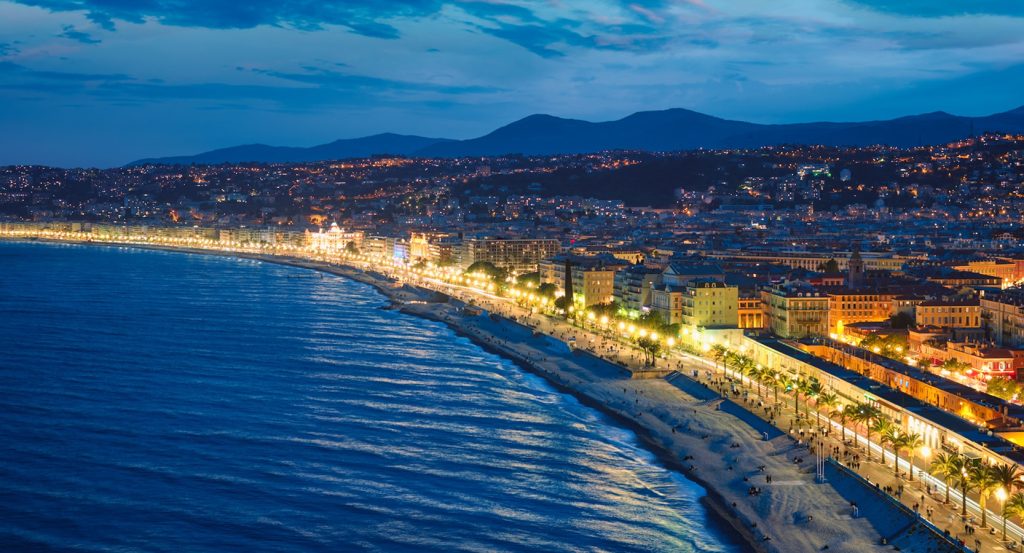
Following the Baie des Anges for seven kilometers between the eastern waterfront near Jardin Albert Ier and the western coastline approaching Nice Côte d'Azur Airport, the promenade connects the Carré d'Or, Gambetta and Magnan districts along a continuous Mediterranean frontage. The broad coastal roadway traces the bay's distinctive crescent, with pebble beaches descending toward the water and the hills surrounding Nice rising beyond the eastern shoreline. Palm-lined pedestrian terraces, dedicated cycling spaces and the celebrated blue seaside chairs establish a recognizable public landscape beside the Mediterranean. Across the boulevard, grand hotels, Belle Époque residences and Art Deco apartment buildings create an architectural sequence whose balconies, terraces and ornamental façades face the sea. The result is a sweeping waterfront corridor whose nineteenth-century origins, architectural grandeur and uninterrupted relationship with the Baie des Anges define the international image of Nice.
What defines Promenade des Anglais.
Promenade des Anglais is best known for emerging from the British winter colony that helped transform Nice from a Mediterranean trading city into one of Europe's principal aristocratic seaside destinations. British visitors had established a seasonal presence during the eighteenth century, attracted by the mild winters and coastal setting of a city belonging to the Kingdom of Sardinia. Wealthy families increasingly settled around the Croix-de-Marbre district, where foreign residents developed social institutions and residential traditions that distinguished the western expansion of Nice. The winter of 1820-1821 brought severe hardship to local laborers, inspiring Reverend Lewis Way, an Anglican clergyman associated with the British community, to organize charitable employment through construction of a coastal footpath. British residents financed the undertaking, creating a modest seaside walkway along terrain that had previously consisted largely of shoreline tracks and undeveloped coastal land. The original route acquired the Niçard designation Camin dei Anglés, meaning Path of the English, establishing the association that would become permanent in the boulevard's French name. Municipal improvements during the 1830s extended and formalized the promenade as Nice began recognizing the economic significance of its foreign winter population. Architect François Aune contributed to the development of the coastal route, whose widening transformed the original charitable footpath into a substantial public thoroughfare. The formal designation Promenade des Anglais followed in 1844, confirming the British community's enduring connection to the city's waterfront. Nice entered a new political era in 1860 when the Treaty of Turin transferred the County of Nice from the Kingdom of Sardinia to France, accelerating the city's integration into French transportation networks and tourism. The arrival of the railway in 1864 strengthened connections with Paris and northern Europe, expanding the seasonal population and encouraging the construction of increasingly ambitious coastal residences. Queen Victoria's visits to Nice during the 1890s reinforced the Riviera's association with European royalty, aristocratic society and fashionable winter travel. The development of grand hotels subsequently transformed the promenade into a ceremonial frontage for the international hospitality industry. Henri Negresco commissioned the Hôtel Negresco, designed by architect Édouard-Jean Niermans and opened in 1913, establishing one of the most recognizable architectural monuments along the boulevard. Its expansive dome, elaborate interiors and association with European high society connected the promenade to the final flowering of Belle Époque luxury before the First World War. The interwar decades introduced another transformation as Art Deco architecture, motor tourism and recreational bathing expanded the waterfront's cultural importance. Nice's seaside culture gradually evolved from aristocratic winter residence toward international summer tourism, with the promenade accommodating changing relationships between public recreation, private beach establishments and the expanding hotel industry. On July 14, 2016, a terrorist attack during Bastille Day celebrations killed 86 people along the waterfront, profoundly affecting the city and establishing the promenade as a place of collective remembrance. In 2021, UNESCO inscribed Nice, Winter Resort Town of the Riviera, on the World Heritage List, recognizing the urban and architectural development associated with the city's international winter-resort history. The promenade forms a central element of that heritage, preserving the physical connection between nineteenth-century British patronage, European aristocratic travel and the emergence of the French Riviera as a global cultural destination.
The Baie des Anges gives Promenade des Anglais its defining geographical structure, shaping a continuous coastal boulevard around one of the Mediterranean's most recognizable urban shorelines. The bay's broad curvature creates an unusually expansive relationship between the city and the sea, allowing successive sections of the promenade to reveal changing perspectives toward Cap de Nice and the surrounding Alpine foothills. The shoreline consists predominantly of rounded pebbles shaped by the coastal environment, producing a distinctive interface between the Mediterranean and the developed city. The public promenade occupies an elevated position above the beaches, creating a clear separation between the pedestrian terraces and the sloping shore below. The celebrated chaises bleues became an enduring symbol of Nice's seaside culture during the twentieth century, providing a distinctive form of public seating oriented toward the Mediterranean. Their blue-painted metal construction established a visual association with the coastal landscape that became inseparable from the promenade's international image. The boulevard's architectural frontage introduces another defining feature through the concentration of buildings developed during the city's emergence as a fashionable resort. The Palais de la Méditerranée, designed by architects Charles and Marcel Dalmas and inaugurated in 1929, brought Art Deco architecture into the waterfront's entertainment culture through a prestigious casino and performance establishment. Its expansive façade, sculptural decoration and geometric composition represented the architectural ambitions of the interwar Riviera. The original building underwent substantial demolition during the twentieth century, but its protected Art Deco façade survived and became the defining feature of a later hotel redevelopment. The nearby Hôtel Negresco preserves an earlier architectural language through its Belle Époque composition, establishing a striking historical contrast along the same coastal frontage. The Villa Masséna, completed in the early twentieth century for Victor Masséna, Prince of Essling, contributes another dimension through its aristocratic residential architecture and landscaped gardens. These buildings establish the promenade as a continuous architectural record of Nice's development through aristocratic winter tourism, casino entertainment and international luxury hospitality. The public waterfront also supports one of the city's most important cultural traditions through the Carnaval de Nice, whose historical processions and elaborate floats have repeatedly incorporated the promenade into major civic celebrations. The annual carnival developed into an internationally recognized event during the nineteenth century, connecting the coastal boulevard with the theatrical traditions of the Riviera. Sporting culture introduced another major association through the Paris-Nice cycling race, whose Mediterranean conclusion helped establish the city as an important destination within professional European cycling. The promenade also became associated with major international gatherings, including the 2013 Tour de France, which brought a team time trial through Nice during the race's centennial edition. These successive uses demonstrate the unusual flexibility of a coastal space that accommodates ceremonial processions, international sport, public recreation and the daily social customs of the city. Promenade des Anglais unites the geography of the Baie des Anges with the architectural and cultural institutions that shaped Nice's transformation into a Mediterranean capital of international tourism.
How Promenade des Anglais fits.
Promenade des Anglais provides the starting point for an exploration connecting Nice's aristocratic resort heritage, Mediterranean landscape and the artistic culture that developed around the French Riviera during the twentieth century.
Begin at Musée Masséna, the historical museum occupying the former Villa Masséna beside the promenade. The residence was commissioned by Victor Masséna, Prince of Essling, and developed between 1898 and 1901 by architects Hans-Georg Tersling and Aaron Messiah. Its Italianate architectural composition and elaborate decorative interiors preserve the residential ambitions of the international aristocracy that transformed Nice during the Belle Époque. The surrounding gardens were designed by landscape architect Édouard André, whose work established a formal relationship between the residence and the Mediterranean waterfront. The property entered municipal ownership in 1919 and subsequently became a museum devoted to the history of Nice and the French Riviera. Its collections include paintings, historical objects and memorabilia associated with Napoleon Bonaparte and the Masséna family, connecting the city's political history with its development as an international resort. Continue to Jardin Albert Ier, among Nice's oldest public gardens, positioned between the coastal waterfront and the urban center near Place Masséna. The garden originated during the nineteenth century as the city expanded its landscaped public spaces alongside the emerging seaside resort district. Its development created an important green connection between the Mediterranean shoreline and the formal urban composition of Central Nice. The Théâtre de Verdure, an open-air performance venue established during the twentieth century, introduced concerts and cultural programming into the garden's public landscape. Bernar Venet's expansive Arc 115.5°, installed in 1988, brought contemporary sculpture into the historic setting through a towering curved steel structure. The garden connects Nice's nineteenth-century landscape traditions with the modern cultural life of the city. Conclude at Musée Matisse, the museum dedicated to Henri Matisse in the Cimiez district above Central Nice. Matisse arrived in Nice in 1917 and developed a lasting relationship with the city, whose Mediterranean light became fundamental to his artistic development. The artist eventually settled at the Hôtel Régina in Cimiez, where he continued working during the final decades of his life. The museum occupies the seventeenth-century Villa des Arènes, a Genoese-style residence surrounded by historic olive groves near the archaeological remains of Roman Cemenelum. Established in 1963, the institution developed around works and personal objects associated with Matisse, including paintings, drawings, sculptures and decorative creations. Architect Jean-François Bodin designed a substantial museum extension completed in 1993, expanding the institution's exhibition facilities and strengthening its role in the cultural landscape of Nice. The progression moves from Musée Masséna's aristocratic Riviera heritage through Jardin Albert Ier's landscaped civic culture and culminates in Musée Matisse's exploration of modern art, connecting the social, urban and creative developments that established Nice as one of the Mediterranean's defining cultural destinations.
Where your story begins.
Foresyte Travel reveals places that feel extraordinary long before you arrive.
Enjoy editorial crafted for luxury travelers.
Foresyte may earn a commission when you book.