Why Puʻuhonua o Hōnaunau National Historical Park matters.
Puʻuhonua o Hōnaunau National Historical Park is a sacred Hawaiian historical sanctuary where South Kona's royal heritage meets ancient religious traditions, expansive volcanic stonework, and the enduring cultural significance of refuge under the kapu system.
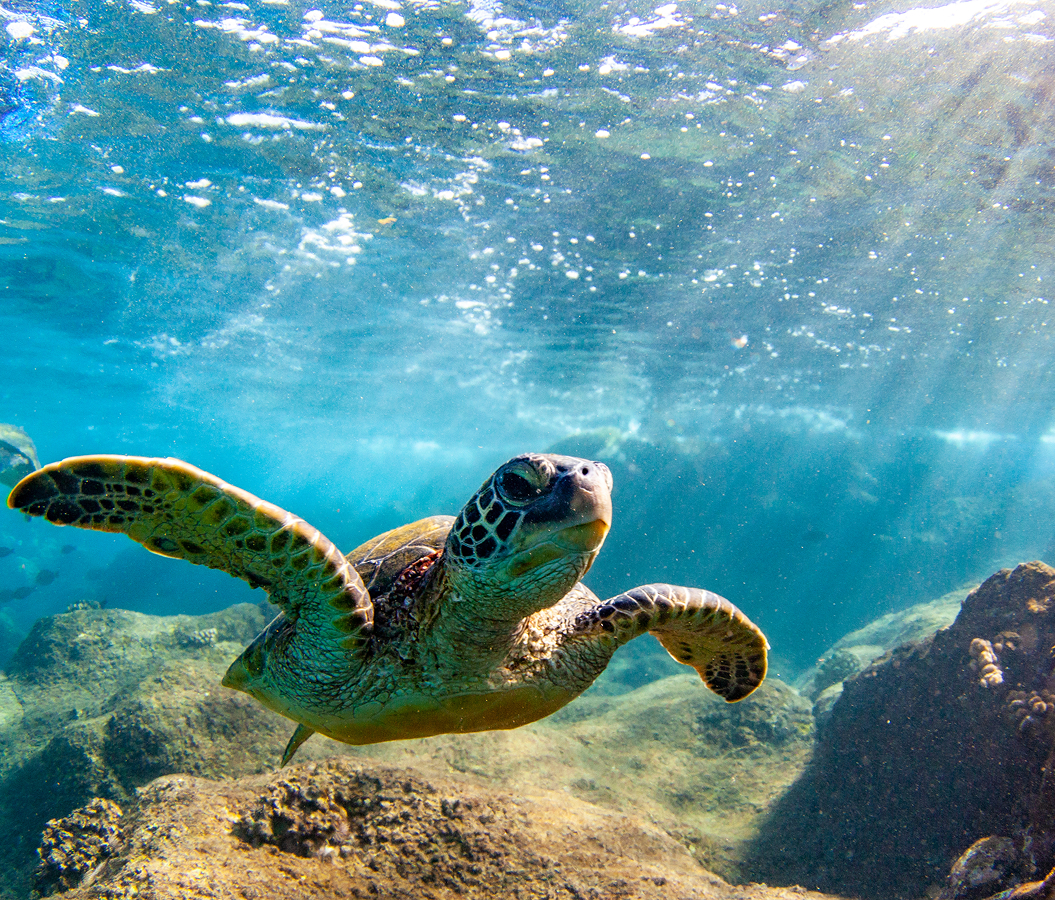
Occupying the lava shoreline of Hōnaunau Bay on Hawaiʻi Island's western coast, Puʻuhonua o Hōnaunau National Historical Park lies south of Kealakekua Bay, with the slopes of Mauna Loa rising inland above the coastal settlements of South Kona. The protected landscape encompasses the Royal Grounds, a former ceremonial precinct overlooking Keoneʻele Cove, and the adjoining Puʻuhonua, whose sacred enclosure extends across the rugged volcanic shoreline. A massive dry-stacked basalt wall separates the two precincts, establishing a formidable physical boundary between chiefly activity and the protected sanctuary. Traditional thatched structures, stone platforms, and carved wooden kiʻi occupy the coastal grounds, preserving the architectural character of ancient Hawaiian religious and political life. Hale o Keawe stands near the ocean behind a wooden palisade, its steeply pitched thatched roof and carved guardians recalling the sacred architecture associated with Hawaiian royalty. Narrow pathways cross uneven lava formations, passing ancient foundations, low coastal vegetation, and open stretches of black volcanic rock exposed to the Pacific. The surrounding shoreline supports Hawaiian green sea turtles, whose presence connects the protected archaeological landscape with the living marine environment of Hōnaunau Bay. The result is a concentrated sacred landscape where expansive stone construction, traditional Hawaiian architecture, and volcanic coastal geography preserve the physical setting of one of Polynesia's most consequential sanctuaries.
What defines Puʻuhonua o Hōnaunau National Historical Park.
Puʻuhonua o Hōnaunau National Historical Park is best known for preserving an ancient Hawaiian place of refuge whose religious authority provided sanctuary for individuals facing death under the kapu system. The kapu system regulated Hawaiian society through sacred prohibitions governing relations between aliʻi, the ruling chiefs, and makaʻāinana, the common people, establishing restrictions concerning food, religious conduct, social hierarchy, and access to places associated with chiefly power. Violations carried severe penalties, making designated sanctuaries essential institutions within the political and religious organization of the Hawaiian Islands. Hōnaunau developed into an important chiefly and ceremonial center during the expansion of political authority across Hawaiʻi Island, with religious structures and royal facilities occupying the protected coastal setting. Individuals who successfully entered the Puʻuhonua received protection through the sacred authority of the sanctuary, including defeated warriors, civilians escaping conflict, and people who had violated kapu. Priests performed purification ceremonies that permitted offenders to return to their communities, giving the refuge a distinctive function within Hawaiian religious law. The sanctuary's protective authority derived from mana, the spiritual power associated with divine forces, chiefly ancestry, and sacred places. Hale o Keawe became central to that authority through its association with Keaweʻīkekahialiʻiokamoku, the powerful ruler of Hawaiʻi Island during the late seventeenth and early eighteenth centuries and an ancestor of Kamehameha I. The temple functioned as a royal mausoleum containing the remains of twenty-three aliʻi, whose ancestral mana sanctified the surrounding refuge. Its position beside the Great Wall reinforced the relationship between chiefly burial traditions and the protected ground beyond the royal precinct. The Great Wall itself represents an exceptional achievement in traditional Hawaiian masonry, extending 978 feet with a width of seventeen feet and a height approaching ten feet. Hawaiian builders assembled enormous basalt blocks through dry-set construction, relying on carefully fitted stone surfaces and the weight of the individual blocks to create a substantial barrier. The adjoining Royal Grounds formed a separate ceremonial center where high-ranking chiefs maintained residences and conducted political and religious activities. Keoneʻele Cove served as a restricted royal canoe landing, connecting the ceremonial compound directly with maritime travel along the Kona coast. The death of Kamehameha I in 1819 precipitated a fundamental transformation in Hawaiian religious life when his successor Liholiho, Kamehameha II, and influential royal figures including Kaʻahumanu challenged the traditional kapu system. The ʻAi Noa, or free-eating period, overturned longstanding religious prohibitions and accelerated the abandonment of institutions whose authority depended on the former sacred order. Hale o Keawe survived the initial destruction of numerous Hawaiian temples, preserving its ancestral significance after the religious system supporting the Puʻuhonua had ended. Queen Kaʻahumanu ordered the removal of the remaining chiefly bones and the dismantling of the temple in 1829, beginning a period of physical deterioration intensified by destructive ocean conditions. Powerful surf and coastal erosion damaged the original temple platform during the nineteenth century, leaving the former mausoleum substantially altered by the beginning of the twentieth century. Restoration began in 1902 under W. A. Wall, followed by extensive archaeological work directed by Edmund J. Ladd during 1966 and 1967 that exposed the original platform beneath earlier reconstruction. The United States established the site as City of Refuge National Historical Park in 1961, subsequently adopting the Hawaiian name Puʻuhonua o Hōnaunau National Historical Park in 1978. Reconstruction of Hale o Keawe during the 1960s returned a traditional temple structure, wooden palisade, and carved kiʻi to the sacred precinct. The park's historical significance rests on the relationship between Hawaiian religious law, ancestral chiefly authority, the political transformation of the kingdom, and the preservation of a sanctuary whose foundations illuminate the organization of precontact Hawaiian society.
ʻĀleʻaleʻa Heiau extends the sanctuary's religious significance into an earlier period of Hawaiian ceremonial construction, preserving one of the oldest temple foundations within the Puʻuhonua. The basalt platform developed through seven construction stages, demonstrating how successive generations enlarged and modified sacred architecture as the coastal religious center gained importance. Another ancient temple foundation occupies the refuge, establishing a concentration of ceremonial structures within the protected enclosure. These religious platforms stand across prehistoric lava flows originating from Mauna Loa, whose volcanic activity created the rugged coastal terrain that shaped settlement and movement through South Kona. Natural depressions, irregular basalt surfaces, and narrow coastal approaches influenced the arrangement of ceremonial spaces and the physical difficulty of reaching sanctuary from the ocean. The park's broader landscape also preserves three hōlua slides associated with an exceptionally demanding traditional Hawaiian sport practiced by the aliʻi. Competitors descended steep stone courses on narrow wooden sleds known as papa hōlua, transforming prepared volcanic slopes into ceremonial sporting grounds where balance, speed, and physical courage carried considerable prestige. The relationship between chiefly recreation and religious authority extended into the Royal Grounds through kōnane, a traditional Hawaiian strategy game played with contrasting stones on prepared surfaces. Coastal fishponds supplied another dimension of chiefly life, with the Heleipālala ponds forming part of the productive shoreline landscape associated with the royal compound. Brackish springs supported occupation along a coast where freshwater resources influenced the placement of settlements and ceremonial structures. Hawaiian cultural practitioners maintain the sacred significance of Hale o Keawe through hoʻokupu, offerings placed at the temple as acts of reverence and spiritual continuity. Traditional woodcarving likewise survives through the creation and maintenance of kiʻi by Hawaiian craftspeople whose knowledge connects religious sculpture with ancestral artistic practice. Puʻuhonua o Hōnaunau preserves an interconnected Hawaiian cultural landscape in which temple architecture, chiefly recreation, coastal subsistence, and continuing spiritual observance occupy the same sacred ground.
How Puʻuhonua o Hōnaunau National Historical Park fits.
Puʻuhonua o Hōnaunau National Historical Park anchors an exploration of South Kona's indigenous settlements, nineteenth-century religious transformation, and the encounter between Hawaiian society and European maritime expansion.
Begin at Kiʻilae Village, the abandoned coastal settlement reached along the historic 1871 Trail south of the park's principal ceremonial grounds. The village developed within the Kiʻilae ahupuaʻa, a traditional Hawaiian land division extending between upland agricultural areas and coastal fishing grounds. Kamehameha I granted the surrounding lands to John Young, the British-born adviser whose military assistance contributed to the unification of the Hawaiian Islands. Families sustained the settlement through fishing, cultivation, and gathering marine resources, preserving customary coastal practices into the twentieth century. Stone-walled residential parcels, house platforms, burial structures, agricultural features, and salt-production areas survive across the former village. The settlement's persistence into the twentieth century provides a rare physical connection between precontact Hawaiian subsistence traditions and the economic changes accompanying the territorial period. Continue inland to St. Benedict's Painted Church, the Catholic sanctuary developed after South Kona families began relocating from coastal settlements toward the more fertile slopes of Mauna Loa. Catholic missionary activity had reached the district during the nineteenth century, initially concentrating around St. Francis Regis Chapel near Hōnaunau Bay. Belgian priest Father John Berchmans Velghe arrived in 1899 and directed the relocation and reconstruction of the congregation's church on higher ground. Bishop Gulstan Ropert dedicated the building to St. Benedict in August 1902. Velghe subsequently covered its wooden interior with biblical paintings, developing dramatic religious scenes that communicated Christian teachings through imagery. His compositions incorporated episodes of judgment, temptation, salvation, and divine punishment, producing one of Hawaiʻi's most distinctive surviving examples of missionary folk painting. The church entered the National Register of Historic Places in 1979, preserving a religious interior shaped by the encounter between European Catholic instruction and Hawaiian community life. Conclude at Kealakekua Bay State Historical Park, where the encounter between Hawaiian religious traditions and European exploration reached a consequential turning point in 1779. Captain James Cook entered Kealakekua Bay aboard HMS Resolution during his third Pacific voyage, arriving during the season associated with Makahiki, the annual festival honoring the Hawaiian deity Lono. His expedition encountered an established Hawaiian religious and political center whose ceremonial landscape included Hikiau Heiau near the shoreline. Cook departed the bay before returning after damage to his ship, initiating a confrontation that culminated in his death on February 14, 1779. The episode became one of the most consequential encounters in the history of European exploration of the Pacific. A white obelisk erected in 1874 marks the site associated with Cook's death on the opposite shore, preserving the memory of an event that preceded profound changes in Hawaiian political, religious, and economic life. The progression moves from Kiʻilae Village's enduring coastal traditions through St. Benedict's Painted Church's missionary transformation and culminates at Kealakekua Bay State Historical Park, connecting indigenous Hawaiian society with the religious and maritime encounters that reshaped South Kona.
Where your story begins.
Foresyte Travel reveals places that feel extraordinary long before you arrive.
Enjoy editorial crafted for luxury travelers.
Foresyte may earn a commission when you book.