
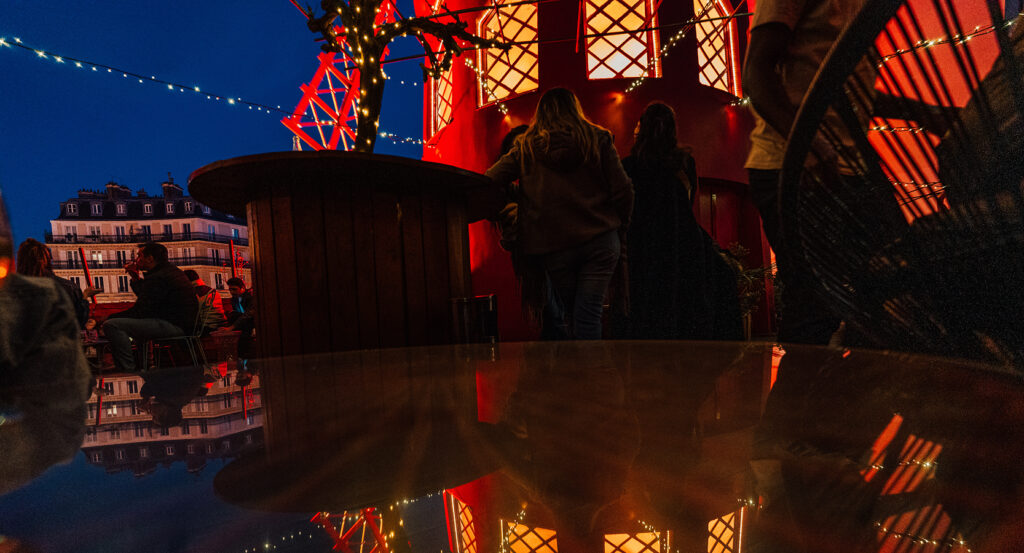
Why you should experience The Windmill at Moulin Rouge in Paris, France.
The Windmill at Moulin Rouge is a celebrated architectural symbol where Pigalle's Belle Époque heritage, theatrical performance, artistic personality, and Parisian nightlife preserve one of the world's most recognizable cultural emblems.
Set along Boulevard de Clichy near Place Blanche and just steps from Moulin Rouge, this instantly recognizable crimson windmill crowns the renowned cabaret through illuminated rotating blades, Belle Époque ornamentation, and theatrical architecture that has welcomed audiences for well over a century. Brilliant nighttime illumination, richly detailed façades, historic signage, and the unmistakable silhouette of the rotating windmill evoke the exuberance of late nineteenth-century Montmartre while celebrating the district's enduring role as the birthplace of modern cabaret. Inspired by the windmills that once dotted the slopes of Montmartre, the structure transformed a familiar local landmark into an internationally recognized symbol of Parisian entertainment. The result is an experience defined by theatrical heritage, architectural personality, and one of France's most enduring cultural symbols.
What you should know about The Windmill at Moulin Rouge.
The Windmill at Moulin Rouge is best known for crowning the cabaret founded by Joseph Oller and Charles Zidler on 6 October 1889, when the entrepreneurs intentionally installed a bright red rotating windmill inspired by the historic flour mills that once covered Montmartre, creating an instantly recognizable architectural character that helped establish the venue as the birthplace of the modern French cancan while becoming one of the world's most enduring symbols of Parisian entertainment through the celebrated paintings and posters of Henri de Toulouse-Lautrec. The windmill referenced the dozens of working mills that operated across Montmartre before urban expansion transformed the hill during the nineteenth century, including the surviving Moulin de la Galette that remains a reminder of the neighborhood's agricultural past. Unlike traditional mills, the Moulin Rouge windmill was conceived entirely as theatrical architecture, using illuminated rotating blades, vivid crimson paint, and dramatic visibility along Boulevard de Clichy to distinguish the cabaret from the surrounding cafés, dance halls, and music venues. Toulouse-Lautrec's groundbreaking lithographs and paintings of performers including La Goulue, Jane Avril, and Aristide Bruant permanently linked the windmill with the artistic character of Belle Époque Paris, making its silhouette instantly recognizable throughout Europe and beyond. After a devastating fire severely damaged the cabaret in 1915, the windmill was faithfully reconstructed before the venue reopened in 1921, preserving the distinctive architectural symbol that had already become inseparable from Parisian nightlife. Over subsequent decades the illuminated windmill appeared in films, literature, photography, advertising, fashion, and popular culture across the world while continual restoration ensured that its proportions, rotating blades, lighting systems, and unmistakable profile remained true to the original nineteenth-century concept. Today the windmill continues serving as the defining emblem of the Moulin Rouge, representing more than 135 years of cabaret history, architectural symbolism, artistic innovation, and the enduring creative spirit of Montmartre.
Beyond its extraordinary cultural legacy, the Windmill at Moulin Rouge demonstrates how architecture can transcend function to become one of the world's most recognizable symbols of entertainment. Its illuminated blades, bold silhouette, and theatrical composition transformed a simple architectural reference into an enduring international icon recognized across generations and continents. Every evening the windmill continues performing the role envisioned by its founders in 1889, announcing a destination devoted to music, dance, performance, and artistic expression while preserving one of Paris's most celebrated visual identities. Together, historical continuity, architectural symbolism, and exceptional cultural influence establish the Windmill at Moulin Rouge among the world's most recognizable entertainment symbols.
How to fold The Windmill at Moulin Rouge into your trip.
The Windmill at Moulin Rouge works as part of an exploration through Montmartre's celebrated artistic and entertainment heritage.
Begin at Place Blanche, where the historic gateway to Pigalle introduces the energetic atmosphere surrounding the Windmill at Moulin Rouge before admiring one of Paris's most recognizable architectural symbols. Continue to Musée de Montmartre, whose collections illuminate the artists, performers, and cabaret culture that transformed the neighborhood during the Belle Époque. Conclude at Basilica of Sacré-Coeur, where panoramic views across Paris provide a memorable finale connecting the hill's historic windmills with the neighborhood that inspired one of the world's most famous entertainment venues. The progression moves naturally from historic boulevard to artistic heritage before concluding through Montmartre's defining monument, revealing why the Windmill at Moulin Rouge remains one of Paris's most enduring cultural symbols.
Where your story begins.
Foresyte Travel reveals places that feel extraordinary long before you arrive.
Experience premium editorial crafted for luxury travelers.














































































































