
Why Royal Palace of Madrid matters.
Royal Palace of Madrid is an eighteenth-century Bourbon residence where Palacio's royal heritage meets the architectural ambitions of Philip V, the ceremonial institutions of the Spanish monarchy and the artistic patronage that shaped Madrid's imperial court.
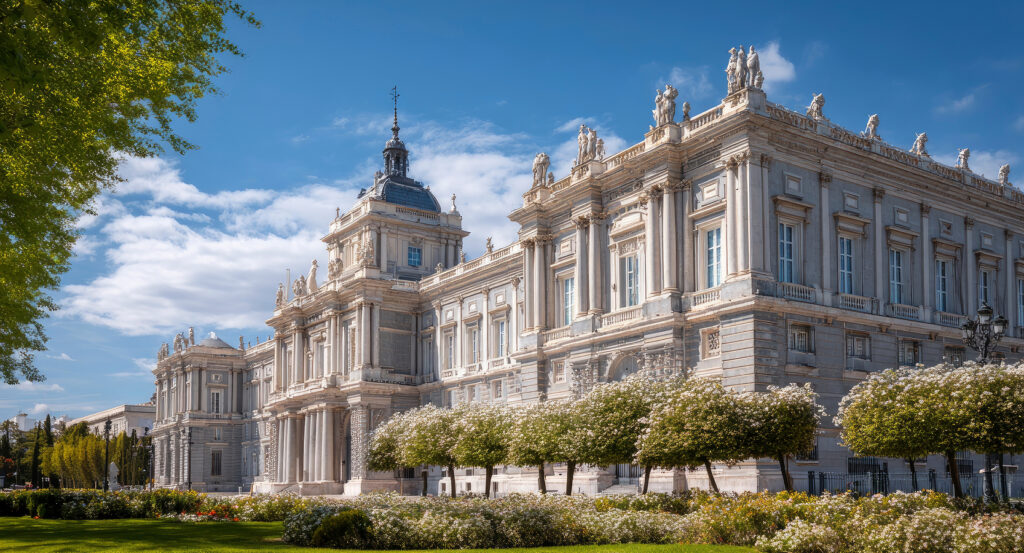
Occupying the western edge of Madrid's historic center above the Manzanares valley, the palace stands between Plaza de Oriente and the gardens descending toward the river, where its quadrangular plan encloses a central courtyard and substantial ceremonial apartments overlooking the surrounding royal precinct. Four principal façades organize the building around an expansive stone enclosure. Classical pilasters, balustrades and sculptural ornament establish a consistent architectural treatment across its exterior elevations. Terraced gardens and formal plazas connect the palace with the adjoining historic streets and religious buildings. The result is a royal residence whose architectural scale and ceremonial organization preserve the political authority and artistic patronage of the Spanish Bourbon monarchy.
What defines Royal Palace of Madrid.
Royal Palace of Madrid is best known for its construction following the destruction of the medieval Alcázar, which had served as the principal royal residence of the Spanish monarchy. The Alcázar occupied a strategic position overlooking the Manzanares and developed through successive phases of Islamic, medieval Christian and Habsburg construction. A fire on Christmas Eve 1734 destroyed much of the historic residence, creating an opportunity for Philip V to commission a new royal palace. The king sought an architectural composition associated with the expansive traditions of European absolutist courts, particularly the French and Italian royal residences familiar to the Bourbon dynasty. Italian architect Filippo Juvarra prepared an ambitious preliminary design incorporating extensive courtyards and ceremonial approaches. Following Juvarra's death in 1736, his pupil Giovanni Battista Sacchetti assumed responsibility for the project and developed a more compact plan suited to the existing hilltop site. Construction began in 1738, with substantial masonry foundations supporting a building organized around a central courtyard. The principal structure incorporated granite and limestone, combining durable construction with an elaborate classical architectural program. Ferdinand VI continued the project following his accession in 1746, supporting the completion of major structural and decorative elements. Charles III became the first monarch to occupy the completed palace in 1764, establishing its principal ceremonial functions within the Bourbon court. Subsequent rulers commissioned alterations to the residential apartments, decorative schemes and institutional spaces. Charles IV and Ferdinand VII contributed to the development of interior furnishings and collections associated with the royal household. During the nineteenth century, the palace witnessed political changes connected with the Napoleonic occupation, constitutional struggles and the transformation of the Spanish monarchy. Alfonso XIII became the last monarch to reside there as his principal royal residence before the establishment of the Second Spanish Republic in 1931. The building subsequently retained its importance for official state ceremonies, diplomatic receptions and royal occasions. Patrimonio Nacional administers the palace as part of Spain's historic royal heritage, preserving its architectural interiors and collections for public access and institutional use.
Giovanni Battista Tiepolo's ceiling frescoes contribute to the palace's ceremonial interiors through an extensive decorative program developed during the reign of Charles III. The Throne Room contains Tiepolo's The Apotheosis of the Spanish Monarchy, a painted composition incorporating allegorical figures, royal symbolism and architectural illusion. Its gilded furnishings, crimson wall coverings and substantial chandeliers establish the ceremonial character of the room used for royal audiences. The Royal Chapel incorporates architectural work associated with Ventura Rodríguez, whose design developed a substantial domed interior for religious ceremonies connected with the court. The Royal Armoury preserves weapons and armor associated with Spanish monarchs, including pieces connected with Charles V and Philip II. Its collections contain ceremonial suits of armor, equestrian equipment and military objects produced by European craftsmen during the Renaissance. The Royal Pharmacy contains historic cabinets, ceramic containers and pharmaceutical equipment associated with the medical requirements of the royal household. The Hall of Columns incorporates substantial marble architectural elements and sculptural decoration within a space associated with official ceremonies. Its proportions and ornamental treatment preserve the palace's relationship with the traditions of European court architecture. The Gasparini Room contains an elaborate decorative program developed under Charles III, incorporating embroidered wall coverings, sculpted ornament and furnishings associated with the Italian designer Mattia Gasparini. The room's carefully coordinated interior demonstrates the importance of decorative arts within the ceremonial apartments of the Bourbon monarchy. The Royal Dining Room occupies a sequence of former residential spaces adapted during the nineteenth century into a substantial ceremonial dining hall. Its extensive table arrangement, chandeliers and decorative furnishings accommodate official banquets associated with state visits. The palace's artistic character develops through these specialized interiors, preserving the relationship between royal ceremony, European decorative arts and the institutional functions of the Spanish court.
How Royal Palace of Madrid fits.
Royal Palace of Madrid works as the Bourbon ceremonial centerpiece for a Madrid outing connecting the monarchy's religious institutions, the capital's historic public spaces and the cultural development of its western royal precinct.
Begin at Almudena Cathedral, the principal Catholic cathedral of Madrid, positioned immediately south of the palace. Construction began in 1883 under architect Francisco de Cubas, whose original design incorporated Gothic Revival architectural principles. Subsequent architects modified the project, developing a neoclassical exterior intended to complement the neighboring royal residence. The cathedral was consecrated by Pope John Paul II in 1993, marking the completion of a building campaign extending across more than a century. Its interior incorporates contemporary stained glass, religious sculpture and a substantial crypt containing columns and chapels associated with the cathedral's earliest construction phases. Continue to Plaza de la Villa, the historic civic square associated with Madrid's medieval municipal institutions. The Casa de la Villa, completed during the seventeenth century, served as the headquarters of the municipal government for successive generations. Its architectural composition incorporates granite construction, corner towers and a substantial central entrance. The adjoining Casa de Cisneros, constructed during the sixteenth century, preserves Plateresque architectural details associated with early Renaissance Madrid. The Torre de los Lujanes, developed during the fifteenth century, contributes one of the city's surviving examples of medieval domestic architecture. Conclude at Teatro Real, the opera house facing the eastern side of Plaza de Oriente. Construction began during the reign of Ferdinand VII, and the theater opened in 1850 with a performance of Donizetti's La favorita. Its auditorium and stage facilities supported the development of Madrid's nineteenth-century operatic institutions. The building subsequently underwent structural alterations and periods of changed use before reopening as an opera house in 1997. Its repertory incorporates major European operatic works and contemporary productions, preserving its importance within Spain's performing arts institutions. The progression moves from the monarchy's principal cathedral through Madrid's medieval civic government and culminates at the royal opera house, connecting Royal Palace of Madrid with the religious, municipal and cultural institutions of the Spanish capital.
Where your story begins.
Foresyte Travel reveals places that feel extraordinary long before you arrive.
Enjoy editorial crafted for luxury travelers.
Foresyte may earn a commission when you book.














































































































