
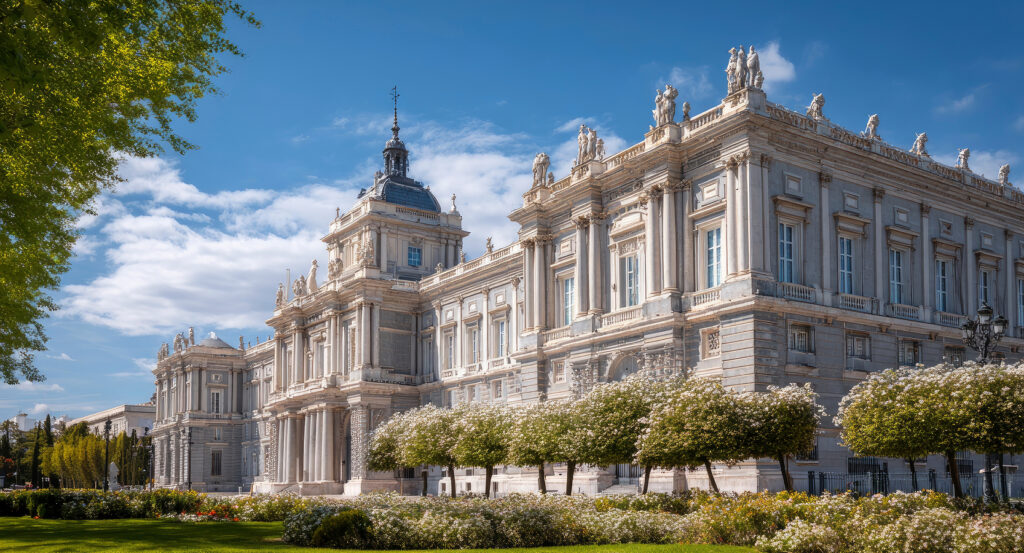
Why Plaza de la Armería matters.
The Plaza de la Armería is where the Royal Palace breathes, a grand expanse of stone and sky where Spain's centuries of ceremony unfold.
Framed by the palace to the east and the Almudena Cathedral to the west, the square bridges the sacred and the sovereign in perfect symmetry. Its vast limestone floor glows ivory in the sun, reflecting the rhythm of boots, carriages, and brass bands during royal parades. The air here carries echoes of coronations and military salutes, yet it remains serene, a rare equilibrium between majesty and quiet. Stand at its center and turn slowly: every direction reveals history in motion. The palace's Baroque façade rises like a stage curtain; the cathedral's domes shimmer like a benediction. Together, they form Madrid's most regal dialogue, power and faith meeting eye to eye beneath an open sky.
What defines Plaza de la Armería.
Though its grandeur feels timeless, the Plaza de la Armería is among the palace complex's younger spaces, the product of vision and restraint.
While the Royal Palace was completed in the mid-18th century, this courtyard was not finalized until the 1890s, when architect Enrique Repullés y Vargas designed it to harmonize the palace with the newly constructed Almudena Cathedral. The result was a space of ceremonial purpose, at once military, monarchical, and architectural. The name “Armería” recalls the Royal Armory, which once occupied the western edge of the square and still houses one of Europe's finest collections of armor. The plaza's geometric paving, designed from gray and white granite, mirrors the patterns of Renaissance courtyards but with neoclassical clarity. Beneath the surface lies a network of service tunnels, an unseen infrastructure that allowed guards and staff to move unseen during state events. Few visitors realize the square's orientation was calculated to align perfectly with the cathedral's central nave, creating a visual corridor that symbolically links crown and altar. From its balconies, monarchs have addressed troops, foreign dignitaries, and the Spanish people, each speech echoing through the same expanse of stone that once hosted imperial processions. At sunset, the plaza's colonnades catch a golden hue that softens its grandeur, transforming it from fortress to sanctuary.
How Plaza de la Armería fits.
Enter from the Calle de Bailén side, where the gates open onto a view that could only belong to Madrid, regal yet inviting.
Visit in the morning to watch the light sweep across the palace façade, or arrive at noon to witness the Changing of the Guard, when soldiers in navy and crimson march in cadence to the echo of drums. Stand near the equestrian statue of Philip IV, positioned with mathematical precision to balance the scale of the square. From here, the Almudena Cathedral's dome rises directly ahead, creating one of the city's most photogenic alignments. After exploring the plaza, step toward the Royal Palace entrance for a tour of its ceremonial halls, the Throne Room and the Hall of Columns are direct extensions of the pageantry that begins here. As you leave, take a final look from the balustrade overlooking the Campo del Moro gardens below; the palace gleams like a crown suspended above the trees. The Plaza de la Armería isn't just an open space, it's the stage upon which Spain's royal character continues to unfold, one step and one echo at a time.
Where your story begins.
Foresyte Travel reveals places that feel extraordinary long before you arrive.
Experience premium editorial crafted for luxury travelers.














































































































