
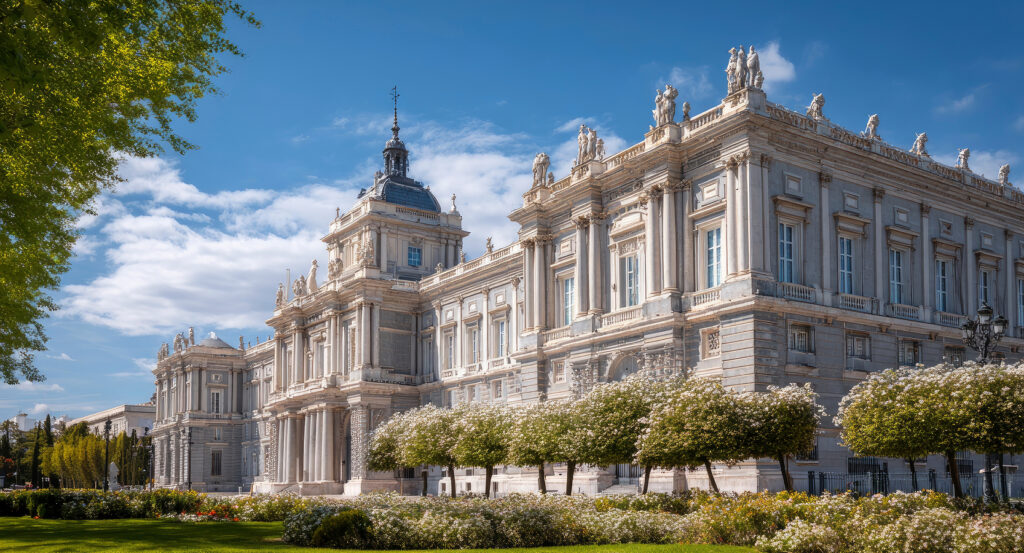
Why Campo del Moro matters.
Campo del Moro is Royal Palace of Madrid's living dreamscape, a vast green expanse where geometry meets grace and history exhales in birdsong.
Spread beneath the western terrace of the Royal Palace, these gardens form a mirror of serenity against the city's energetic pulse. From above, the lawns unfold like silk, long, symmetrical avenues framed by fountains, cedars, and cypress. Step through the gate on Paseo de la Virgen del Puerto, and you descend not only in elevation, but in time. The air cools, the noise fades, and the palace appears distant yet ever present, gleaming high above the treetops like a crown suspended in light. Every path seems drawn toward that vision. Campo del Moro is not merely a royal garden; it's Madrid's most poetic vantage point, where landscape design becomes choreography, and silence becomes eloquent.
What defines Campo del Moro.
The gardens owe their name to a 12th-century legend: during the Reconquista, Moorish troops encamped here while attempting to retake the city's fortress, campo del moro, the “field of the Moor.”
Centuries later, the same slopes became a royal refuge. In the early 19th century, Queen María Cristina commissioned a complete redesign of the neglected grounds, entrusting landscape architect Narciso Pascual y Colomer with creating a romantic English-style garden that would complement the palace's austere grandeur. The result was a masterpiece of balance, a space that feels both natural and choreographed, where straight axial views meet winding paths and reflective ponds. The garden's central feature, the Fountain of the Shells, glimmers like a jewel amid the symmetry, while the Fountain of the Tritons murmurs softly beneath chestnut trees. Beyond its ornamental beauty, the site hides architectural subtleties: irrigation channels fed by the Manzanares River, and terraces engineered to create an illusion of infinite depth when viewed from the palace balcony. Few visitors realize that the palace itself was designed to be seen from here, its façade proportioned so the building appears perfectly framed by the garden's central avenue. Campo del Moro is one of Europe's few surviving examples of royal gardens laid entirely on a steep incline, a technical and aesthetic feat achieved through precise grading and optical trickery.
How Campo del Moro fits.
Approach the gardens from Paseo de la Virgen del Puerto and allow the gradual climb of perspective to unfold before you.
Enter through the wrought-iron gates in the morning, when dew still lingers on the lawns and the first light gilds the palace façade above. Follow the central promenade toward the Fountain of the Shells, pausing halfway to take in the symmetry of the scene, the palace rising at the far end, framed by sweeping alleys of elm and oak. Wander down the side paths where the canopy thickens; you'll find secluded benches and small clearings where time feels suspended. Continue toward the Fountain of the Tritons, its marble figures half-hidden in shadow, and listen to the quiet trickle of water mingling with the rustle of leaves. If you visit in late afternoon, stand near the upper terrace as the sun sets, the palace glows in pale gold, reflected in the ponds below like a painter's study of light. Campo del Moro is best experienced unhurried. Let its stillness recalibrate you. When you leave, you'll realize you've seen Madrid not from its streets, but from its soul, a city whose heart beats through its gardens as much as its palaces.
Where your story begins.
Foresyte Travel reveals places that feel extraordinary long before you arrive.
Experience premium editorial crafted for luxury travelers.














































































































