
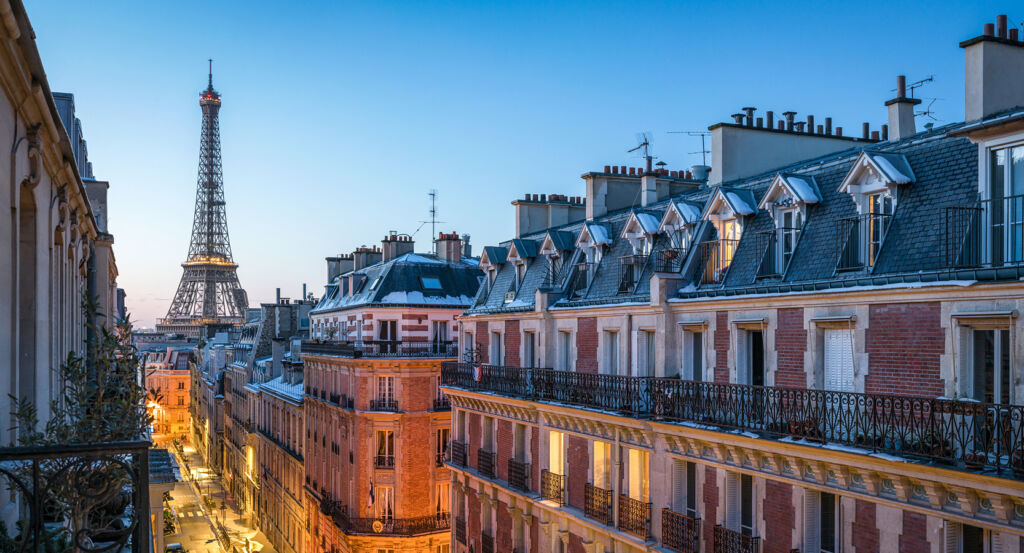
Why you should experience Rue d'Hauteville in Paris, France.
Rue d'Hauteville is a distinguished Porte-Saint-Denis corridor where industrial innovation, architectural elegance, cosmopolitan heritage, and creative Parisian life converge along one of the Right Bank's most fascinating historic streets.
Running through Porte-Saint-Denis between Boulevard de Bonne-Nouvelle and Gare de l'Est, this graceful corridor unfolds through elegant Haussmann residences, historic hotels, independent cafés, creative studios, landmark institutions, and beautifully preserved nineteenth century architecture that reflects the transformation of northern Paris into a thriving commercial and residential quarter. Broad sidewalks, richly ornamented façades, neighborhood businesses, and a lively multicultural atmosphere create a streetscape where entrepreneurial ambition and artistic reinvention continue shaping everyday life. Every section of the corridor reflects the remarkable evolution of this once-industrial district into one of Central Paris' most dynamic neighborhoods. The result is a corridor defined by architectural character, historical significance, and one of the capital's most engaging urban corridors.
What you should know about Rue d'Hauteville.
Rue d'Hauteville is best known for preserving the remarkable legacy of Maison Antoine Lumière, where photographer and industrialist Antoine Lumière established his Paris headquarters before helping finance the pioneering experiments of his sons Auguste and Louis Lumière, whose invention of the Cinématographe transformed the history of motion pictures. Originally developed during the seventeenth century as part of the expanding Faubourg Poissonnière, the corridor flourished during the nineteenth century as railways, nearby Gare de l'Est, and expanding commercial districts attracted manufacturers, publishers, merchants, and prosperous residents to its elegant new apartment houses. The avenue also became closely associated with Parisian hospitality through the renowned Hôtel des Deux Gares district while preserving notable examples of Second Empire residential architecture distinguished by elaborate stone carving, wrought-iron balconies, and richly ornamented entrances. During the twentieth and twenty-first centuries Rue d'Hauteville evolved into a spirited creative quarter where former commercial buildings and workshops found new life as architectural studios, independent galleries, design firms, and innovative hospitality venues, illustrating the district's remarkable capacity for reinvention while retaining its historic urban fabric.
The corridor continues expressing an exceptional blend of industrial heritage, architectural refinement, and contemporary creativity through buildings that preserve the ambitions of nineteenth century Paris while accommodating new generations of entrepreneurs, designers, and cultural institutions. Historic façades, carefully restored residences, and longstanding neighborhood businesses maintain the avenue's distinctive identity, while its proximity to the capital's great railway stations reinforces the commercial importance that first shaped its development. Few streets demonstrate so clearly how innovation, transportation, architecture, and urban renewal have combined to define the evolution of modern Paris.
How to fold Rue d'Hauteville into your trip.
Rue d'Hauteville works as an exploration through Porte-Saint-Denis' remarkable architecture, cultural landmarks, and historic neighborhoods.
Begin at Porte Saint-Denis, where Louis XIV's triumphal arch establishes the historic significance of the surrounding district before following Rue d'Hauteville through one of northern Paris' most character-rich corridors. Continue to Musée des Arts et Métiers, whose extraordinary scientific collections celebrate the inventive spirit reflected in the avenue's industrial heritage. Conclude at Passage Brady, where one of Paris' most energetic nineteenth century covered passages provides a memorable finale celebrating the multicultural energy and entrepreneurial traditions that continue defining the neighborhood. The progression moves naturally from royal monumentality to scientific innovation before culminating in one of the city's most distinctive commercial arcades, revealing why Rue d'Hauteville remains one of Paris' most rewarding historic corridors.
Where your story begins.
Foresyte Travel reveals places that feel extraordinary long before you arrive.
Experience premium editorial crafted for luxury travelers.














































































































