
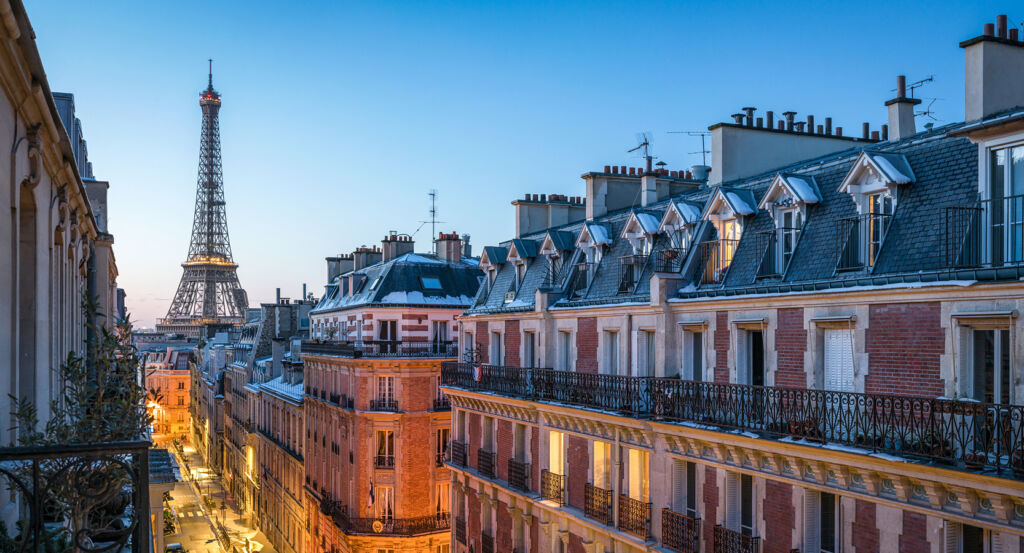
Why you should experience Rue de Belleville in Paris, France.
Rue de Belleville is a spirited Belleville corridor where immigrant heritage, artistic innovation, revolutionary history, and panoramic Parisian life converge along one of the capital's most culturally dynamic streets.
Running through Belleville between Boulevard de Belleville and Rue des Pyrénées, this energetic corridor unfolds through historic cafés, celebrated street art, independent galleries, neighborhood markets, diverse restaurants, and distinctive nineteenth century buildings that reflect generations of cultural transformation. Family-owned businesses, colorful murals, artisan bakeries, lively terraces, and independent music venues create a streetscape where successive waves of immigration have continually reshaped one of Paris' most creative neighborhoods. Every section of the corridor reveals a remarkable blend of tradition, reinvention, and community spirit that distinguishes Belleville from anywhere else in the capital. The result is a corridor defined by cultural diversity, artistic vitality, and one of Paris' most authentic historic avenues.
What you should know about Rue de Belleville.
Rue de Belleville is best known for following the ancient road to the former independent village of Belleville, annexed to Paris in 1860, while preserving one of the capital's richest legacies of working-class culture, immigration, and artistic innovation. The corridor became internationally significant as the birthplace of Édith Piaf in 1915, whose extraordinary career transformed her into France's most celebrated chanson singer, while generations of immigrants from Auvergne, Armenia, Greece, Algeria, Tunisia, Morocco, China, and Southeast Asia established the multicultural character that continues defining Belleville today. During the nineteenth century the avenue flourished as a center of vineyards, gypsum quarries, guinguettes, and political activism before playing an important role during the Paris Commune of 1871, when Belleville became one of the final strongholds of the Communards during the Bloody Week. Throughout the twentieth century the neighborhood emerged as one of Paris' foremost artistic districts, attracting painters, photographers, filmmakers, musicians, and street artists whose work transformed the surrounding streets into one of Europe's most celebrated open-air galleries. The corridor also preserves the remarkable Parc de Belleville, created by architect François Debulois and landscape architect Paul Brichet in 1988 atop former hillside vineyards, offering one of the highest public viewpoints in Paris while recalling the area's centuries-old winemaking tradition.
The avenue continues expressing an extraordinary continuity of cultural exchange through independent galleries, community organizations, neighborhood markets, and family-owned businesses representing dozens of national traditions. Historic workers' housing, contemporary murals, music venues, and surviving traces of Belleville's village origins demonstrate how the neighborhood has continually absorbed new communities while preserving its unmistakable identity. Few Parisian streets demonstrate the city's social history, artistic evolution, and multicultural character with such remarkable richness and authenticity.
How to fold Rue de Belleville into your trip.
Rue de Belleville works as an exploration through Belleville's celebrated viewpoints, artistic landmarks, and multicultural neighborhoods.
Begin at Parc de Belleville, where sweeping panoramic views establish the remarkable hillside setting before following Rue de Belleville through one of Paris' most creative districts. Continue to Maison de l'Air, whose exhibitions explore the environmental and geological history of the neighborhood while introducing the park's remarkable landscape. Conclude at Atelier des Lumières, where immersive digital exhibitions inside a restored nineteenth century foundry provide a memorable finale celebrating the artistic innovation that continues defining eastern Paris. The progression moves naturally from panoramic discovery to neighborhood history before culminating in contemporary artistic expression, revealing why Rue de Belleville remains one of the capital's most compelling cultural corridors.
Where your story begins.
Foresyte Travel reveals places that feel extraordinary long before you arrive.
Experience premium editorial crafted for luxury travelers.














































































































