
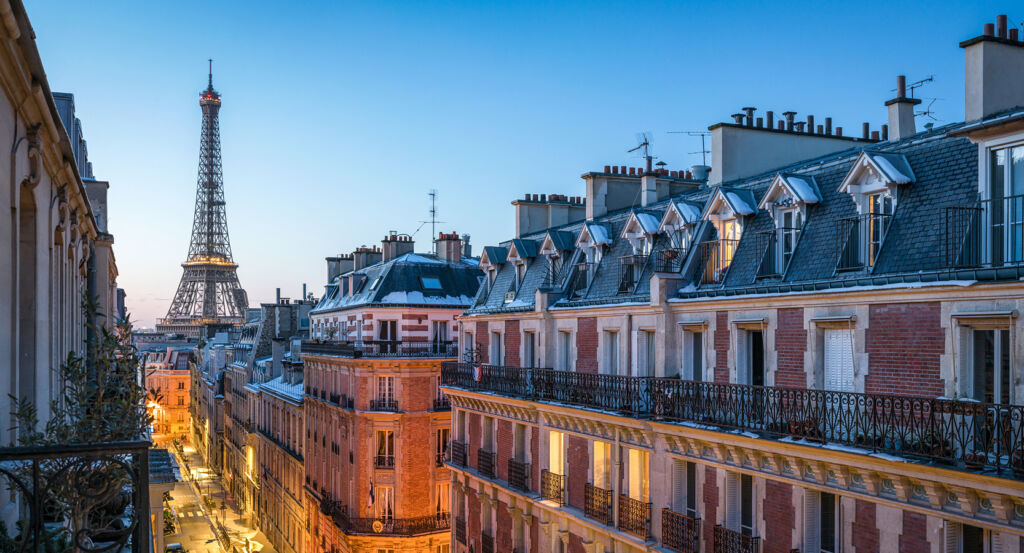
Why you should experience Rue de Turbigo in Paris, France.
Rue de Turbigo is a dynamic Arts-et-Métiers corridor where Haussmannian ambition, commercial innovation, architectural grandeur, and modern Parisian life converge along one of the Right Bank's defining nineteenth century boulevards.
Running through Arts-et-Métiers between Les Halles and Place de la République, this broad corridor unfolds through imposing Haussmann façades, historic commercial buildings, landmark institutions, energetic cafés, and elegant residential architecture that reflect one of Baron Haussmann's most transformative urban interventions. Monumental stone buildings, generous sidewalks, thriving independent businesses, and a constant rhythm of neighborhood life demonstrate how visionary planning reshaped the historic fabric of Central Paris. Every section of the corridor reveals the confidence and scale that defined the Second Empire's reinvention of the capital. The result is a corridor defined by urban transformation, architectural distinction, and one of Paris' most consequential historic streets.
What you should know about Rue de Turbigo.
Rue de Turbigo is best known as one of Baron Haussmann's major Second Empire thoroughfares, declared of public utility in 1854 alongside Boulevard de Sébastopol and the extension of Rue Réaumur to create a new east-west artery linking the newly constructed Halles Centrales with the Place du Château-d'Eau, today's Place de la République, fundamentally reshaping the medieval street network of Central Paris. Named after the Franco-Sardinian victory at the Battle of Turbigo during the Second Italian War of Independence, the corridor commemorates one of Napoleon III's defining military campaigns while preserving remarkable landmarks including the former site of the Madelonnettes Prison, the birthplace of future French Prime Minister Pierre Mendès France, the location of Ernest Cognacq's first unsuccessful shop before he co-founded La Samaritaine with Marie-Louise Jaÿ, and the celebrated three-story caryatid known as L'Ange de Turbigo, the largest architectural caryatid in Paris, sculpted in 1859 from a design by Auguste Émile Delange. The boulevard's construction required the demolition of extensive medieval streets and religious complexes, replacing them with the grand uniform architecture that became synonymous with Haussmann's vision while establishing a principal commercial connection between Les Halles, the Sentier textile district, and Arts-et-Métiers that continues serving Central Paris today.
The corridor became a showcase for nineteenth century commercial Paris, attracting department stores, textile merchants, educational institutions, and manufacturers that reinforced its importance within the rapidly modernizing capital. Carefully aligned limestone façades, sculptural ornamentation, and generous proportions still embody Haussmann's philosophy of light, circulation, and grand urban order, while surviving architectural details such as the extraordinary caryatid at number 57 demonstrate the artistic ambition invested even in speculative residential buildings. More than a century and a half after its completion, Rue de Turbigo remains one of the clearest expressions of how engineering, architecture, commerce, and political vision combined to permanently redefine the modern city.
How to fold Rue de Turbigo into your trip.
Rue de Turbigo works as an exploration through Arts-et-Métiers' remarkable architecture, engineering heritage, and historic commercial districts.
Begin at Musée des Arts et Métiers, where one of the world's oldest technical museums introduces centuries of French scientific and industrial innovation before following Rue de Turbigo through one of Haussmann's most ambitious urban transformations. Continue to Passage du Grand Cerf, whose soaring nineteenth century glass-roofed arcade showcases exceptional artisan workshops and elegant commercial architecture only moments from the corridor. Conclude at Bourse de Commerce, where Tadao Ando's celebrated transformation of the historic commodity exchange into the Pinault Collection provides a memorable finale celebrating the continuing evolution of commerce, architecture, and cultural innovation in the heart of Paris. The progression moves naturally from scientific achievement to historic retail architecture before concluding through one of the capital's finest examples of adaptive reuse, revealing why Rue de Turbigo remains one of Paris' most significant urban corridors.
Where your story begins.
Foresyte Travel reveals places that feel extraordinary long before you arrive.
Experience premium editorial crafted for luxury travelers.














































































































