
Why The Dome Tour at Basilique du Sacré-Coeur matters.
The Dome Tour at Basilique du Sacré-Coeur is a soaring architectural ascent where Montmartre's hilltop character meets Paul Abadie's Romano-Byzantine basilica, a sequence through its roofscape and an uninterrupted panorama above Paris.
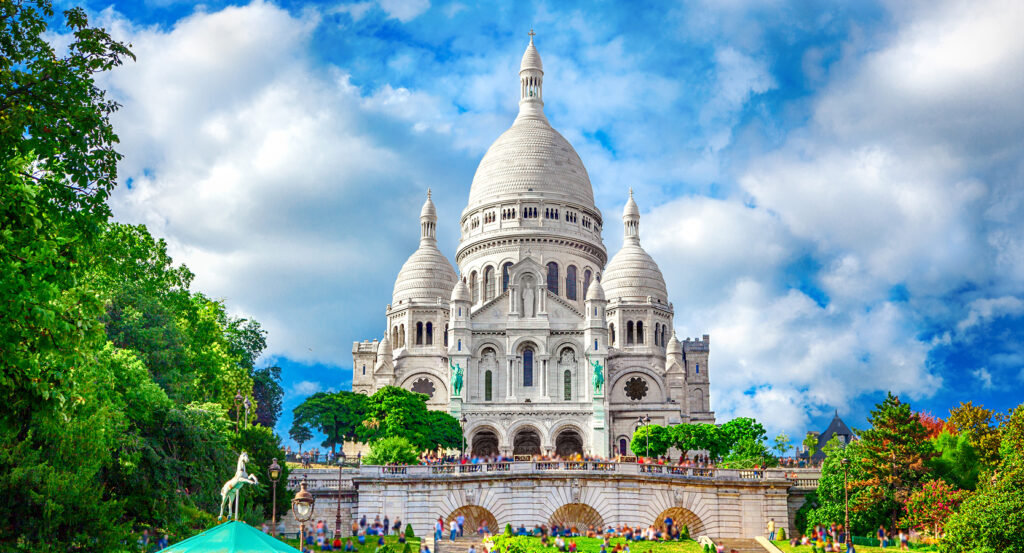
Set along Rue du Chevalier de la Barre near Rue du Cardinal Guibert and just steps from Parvis du Sacré-Coeur, the ascent occupies the basilica's highest accessible structure above a steep urban hillside where stone stairways, garden terraces, compact apartment blocks and the older streets of Montmartre descend toward northern Paris. 300 steps rise through confined masonry passages before emerging among the curved roofs and pale stone volumes surrounding the central dome. Successive openings bring Abadie's clustered cupolas, lanterns and sculptural architecture into close view as the route gains height above the basilica. The summit opens to a 360-degree panorama from the Butte, whose elevation places the dense roofs of Paris beneath a horizon punctuated by major civic and religious structures. The result is an architectural climb that converts Sacré-Coeur from a distant hilltop silhouette into a sequence of stone, roof forms and changing elevations before releasing the full geography of Paris at its summit.
What defines The Dome Tour at Basilique du Sacré-Coeur.
The Dome Tour at Basilique du Sacré-Coeur is best known for reaching the great central dome conceived within Paul Abadie's winning 1874 design for a Romano-Byzantine basilica organized as a Greek cross. Alexandre Legentil and Hubert Rohault de Fleury had formulated the Voeu National in 1871, Archbishop Joseph-Hippolyte Guibert approved its final text in 1872 and the National Assembly declared construction of the basilica a matter of public utility in July 1873. Seventy-eight projects entered the architectural competition the following year before Abadie secured the commission with a scheme whose north-south orientation opened the church toward Paris. The foundation stone was laid in 1875, initiating a construction campaign that continued beyond Abadie's death in 1884 under architects who altered elements of his original composition. The basilica opened ceremonially in 1891 without its great dome, leaving the structure that now defines both the skyline and the tour unfinished. Work on the central dome advanced during the 1890s, and Abadie's successors increased its height beyond the original scheme as they developed the upper portions of the church. Paris Musées places construction of the enlarged great dome 1896 and its completion at the end of 1899, fixing the principal architectural destination of the present ascent within a late phase of the basilica's decades-long building campaign. The campanile followed, receiving the cross on its lantern in 1912, and the First World War postponed the basilica's planned 1914 consecration until October 16, 1919. The dome climb consequently enters the component that completed the dominant silhouette of a church begun under Abadie but physically developed across successive architectural administrations.
The dome's architectural program extends Abadie's centralized plan into a hierarchy of religious symbols built directly into the upper structure. Four subsidiary domes correspond to the Evangelists, with the central dome assigned to Christ and developed internally as a three-tiered crown. A triforium around the lower portion carries bas-relief representations of the four Evangelists with their associated creatures, followed by a frieze bearing the Voeu National dedication to the Sacred Heart. Passages from the Nicene-Constantinopolitan Creed appear beneath that inscription, binding the architectural hierarchy to texts concerning the Incarnation and Redemption. Four immense supports carry the central structure, and sculpted angels positioned upon them hold instruments associated with the Passion of Christ. Louis-Ernest Barrias, Gustave Michel, Louis Noël and Léon Fagel divided responsibility for those angelic sculptures, embedding four named practitioners within the structural transition toward the cupola. The public route approaches this complex from outside through 300 steps, moving close to the basilica's roofs before reaching the upper gallery. At the summit, the circular viewpoint opens across Paris in every direction, turning the central dome's elevated position into the defining physical mechanism of the tour.
How The Dome Tour at Basilique du Sacré-Coeur fits.
The Dome Tour at Basilique du Sacré-Coeur works as the anchor for a daytime exploration across the summit of the Butte using three nearby sites that move from a medieval abbey church through a seventeenth-century house occupied by major artists into a former market hall converted for outsider art.
Begin at Saint-Pierre de Montmartre, whose Romanesque fabric preserves the religious history of the hill centuries before construction of Sacré-Coeur. The church belonged to the royal Benedictine abbey founded in the twelfth century and survived the disappearance of most monastic buildings after the Revolution. Ancient columns incorporated into the nave connect its fabric with earlier occupation of the site, and later intervention altered the church repeatedly before architect Louis Sauvageot directed a major recovery between 1900 and 1905, rescuing a structure that had faced demolition. Paris Musées imagery from the period captures Saint-Pierre beside the unfinished Sacré-Coeur dome, placing medieval Montmartre and its new pilgrimage basilica within the same construction-era view. Continue to Musée de Montmartre at 12 Rue Cortot, established in 1960 within the seventeenth-century Maison du Bel Air, among the oldest surviving houses on the Butte. Auguste Renoir maintained a studio there, and the property later accommodated artists including Émile Bernard, Suzanne Valadon, Maurice Utrillo, Raoul Dufy and Charles Camoin. Renoir painted works associated with his Montmartre period on the premises, and the present Jardins Renoir occupy ground overlooking the Clos Montmartre vineyard. The museum's collection of paintings, posters and drawings develops the history of the hill's studios and cabarets, with the reconstructed Valadon and Utrillo studio returning another layer of artistic production to the house itself. Conclude at Halle Saint-Pierre, the former covered market at the foot of the Sacré-Coeur gardens whose iron-and-glass construction belongs to the nineteenth-century architecture that accompanied Montmartre's incorporation into Paris. Its later conversion into an exhibition center established a program devoted to art brut, outsider art and other work developed beyond conventional academic channels, extending the hill's artistic history into a distinct contemporary institution. The progression moves from Saint-Pierre's surviving medieval religious fabric through the studios and artistic households preserved at Rue Cortot into the repurposed market architecture of Halle Saint-Pierre, carrying the descent from Sacré-Coeur through three different mechanisms that shaped Montmartre's religious and artistic history.
Where your story begins.
Foresyte Travel reveals places that feel extraordinary long before you arrive.
Experience premium editorial crafted for luxury travelers.
Foresyte Travel may earn a commission when you book through the link on this page.














































































































