
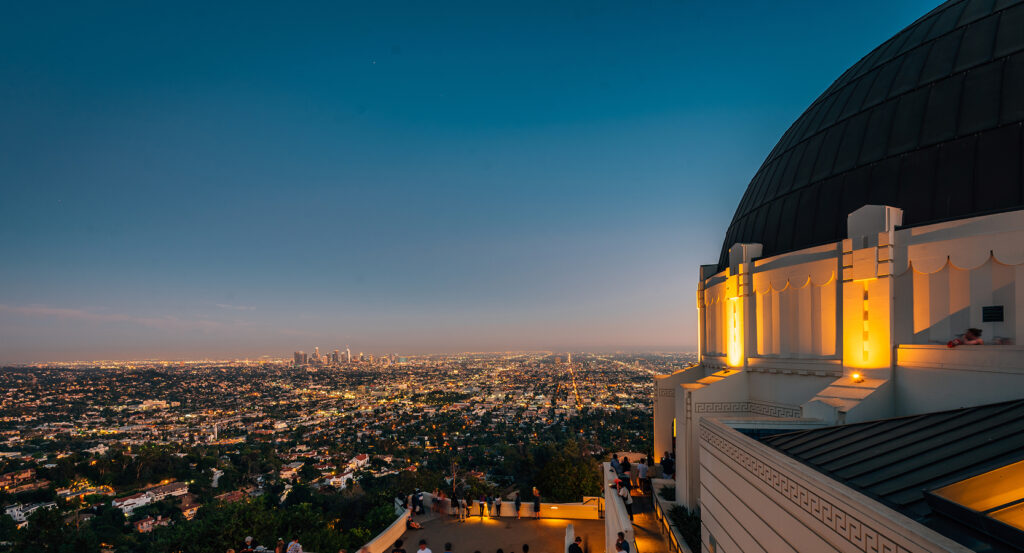
Why Samuel Oschin Planetarium matters.
Samuel Oschin Planetarium is a transporting astronomy theater where Los Feliz's scientific-cultural character meets live interpretation, enveloping projection and a technologically exact recreation of the night sky.
Set inside Griffith Observatory on the southern slope of Mount Hollywood near the building's central rotunda, the theater occupies the great dome rising above the western side of the historic complex. Reclining seating directs attention upward toward a continuous overhead surface, removing the conventional separation between stage and audience as imagery spreads across the ceiling. A presenter guides the encounter in real time, coordinating spoken interpretation with astronomical imagery and theatrical cues across the room. Darkness, surround sound and controlled illumination deepen the spatial effect as celestial objects expand from recognizable points overhead into large-scale astronomical phenomena. The result is a performance environment that turns astronomical explanation into collective observation, using human interpretation and enveloping imagery to connect the simulated heavens with the real sky beyond the Observatory.
What defines Samuel Oschin Planetarium.
Samuel Oschin Planetarium is best known for combining live astronomical presentation with the Zeiss Universarium Mark IX, a German-built fiber-optic star projector customized through collaboration between Griffith Observatory scientists and Zeiss engineers. Its computerized optical system reproduces thousands of stars and reorients the heavens to represent the sky at different moments in human history. Observatory scientists pursued refinements to the standard star field during development, and Zeiss incorporated those improvements into later projectors. The instrument entered the building during the Observatory's major twenty-first-century reconstruction, with installation beginning in May 2005 before the restored complex reopened on November 3, 2006. A custom lift allows the projector to rise into operating position for presentations, integrating a precision astronomical instrument directly into the theatrical staging. The finished room accommodates 290 people beneath a 75-foot dome, placing a large celestial field above a relatively concentrated audience. Griffith preserves an uncommon presentation tradition inside that technological system: programs remain live, giving lecturers direct control over pacing and astronomical interpretation instead of assigning the entire presentation to prerecorded narration.
The projection environment has continued to change long after the rebuilt theater entered service. Griffith Observatory Foundation secured support from the Ahmanson Foundation for a major 2015-16 replacement and upgrade of the digital video projection and lighting systems under Observatory Curator Dr. Laura Danly. Another technical cycle followed through the W. M. Keck Foundation, whose grant funded a Digistar 7 system to modernize the theater's digital capabilities. By 2022 the room incorporated 8K digital laser projection alongside surround sound and theatrical lighting, allowing astronomical visualization to extend beyond the optical star field into full-dome scientific imagery. Producing the live programs demands an equally specialized human system: performers undergo 25 to 30 hours of stop-and-start preparation for an individual show before moving into 20 additional hours of rehearsals beneath the dome. Directors then coordinate vocal delivery with radio microphones, lighting levels, sound and visual cues before performers begin the standard schedule of successive public presentations. The theater operates as both a precision projection facility and a live performance discipline, with continuing technical renewal supporting a presentation method dependent on trained people in the room.
How Samuel Oschin Planetarium fits.
Samuel Oschin Planetarium works as the anchor for a daytime sequence through Griffith Park, tracing how civic entertainment, constructed nature and volunteer horticulture turned the surrounding mountains into a public landscape shaped by Angelenos across successive generations.
Begin at Greek Theatre, conceived through Griffith J. Griffith's bequest for an outdoor amphitheater and developed after Los Angeles park commissioners examined Greek theatrical precedents. Its cornerstone was laid in 1928, formal dedication followed on September 25, 1930 and the first season opened the next June with operatic programming; 4,000 people attended the inaugural performance, with seats in the first two sections priced at one dollar and the remainder free. The venue assumed an entirely different role during much of the 1940s when military use converted it into barracks, before theatrical productions returned and later concert promoters brought performers including Frank Sinatra, Elton John, Bruce Springsteen and Carlos Santana to its canyon stage. City stewardship has continued through structural work, restoration of the original façade and a self-operated open-venue model introduced in 2015. Continue to Fern Dell Nature Area, where Los Angeles park officials began constructing a rustic fern garden in a stream-fed western canyon in 1914, moving boulders and creating dams, pools, planting beds and bridges around the watercourse. More than 400 ferns had been planted by 1916, and Depression-era Civilian Conservation Corps crews later expanded the northern section with stonework and additional park infrastructure. The site carries a much older human association as a former Tongva/Gabrieleño gathering place known as Mococahuenga, giving the cultivated ravine a history extending far beyond its municipal garden phase. Conclude at Dante's View, created in 1964 when Dante Orgolini began carrying water and plants into an exposed mountainside area and cultivating it largely through his own labor. Park officials initially resisted the unauthorized work before accepting the garden, and Orgolini continued developing the retreat with fellow volunteer Charlie Turner as planted terraces and shaded resting ground accumulated around the trail. Fire later destroyed the garden, yet volunteers rebuilt the site and continued the stewardship model initiated by Orgolini. The progression moves from a publicly financed amphitheater through a municipal fern garden layered over an Indigenous gathering place into an individual volunteer's mountainside refuge, revealing three distinct traditions through which Griffith Park acquired cultural spaces beyond its natural terrain.
Where your story begins.
Foresyte Travel reveals places that feel extraordinary long before you arrive.
Enjoy editorial crafted for luxury travelers.
Foresyte may earn a commission when you book.





































































































