
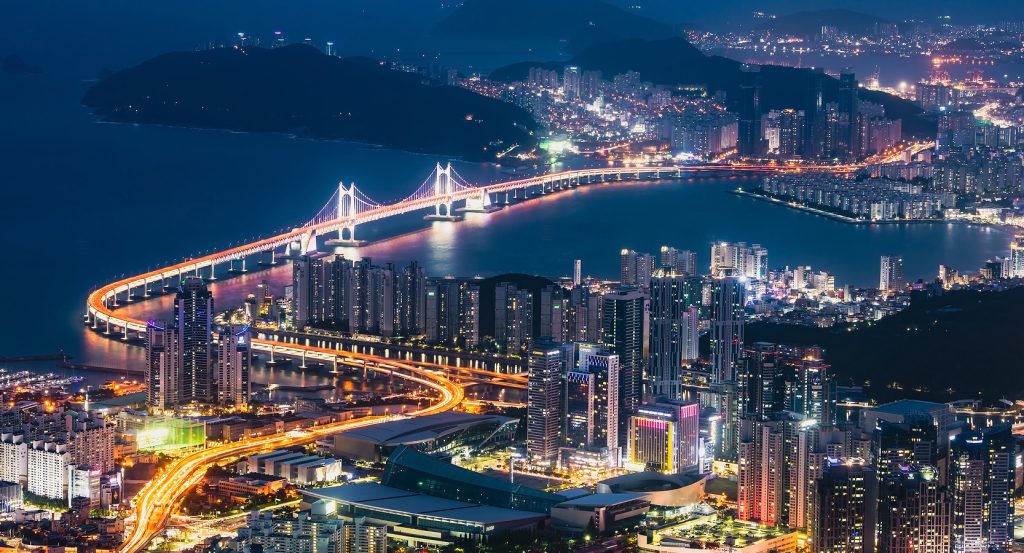
Why you should experience Seo-gu in Busan, South Korea.
Seo-gu is a historic waterfront district where hillside communities, maritime heritage, and the enduring spirit of old Busan continue to overlook the harbor that built the city.
Stretching across the western edge of Central Busan between the slopes above the port and the waters that connect Korea to the wider world, this district preserves a side of the city that predates the glass towers and beachfront skylines often associated with modern Busan. The landscape unfolds vertically. Narrow streets climb steep hillsides lined with homes, local businesses, and neighborhoods shaped by generations of residents who built their lives around the harbor below. Ferries drift across the horizon. Fishing boats return to port. Daily routines unfold against a backdrop of sea breezes and panoramic views that remind visitors how closely Busan's character remains tied to the water. There is an authenticity to Seo-gu that feels increasingly rare in rapidly modernizing cities. The district rewards curiosity rather than performance, revealing itself through local markets, community spaces, and streets that carry the accumulated memory of countless lives lived along Korea's southern coast. For travelers seeking a deeper understanding of Busan's origins, few districts offer a more compelling perspective.
What you should know about Seo-gu.
Seo-gu is best known for being home to Songdo Beach, Korea's first public beach, which opened in 1913 and helped establish Busan as one of the country's premier coastal destinations.
Long before Busan became an internationally recognized port city and tourism hub, Songdo introduced generations of Koreans to seaside recreation and coastal leisure. Its opening marked a significant moment in the country's relationship with public waterfront spaces, and its legacy continues to shape the character of the district today. Beyond Songdo, Seo-gu played an important role in Busan's historical development as a maritime center, benefiting from its proximity to the harbor and the trade routes that fueled the city's growth. The district's steep terrain and waterfront setting created neighborhoods that remain visually distinctive within the broader urban landscape. Today, Seo-gu balances its historical foundations with modern attractions, while preserving the local character that distinguishes it from many of Busan's more heavily commercialized districts. The result is a neighborhood where history, geography, and community remain deeply intertwined.
How to fold Seo-gu into your trip.
Seo-gu works as a journey through the maritime history and coastal landscapes that helped shape modern Busan.
Begin at Songdo Beach, where the district's legacy as Korea's first public beach immediately comes into focus through its shoreline, waterfront promenade, and relaxed atmosphere. Continue to Songdo Marine Cable Car, whose elevated views provide a sweeping perspective of the coastline, harbor, and surrounding cityscape. From there, make your way toward Gamcheon Culture Village, where colorful hillside homes and winding alleys create one of Busan's most recognizable urban landscapes. The progression feels natural, moving from the sea to the sky and finally into the residential hillsides that define much of the district's character. Along the way, pause at local cafés, viewpoints, and neighborhood streets that reveal the quieter rhythms of daily life. By the end of the day, Seo-gu emerges not simply as a place to visit, but as one of the districts where Busan's maritime past remains most vividly present.
Where your story begins.
Foresyte Travel reveals places that feel extraordinary long before you arrive.
Experience premium editorial crafted for luxury travelers.

















































































































