
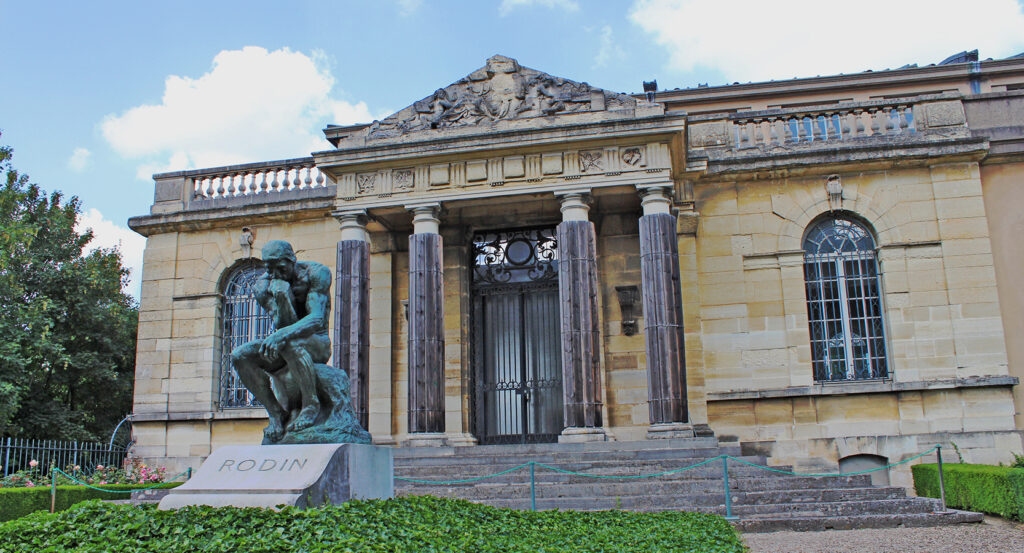
Why you should experience The Gates of Hell at Musée Rodin in Paris, France.
The Gates of Hell is not simply a sculpture, it is an epic carved in bronze, a fever dream of torment and transcendence rendered with divine precision.
Standing before it, you are struck not by its size but by its density, every inch teems with figures twisting, writhing, reaching for deliverance that never comes. It's Rodin's most ambitious and haunting creation, inspired by Dante's Inferno, yet it transcends its literary source to become a reflection of the human psyche itself. Over 200 figures, including early versions of The Thinker, The Kiss, and The Three Shades, emerge from the molten chaos of its panels. Each form seems caught mid-scream, mid-thought, mid-fall, suspended in an eternal cycle of desire and despair. Light grazes across the bronze surface like fire licking through smoke, revealing and concealing details with every shift of the sun. The experience is visceral, almost cinematic, as if the entire piece might come alive in a flash of divine judgment. Few works embody the paradox of beauty born from suffering so completely.
What you should know about The Gates of Hell at Musée Rodin.
Commissioned in 1880 for a museum that was never built, the project became his lifelong obsession. Rodin revised, dismantled, and reimagined it countless times, modeling figures directly in clay, often reusing them in later, standalone works. The Thinker and The Kiss both originated here, born from the crucible of this infernal portal. Each figure is a fragment of Rodin's psyche, not merely depictions of sinners but examples of human longing, fear, and ecstasy. The gate was never cast in bronze during his lifetime; it existed only in plaster, evolving with every stroke of his hand. It wasn't until years after his death that the grand bronze version was finally completed. What's most extraordinary is that Rodin didn't see hell as punishment but as passion unbound, his inferno was not divine wrath but human emotion in its rawest form.
How to fold The Gates of Hell at Musée Rodin into your trip.
To experience The Gates of Hell as Rodin intended, you must let it overwhelm you.
Stand before it slowly, not as a tourist, but as a pilgrim to a vision of humanity unmasked. Begin at eye level and trace your gaze upward, noting how the chaos crescendos toward The Thinker perched at its summit, surveying the damned below. Visit during late afternoon, when the bronze burns gold, and the shadows deepen between figures, each crevice alive with secrets. Move in close, and the work reveals hundreds of stories at once: lovers entwined in despair, angels losing faith, mortals clinging to impossible dreams. The Musée Rodin's garden provides the ideal backdrop, serene and sunlit, a deliberate contrast to the resonant storm of the gates. Afterward, step back and take in the entire structure from a distance; it's then that its symmetry, its rhythm, its terrifying beauty become clear. To see The Gates of Hell is to confront the heart of Rodin's philosophy, that even in agony, there is grace, and that art's greatest purpose is to make that contradiction eternal.
Where your story begins.
Foresyte Travel reveals places that feel extraordinary long before you arrive.
Experience premium editorial crafted for luxury travelers.














































































































