
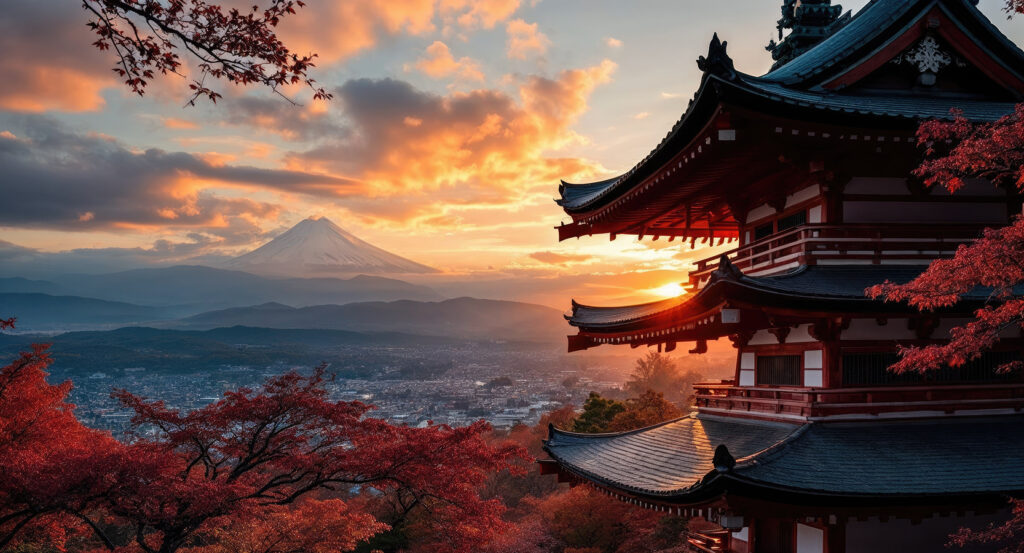
Why you should experience Tō-ji Temple Garden in Kyoto, Japan.
Tō-ji Temple Garden is Kyoto's southern mirror, a sanctuary of water, stone, and sky where reflection becomes revelation.
Stretching out beside the towering five-story pagoda, the garden unfolds in silence: a still pond ringed by pines, maples, and irises, its surface rippling only when the wind remembers to breathe. The pagoda's reflection shimmers across the water like a candle in meditation, each movement dissolving into calm. Gravel paths weave among manicured shrubs and centuries-old stones, inviting a slow rhythm, one that matches the sound of temple bells echoing across the grounds. The garden feels less designed than discovered, like something time built. Morning light turns the pond silver; by afternoon it glows gold. At dusk, the pagoda ignites in shadow, and the entire landscape becomes a living mandala, impermanence rendered in perfect symmetry.
What you should know about Tō-ji Temple Garden.
Tō-ji Temple Garden, known historically as Kōenchi Teien, evolved over twelve centuries as the temple itself transformed from imperial guardian to spiritual refuge.
Its earliest design dates to the Heian period, when Emperor Kanmu commissioned the grounds as a reflection of paradise, a jōdo (Pure Land) garden intended to visualize enlightenment through water and form. Over time, the Shingon monks reshaped the space to align with esoteric cosmology, linking each element, pond, island, bridge, and tree, to aspects of the five Buddhist elements. The garden's centerpiece pond mirrors the pagoda to the west, symbolizing the unity of heaven and earth. In spring, cherry blossoms frame the reflection in soft blush tones; in summer, irises bloom around the edges like painted brushstrokes; in autumn, the maples blaze crimson; and in winter, frost turns every surface to quiet crystal. Few visitors realize that the pond also serves a functional purpose: it collects rainwater from the temple's rooftops, symbolizing the Buddhist principle that even the smallest drop returns to the source. The balance between structure and spontaneity here is precise, a harmony born not from control, but from surrender.
How to fold Tō-ji Temple Garden into your trip.
The garden works as the final act of your visit to Tō-ji Temple, a space to exhale after the power of the pagoda and the gravity of the Kondō Hall.
From the temple's main path, follow the sound of water until the trees part to reveal the pond. Approach slowly, letting the reflections shift with each step. Find a bench along the edge and sit for a while; the pagoda's image on the water will move with the breeze like a living painting. Visit in the morning when mist drifts over the surface, or in the late afternoon when the setting sun turns the entire scene to amber. During festival days, lanterns are placed along the garden paths, their flickering light mirrored in the pond, a quiet discussion between heaven and earth. Walk the perimeter trail that circles the water; each vantage point frames the pagoda differently, as if the garden is teaching perspective itself. Before leaving, turn once more toward the reflection. The scene will never look exactly the same again, and that's the point. Tō-ji Temple Garden is Kyoto's reminder that beauty isn't fixed in stone or sand. It lives in the moment that passes, and the stillness that remains.
Where your story begins.
Foresyte Travel reveals places that feel extraordinary long before you arrive.
Experience premium editorial crafted for luxury travelers.

















































































































