
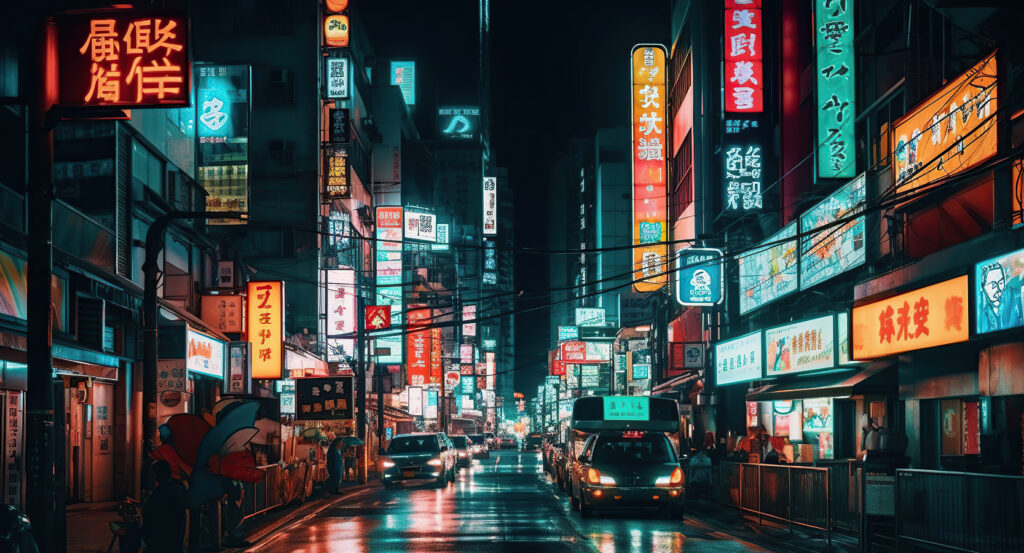
Why Shinjuku Toho Building matters.
Shinjuku Toho Building is a theatrical entertainment complex where Kabukicho's after-dark character meets cinematic performance, high-rise architecture and Godzilla looming above one of Tokyo's most intensely animated streets.
Set along Godzilla Road near Yasukuni-dori and just steps from Cine City Square, the 130-meter tower terminates a direct visual axis from Shinjuku's eastern commercial core, rising above a dense field of signs, entertainment venues and illuminated facades. Takenaka Corporation shaped the lower exterior around the image of a stage curtain opening toward the city, using broad glazed surfaces and layered elevations to expose human activity across the building's base. A luminous tower rises above this active podium, giving the complex a vertical presence visible well before its individual architectural elements resolve at street level. Godzilla Head projects from the eighth-floor terrace 50 meters above ground, matching the stature of the monster in the original 1954 film and creating the startling impression that the creature has emerged between Kabukicho's buildings. The result is an unusually theatrical piece of commercial architecture whose street axis, illuminated tower, exposed activity and colossal cinematic figure turn the approach itself into part of the encounter.
What defines Shinjuku Toho Building.
Shinjuku Toho Building is best known for replacing Shinjuku Koma Theater, a 52-year center of Kabukicho entertainment, with a 2015 complex that reconnected Toho's historic presence in the district to its film business and Godzilla franchise. Ichizo Kobayashi drove Toho's original expansion into Kabukicho after the company acquired ground used for the 1950 Tokyo Industrial Culture Exposition, responding to local and municipal calls for a theater with an experiment in mass entertainment. Shinjuku Koma Theater was completed in December 1956 and developed into a major performance venue before closing in 2008. Toho subsequently conceived its replacement around cinema and a large hotel, commissioning Takenaka Corporation to design and construct a 54,735-square-meter building with 30 floors above ground and one below. Construction ran from July 2012 through March 2015, producing a steel and steel-reinforced-concrete structure containing a 12-screen cinema with 2,300 seats and a 970-room hotel. The project extended beyond the property line through coordination with Shinjuku City and the local promotion association on rebuilding the former Central Road as the principal approach to the complex. Takenaka's design team included Fujio Ochiai, Nobuaki Miyashita, Kazunori Sekiya, Kazuho Takashima and Kouichiro Yoshimoto, with structural engineering led by Takaaki Hiroshige, Masahiro Hoshino, Kei Muto and Shoko Okamura. Recognition followed with the 2015 Good Design Award, the 49th SDA Award for sign design and the 58th BCS Award in 2017. Shinjuku Toho Building converted the site of a postwar performance institution into a vertically stacked entertainment center, preserving Toho's role in Kabukicho through a new architectural form tied directly to cinema.
How Shinjuku Toho Building fits.
Shinjuku Toho Building works as the anchor for a Shinjuku route through three nearby institutions connecting an Edo-period guardian shrine, Tokyo's surviving yose theater tradition and a museum built around the work of Seiji Togo and Vincent van Gogh.
Begin at Hanazono Shrine, whose origins predate the Edo period and whose Inari deity was brought from Yoshino in Yamato Province before the shrine moved to its present ground during the Kan'ei era of 1624 to 1644. Fires repeatedly destroyed the precinct, and theatrical performances staged there to finance reconstruction became known as Sanko-in Shibai, creating a historical connection between religious life and popular performance long before modern Kabukicho emerged nearby. Continue to Shinjuku Suehirotei, among Tokyo's surviving yose theaters, where rakugo and associated traditional variety arts preserve a form of intimate urban entertainment that flourished across the capital before cinema and broadcasting reorganized popular culture. Its continued presence in Shinjuku gives the district a living performance tradition whose scale and direct relationship between storyteller and audience provide a distinct chapter in the neighborhood's entertainment history. Conclude at Sompo Museum of Art, founded in 1976 as the Seiji Togo Art Museum on the 42nd floor of the Yasuda Fire & Marine Insurance headquarters, Japan's first art museum established high inside a skyscraper. Togo's family donated 345 objects from his estate after his death in 1978, and the collection expanded decisively in 1987 with Vincent van Gogh's Sunflowers before the institution moved into its dedicated six-storey building in 2020. The progression moves from Hanazono Shrine's centuries-old relationship with popular performance through the concentrated theatrical tradition of Shinjuku Suehirotei into a museum shaped by Seiji Togo and Van Gogh, extending Shinjuku Toho Building across the religious, entertainment and artistic history surrounding Kabukicho.
Where your story begins.
Foresyte Travel reveals places that feel extraordinary long before you arrive.
Enjoy editorial crafted for luxury travelers.

















































































































