Why World Bazaar at Tokyo Disneyland matters.
World Bazaar at Tokyo Disneyland is an immersive gateway where Maihama's resort character meets turn-of-the-century American architecture, weather-responsive Disney design and the theatrical transition from the park entrance toward Cinderella Castle.
Set immediately beyond Tokyo Disneyland's entrance near the park's central plaza and just steps from the routes into Adventureland and Tomorrowland, the covered avenue establishes the first sustained environment inside the park. Victorian-style façades line a broad pedestrian street beneath an iron-and-glass canopy, enclosing storefronts and upper stories within a volume that reads simultaneously as an outdoor town center and an immense conservatory. Electric lights, decorative cornices, painted signs and period-inspired windows build the impression of an American community passing from gaslight into the electrical age, the historical moment used to organize the district's visual character. A cross street opens the long axis laterally before the principal route reaches the plaza, where the enclosed streetscape releases into open sky and a direct view toward the park's castle. The result is an entrance sequence that converts arrival into theater, using architecture, enclosure and a carefully controlled reveal to establish Tokyo Disneyland before its other themed lands unfold.
What defines World Bazaar at Tokyo Disneyland.
World Bazaar at Tokyo Disneyland is best known for reworking the Main Street, U.S.A. entrance concept around the environmental and operational requirements of Disney's first theme park built outside the United States. Oriental Land Company and Walt Disney Productions signed their construction and operations agreement in April 1979, establishing the structure through which Disney supplied design expertise and the Japanese company financed and operated the project. Construction plans received Chiba Prefecture approval on November 28, 1980, a groundbreaking ceremony followed on December 3 and full construction commenced the next January. Oriental Land originally estimated the wider park project at ¥100 billion, but president Masatomo Takahashi rejected design compromises as costs increased, and final investment approached ¥180 billion. Tokyo's rain, winter snow and autumn typhoons directly altered the American Disney entrance model: Imagineers placed World Bazaar beneath a vast latticed glass weather roof, among several adaptations developed to support year-round operation at the Tokyo Bay site. Its early-twentieth-century town theme concentrates on a period when electric illumination and motor vehicles were displacing gas lamps and horse-drawn transport, tying architectural decoration to technological change inside the fictional community. Tokyo Disneyland opened during rain on April 15, 1983, and World Bazaar became the ceremonial stage for that event: Takahashi stood on a platform inside the land and formally declared the park open after he and Disney chairman E. Cardon Walker cut the entrance ribbon. World Bazaar was more than Tokyo Disneyland's answer to an established Disney entrance street from its first morning; its enclosed architecture and role in the opening ceremony made it the physical threshold through which the American park model entered Japan.
A separate layer of World Bazaar preserves mechanical entertainment and transportation associated with the American period represented by its architecture. Penny Arcade gathers coin-operated machines inside an illuminated game room built around the amusement technology that preceded electronic arcades, including mechanical baseball games and old-fashioned pinball. Its name refers to the American one-cent coin once associated with inexpensive amusement machines, connecting the attraction directly with the commercial recreation of the period represented along the surrounding streets. Omnibus carries the same historical premise into motion through a double-decker vehicle based on buses that traveled New York City streets at the beginning of the last century. The vehicle leaves the enclosed commercial corridor and circles the Plaza on a six-minute journey, accommodating 33 passengers and revealing the entrances to the surrounding themed lands from an elevated upper deck. Center Street Coffeehouse shifts the architectural chronology forward through an Art Deco interior based on the design culture of the 1920s and 1930s, creating a deliberate stylistic departure from the Victorian streets outside. Mechanical games, motorized street transportation and Art Deco design collectively extend World Bazaar across successive stages of American popular culture, giving the land an internal chronology beneath its unified streetscape.
How World Bazaar at Tokyo Disneyland fits.
World Bazaar at Tokyo Disneyland works as the anchor for a park route through three attractions that move from steam-powered transportation through Audio-Animatronics musical theater and into the fairy-tale architecture at Tokyo Disneyland's visual center.
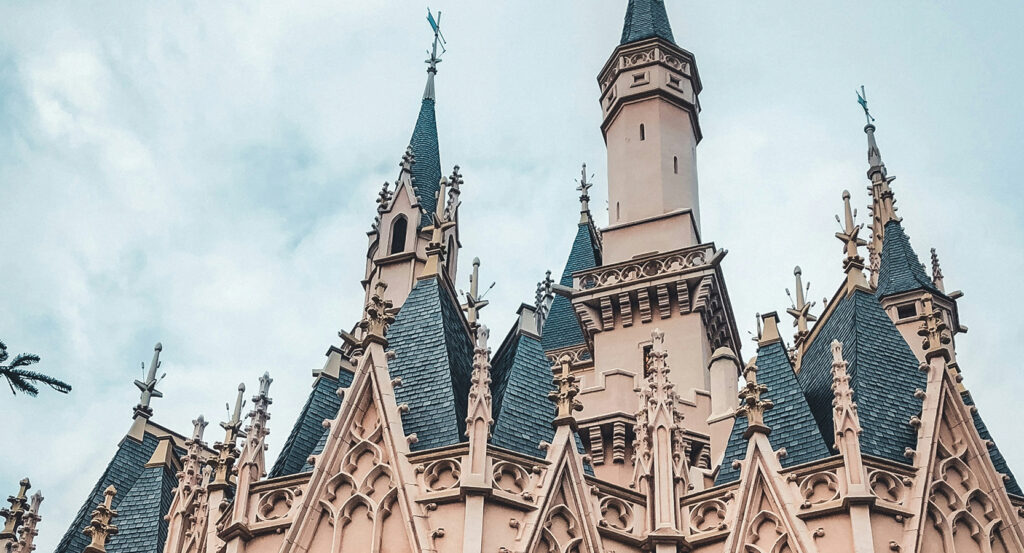
Begin at Western River Railroad, where an authentic steam train departs Adventureland for a circuit through Adventureland, Critter Country and Westernland, carrying its passengers from tropical vegetation into an imagined American West. The journey lasts 15 minutes and accommodates 140 people, turning the railroad into both transportation theater and a moving survey of several landscapes built around nineteenth-century exploration and frontier imagery. Continue to Country Bear Theater, where 18 Audio-Animatronics bears perform country-western music inside a dedicated Westernland auditorium with capacity for 306 people. Its programming preserves an unusual seasonal structure within Tokyo Disneyland: Vacation Jamboree runs through October 31, 2026, followed by Jingle Bell Jamboree from November 1 through January 16, 2027, allowing the same cast of mechanical performers to inhabit changing musical productions during the year. Conclude at Cinderella's Fairy Tale Hall inside Cinderella Castle, where paintings, dioramas and other artworks reconstruct Cinderella's transformation and culminate in the throne room and glass slipper. The attraction turns the park's dominant exterior architectural symbol into an interior exhibition, allowing the castle that organizes distant views across Tokyo Disneyland to become an explorable setting devoted to the 1950 animated film. The progression moves from Western River Railroad's steam-powered journey across multiple themed landscapes through Country Bear Theater's mechanical musical performance into Cinderella's Fairy Tale Hall's inhabitable fairy-tale world, tracing three different techniques through which Tokyo Disneyland converts historical and cinematic references into physical environments.
Where your story begins.
Foresyte Travel reveals places that feel extraordinary long before you arrive.
Enjoy editorial crafted for luxury travelers.
Foresyte may earn a commission when you book.