
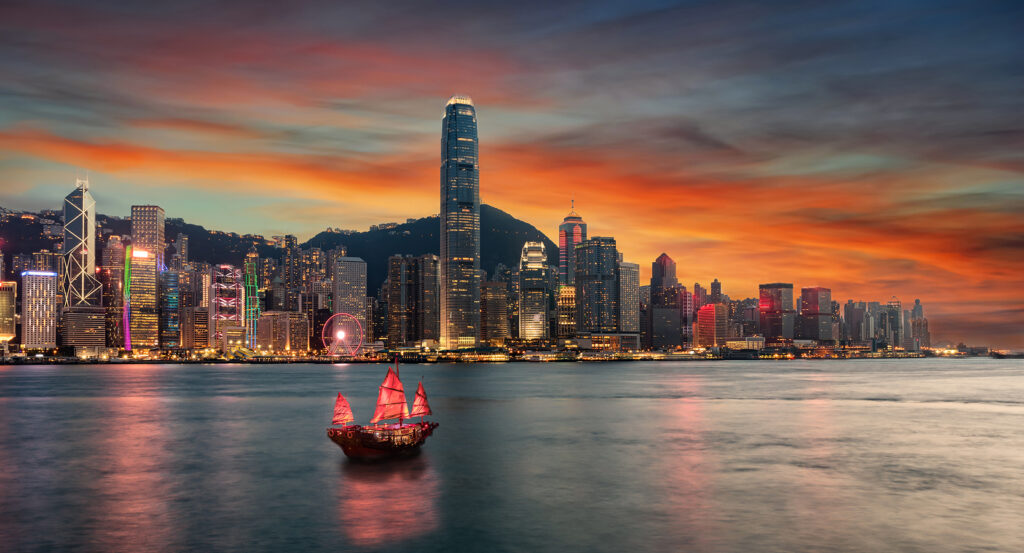
Why you should experience Tsuen Wan in Hong Kong, China.
Tsuen Wan is a transformative urban district where industrial heritage, mountain landscapes, and modern metropolitan development converge at the western gateway to the New Territories.
Towering residential communities, thriving commercial centers, historic temples, waterfront promenades, and forested hillsides create a neighborhood that showcases Hong Kong far beyond its famous island skyline. Originally a collection of fishing villages and market settlements, Tsuen Wan evolved into one of Hong Kong's first major new towns, helping shape the territory's postwar growth and urban expansion. The district balances dense urban development with remarkable access to nature, as mountains, country parks, and coastal scenery frame the cityscape on nearly every side. Shopping centers, transportation hubs, and community institutions serve a large residential population while preserving traces of the area's historic roots. The result is a district that feels both intensely urban and surprisingly connected to the natural environment. To the southeast, Kwai Chung's industrial corridors and transportation infrastructure extend naturally from Tsuen Wan along the western edge of Kowloon, reinforcing the neighborhood's position within Hong Kong's evolving metropolitan landscape. Every waterfront, hillside, and commercial avenue reflects a district shaped by growth, resilience, and transformation.
What you should know about Tsuen Wan.
Tsuen Wan is best known for being Hong Kong's first major satellite new town, a pioneering urban development that transformed the territory's approach to population growth and city planning.
Beginning in the mid-twentieth century, Tsuen Wan became the focus of large-scale residential and industrial development designed to accommodate Hong Kong's rapidly expanding population. The district's success established a model for future new towns throughout the New Territories and helped redefine how the territory approached urban expansion. Factories, housing estates, transportation infrastructure, and commercial centers emerged on a scale previously unseen outside the urban core. The transformation fundamentally altered the area's character while making Tsuen Wan one of the most important chapters in Hong Kong's modern development story. Few districts possess such a significant place in the evolution of the city.
How to fold Tsuen Wan into your trip.
Tsuen Wan works as an exploration of the waterfront landmarks, cultural institutions, and natural landscapes that define one of the New Territories' most important districts.
Begin at Tsuen Wan Waterfront Promenade, where the neighborhood's defining relationship with the harbor and urban development immediately comes into focus. Continue toward Sam Tung Uk Museum, whose preserved Hakka walled village reveals the rural heritage that existed long before the district's modern transformation. From there, make your way to Shing Mun Country Park, where forested trails, reservoirs, and mountain scenery provide a dramatic contrast to the urban environment below. Along the route, you'll encounter shopping districts, historic temples, public parks, waterfront pathways, residential landmarks, and scenic viewpoints that showcase the district's remarkable diversity. The progression moves naturally from modern waterfront to cultural heritage to protected natural landscape, revealing the forces that shaped the neighborhood. Tsuen Wan remains one of the territory's most important urban districts, preserving a remarkable balance between development, history, and nature.
Where your story begins.
Foresyte Travel reveals places that feel extraordinary long before you arrive.
Experience premium editorial crafted for luxury travelers.

















































































































