
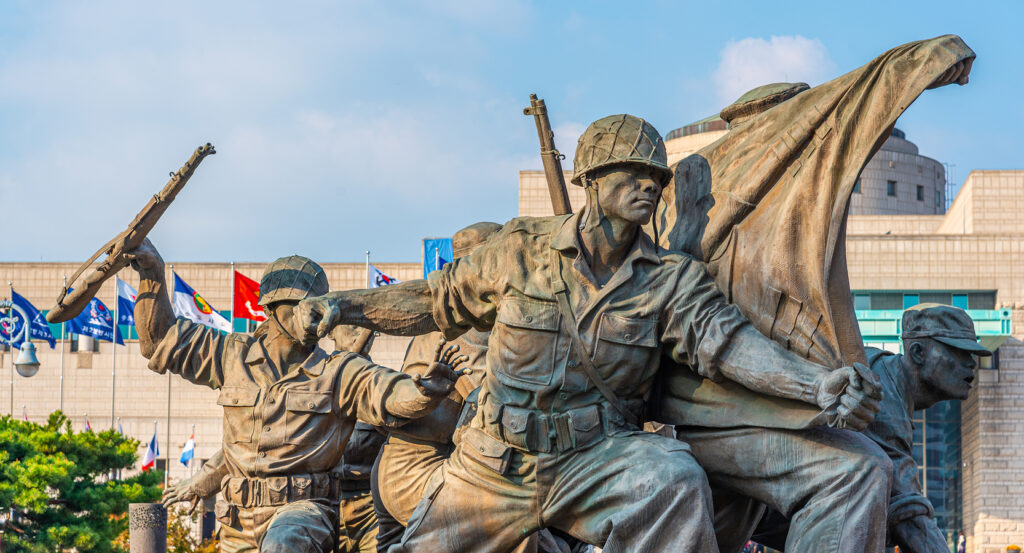
Why you should experience The Memorial Hall at War Memorial of Korea in Seoul, South Korea.
The Memorial Hall at War Memorial of Korea in Seoul is a place where the nation's most defining struggle unfolds not as history on a page, but as a story you can feel in your bones.
From the moment you step inside, the atmosphere shifts. The lighting softens, the air cools, and the distant echo of drums and voices fills the corridor. Dioramas come to life with staggering realism: soldiers crossing the frozen Nakdong River, families fleeing with bundles on their backs, and United Nations troops landing at Incheon under a storm of fire and smoke. Every step through the hall feels cinematic yet deeply human. The scale of the displays, the precision of the uniforms, the photographs and film reels flickering overhead, it all draws you into the heartbeat of 1950, when a divided peninsula fought for survival. This isn't a passive museum experience; it's an act of remembrance, where the silence between sounds carries as much meaning as the exhibits themselves.
What you should know about The Memorial Hall at War Memorial of Korea.
The Memorial Hall occupies the largest and most detailed section of the War Memorial, designed to serve as both documentation and tribute.
It opened in 1994 alongside the main complex and remains one of the most sophisticated war exhibits in Asia. More than 9,000 artifacts are displayed here, from rifles and field maps to letters written from the front lines. But what makes it extraordinary is its narrative structure: the hall is arranged chronologically across seven major galleries, each chronicling a distinct phase of the war, invasion, defense, counterattack, intervention, stalemate, armistice, and reconstruction. Visitors move through the war as if walking through time, guided by immersive installations that blend archival footage, 3D models, and soundscapes of wind, sirens, and whispered dialogue. Among the most haunting displays is the Battle of Incheon Landing Room, where a massive panoramic model replicates General MacArthur's daring amphibious assault, illuminated by synchronized projections. Another standout is the UN Forces Hall, where 16 national flags hang above uniform displays and personal belongings of soldiers from around the world. Few realize that many of these artifacts were donated directly by veterans and their families, turning this hall into a living archive of personal sacrifice. Beyond the military chronology, the final galleries focus on the human cost, black-and-white photographs of refugees, letters written in pencil from makeshift hospitals, and reconstructed trenches where you can stand and hear the echoes of battle. The intention is not performance but empathy, to make visitors understand what war demanded, and what peace ultimately required.
How to fold The Memorial Hall at War Memorial of Korea into your trip.
The Memorial Hall is best experienced with time and openness, it's a place that invites reflection, not haste.
Enter the War Memorial of Korea through Samgakji Station (Exit 12) and allow two hours to explore this section fully. Begin at the Entrance Gallery, where a large relief mural depicts the peninsula before the conflict, whole, unbroken. Move slowly through each phase, reading the placards that pair military detail with human narrative. Don't miss the Incheon Landing Theater, where short films play on a 270-degree curved screen that places you amid the assault itself. Pause in the Letters and Memories Room, a quieter space filled with correspondence and personal effects, photographs, medals, even children's toys found in the rubble. Near the exit, stand before the Wall of Names, engraved with those who fell, both Korean and international. If you can, visit on a weekday morning or late afternoon for a more contemplative atmosphere, when the echoes in the hall feel intimate. Bring water and move gently, it's resonant terrain. Afterward, step outside into the Peace Plaza to watch the sunlight reflect on the memorial pools; the transition from enclosed memory to open air feels intentional, a release from heaviness into hope. The Memorial Hall at War Memorial of Korea in Seoul isn't just a record of conflict, it's a national heartbeat preserved in light and stone, a living space where remembrance and resilience stand shoulder to shoulder.
Where your story begins.
Foresyte Travel reveals places that feel extraordinary long before you arrive.
Experience premium editorial crafted for luxury travelers.

















































































































