
Why Nine-Turn Bridge at Yu Garden matters.
Nine-Turn Bridge is an intricate garden bridge where Shanghai Old City's Jiangnan character meets Qing-era landscape design, shifting water views and the architectural theatre surrounding Yuyuan's central pond.
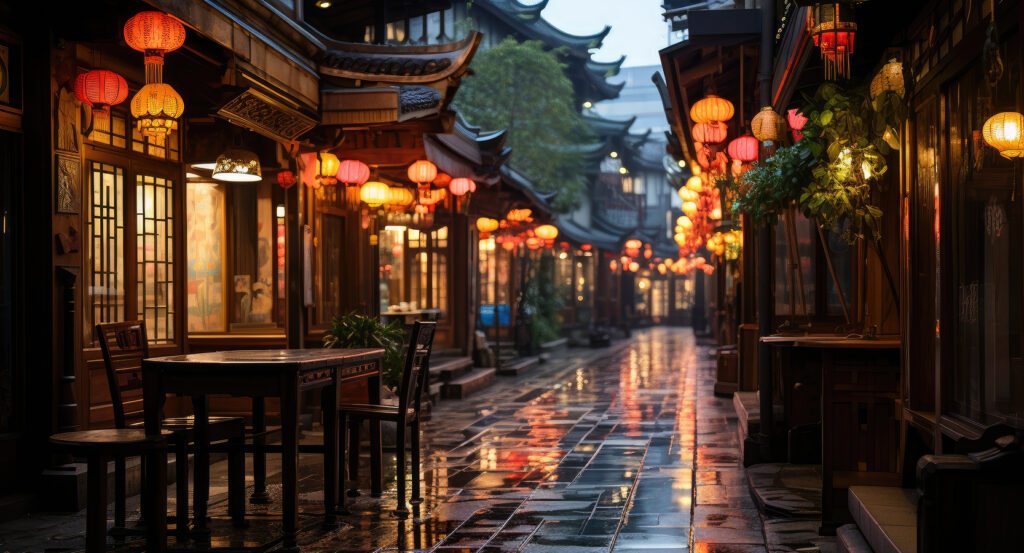
Set within the Yuyuan precinct near Fuyou Road and just beyond the traditional lanes of the former walled city, the bridge crosses the pond at the heart of a dense architectural quarter between Yuyuan Garden, the temple district and the commercial streets extending east toward the Huangpu River, with the Bund rising beyond the Old City to the northeast. Repeated angular changes break the crossing into short segments, preventing the water, roofs and surrounding façades from resolving into a single uninterrupted view. Koi and turtles animate the pond beneath the stone-edged path, bringing movement directly below the compressed succession of turns. After dark, illuminated eaves and reflected light multiply across the water, transforming the same tight geometry into a more theatrical sequence of rooflines, lanterns and mirrored surfaces. The result is a compact Shanghai crossing whose deliberate changes of direction make movement itself part of the composition, compressing water, architecture and Old City density into one of Yuyuan's most recognizable spatial encounters.
What defines Nine-Turn Bridge at Yu Garden.
Nine-Turn Bridge is best known for translating a traditional Chinese garden device into a 104-meter crossing whose apparent simplicity conceals a far more complicated geometry. The structure originated during the Qing dynasty under the Qianlong Emperor as a wooden bridge and belonged to the landscape surrounding the pavilion later known as Huxinting. Fire destroyed the wooden structure in the 1920s, after which reconstruction in cement preserved the angular route in a more durable form. Despite its English name, the present crossing does not contain nine literal turns: one section contains seven and another eight, producing fifteen bends across the full route. Its neighboring pavilion had already undergone its own major transformation in 1784, when the former Fuyi Pavilion was rebuilt and renamed Huxinting, meaning Pavilion in the Heart of the Lake. The surrounding garden had entered a broader revival in 1760 when Shanghai gentry and merchants pooled funds to purchase and reconstruct the deteriorated Yuyuan estate, eventually transferring it to the adjacent temple and completing the principal restoration by 1784. Later warfare damaged the garden again, and guild organizations financed further repairs during the Tongzhi period between 1862 and 1875, when teahouses, restaurants and commercial activity increasingly occupied the precinct. The bridge survives not as an isolated ornamental object but as part of a Qing-era reworking of Yuyuan that transformed a private Ming garden into one of Shanghai's enduring public commercial and social centers.
Lotus patterns mark the entrances to the bridge sections before a sequence of carved flowers turns the crossing into a calendar underfoot. Narcissus represents January, apricot blossom February and peach March, followed by azalea, peony and gardenia through the first half of the year. Lotus takes July before osmanthus, chrysanthemum and hibiscus carry the sequence through October, with camellia and plum blossom closing November and December. The floral cycle gives individual bends their own iconography even as the bridge continuously redirects sightlines across the pond. Its zigzag form belongs to a much older Chinese garden tradition in which angled crossings multiply the number of scenes encountered over a short distance, turning a functional route into a device for viewing water, planting and architecture from successive positions. Nine operates symbolically within the bridge's character rather than as a literal inventory of corners, carrying longstanding associations with auspiciousness and completeness in Chinese culture. The crossing joins geometric movement and seasonal imagery at pedestrian scale, making the path across the pond function simultaneously as circulation, ornament and a controlled sequence of changing views.
How Nine-Turn Bridge at Yu Garden fits.
Nine-Turn Bridge works as the garden anchor for a Shanghai Old City outing connecting the protective cult of the historic county seat, a Confucian institution founded when Shanghai became a county and the surviving fortification that once enclosed the Chinese city.
Begin at City God Temple of Shanghai, whose origins reach to an earlier shrine dedicated to the spirit of Jinshan before conversion into a City God Temple in 1403 during the Yongle Emperor's reign. Qin Yubo, a Yuan official who initially resisted summons to serve the newly established Ming court, became one of Shanghai's city gods after his death, and Qing general Chen Huacheng later joined the temple's protective pantheon after dying during the defense of Shanghai in the First Opium War. Religious traffic drew merchants around the complex, gradually turning the temple surroundings into a commercial district inseparable from the Old City. Continue to Shanghai Confucian Temple, founded in 1294 after Shanghai's elevation to county status and historically paired with the county's principal institution of Confucian learning. Repeated relocations and rebuilding culminated in the present Wenmiao Road complex in 1855 after the Small Swords Society had occupied the earlier temple as its headquarters from 1851 to 1855 and warfare devastated the site. The surviving complex covers more than 10,000 square meters, preserving Shanghai's connection between Confucian ritual, scholarship and civic education across more than seven centuries. Conclude at Shanghai Old City Wall and Dajing Taoist Temple, where fortifications rose in 1553 as coastal raids threatened a city that had previously developed. A Guan Yu temple appeared on the northern archery platform during the Wanli period, a three-story pavilion followed in 1815 and Governor-General Chen Luan supplied the inscription that gave Dajing its name in 1836. Most of the wall disappeared after the 1911 Revolution, yet the Dajing section survived because the demolition command occupied the temple above it, leaving 50 meters of masonry from the boundary that had enclosed old Shanghai for centuries. The progression moves from the divine protection of the county through the institution that joined ritual with formal learning and culminates at the physical defenses built against sixteenth-century attack, placing Nine-Turn Bridge within the religious, intellectual and fortified city from which modern Shanghai expanded.
Where your story begins.
Foresyte Travel reveals places that feel extraordinary long before you arrive.
Enjoy editorial crafted for luxury travelers.
Foresyte may earn a commission when you book.

















































































































