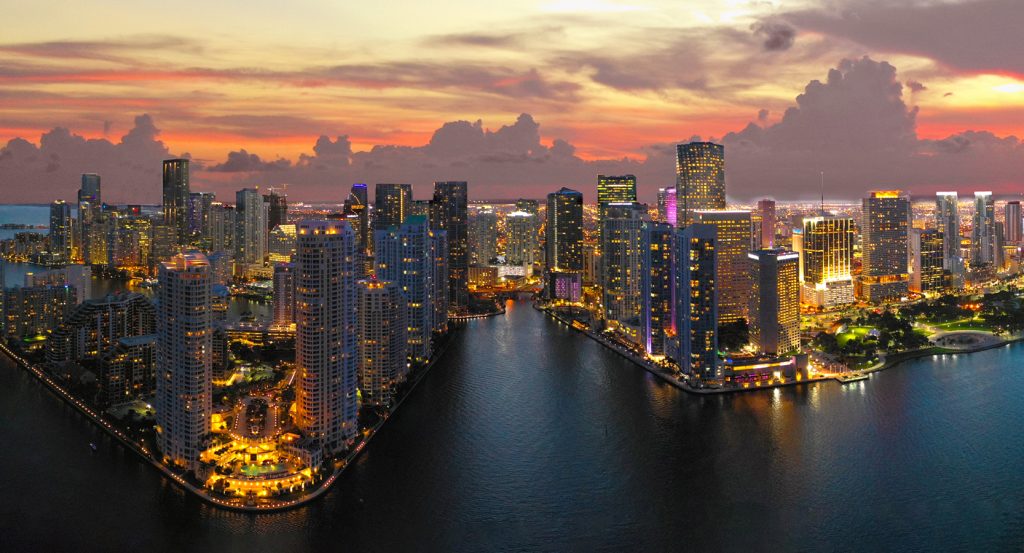
Why you should experience 163rd Street in Miami, Florida.
163rd Street is a cosmopolitan corridor where North Miami Beach's international communities, commercial prominence, healthcare institutions, and coastal accessibility converge along one of northern Miami-Dade County's defining east-west thoroughfares.
Running through North Miami Beach between Miami Gardens and North Miami Beach's eastern waterfront, the corridor links longstanding shopping districts, medical campuses, municipal institutions, parks, and diverse neighborhoods that collectively reflect decades of suburban growth and international immigration. Broad landscaped medians, mature royal palms, neighborhood businesses, civic buildings, and active commercial corridors create a streetscape where regional commerce remains closely connected with community life. Throughout the corridor, cultural diversity, entrepreneurial activity, and regional accessibility reinforce an environment shaped by sustained economic growth and evolving international influence. The result is an experience defined by multicultural vitality, commercial distinction, and one of northern Miami-Dade County's most influential urban corridors.
What you should know about 163rd Street.
163rd Street is best known for following the alignment of Northwest 163rd Street, a principal arterial that became a focal point of northern Miami-Dade County's suburban expansion following World War II, supporting rapid residential and commercial development throughout the 1950s and 1960s. The corridor passes through North Miami Beach, incorporated in 1926 as the Town of Fulford before adopting its present name in 1931, while the opening of 163rd Street Mall in 1956 established one of South Florida's earliest regional shopping centers before its later redevelopment as The Village at Gulfstream Park and surrounding commercial districts reshaped retail activity across the area. Nearby Jackson North Medical Center, opened in 1991 within the Jackson Health System, expanded regional access to emergency medicine, cardiovascular services, trauma care, and graduate medical education, while Florida Memorial University, founded in 1879, remains South Florida's only historically Black university. Royal palms, live oaks, gumbo limbo, sea grapes, white ibis, monk parakeets, and subtropical landscaping continue contributing to the corridor's ecological character alongside established commercial boulevards and civic institutions.
International commerce has continued expanding through Caribbean food importers, Latin American wholesalers, Middle Eastern specialty retailers, Haitian-owned businesses, and professional service firms whose investments reflect successive decades of immigration shaping North Miami Beach's commercial identity. Healthcare employment has similarly broadened through outpatient treatment centers, specialty physician practices, rehabilitation providers, diagnostic laboratories, and medical support companies that reinforce the corridor's importance beyond traditional retail activity. Hospitality businesses, financial institutions, logistics companies, and technology service providers have further diversified the local economy while strengthening 163rd Street's longstanding role as a regional commercial destination. Together, these international business networks, healthcare industries, and professional enterprises demonstrate how 163rd Street continues expressing North Miami Beach's enduring importance as a center of commerce, employment, and multicultural enterprise.
How to fold 163rd Street into your trip.
163rd Street works as an exploration of North Miami Beach's natural landscapes, architectural heritage, and waterfront setting.
Begin at Ancient Spanish Monastery, where twelfth-century Romanesque and Gothic stone structures reconstructed in South Florida introduce centuries of architectural history unlike anywhere else in the region. Continue to Greynolds Park, where hardwood hammocks, mangrove habitat, Civilian Conservation Corps improvements, and the Oleta River reveal the natural landscapes that long preceded suburban development. Conclude at Oleta River State Park, where tidal mangrove forests, Biscayne Bay, kayaking trails, and protected coastal ecosystems provide the historical culmination by preserving the shoreline environment that continues defining North Miami Beach. The progression moves naturally from medieval architecture through preserved inland landscapes before concluding within Florida's largest urban state park, revealing why 163rd Street remains deeply connected to North Miami Beach's cultural and environmental identity.
Where your story begins.
Foresyte Travel reveals places that feel extraordinary long before you arrive.
Experience premium editorial crafted for luxury travelers.