Why 22nd Street matters.
22nd Street is a refined corridor where Logan Square's civic grandeur, cultural ambition, architectural distinction, and institutional legacy define one of Center City's most distinguished north-south streets.
Running through Logan Square between Fairmount and Graduate Hospital, the corridor connects grand civic institutions, celebrated museums, historic residential blocks, and park-lined boulevards that collectively reflect Philadelphia's evolution through City Beautiful planning, transportation investment, and cultural leadership. Successive blocks reveal how nineteenth-century expansion, civic planning, and architectural ambition established an avenue whose historic fabric continues shaping western Center City. Monumental public buildings, Beaux-Arts architecture, mature tree canopies, and historic rowhouses document more than a century of urban development. The result is an experience defined by elegance, continuity, and one of Philadelphia's most distinguished corridors.
What you should know 22nd Street.
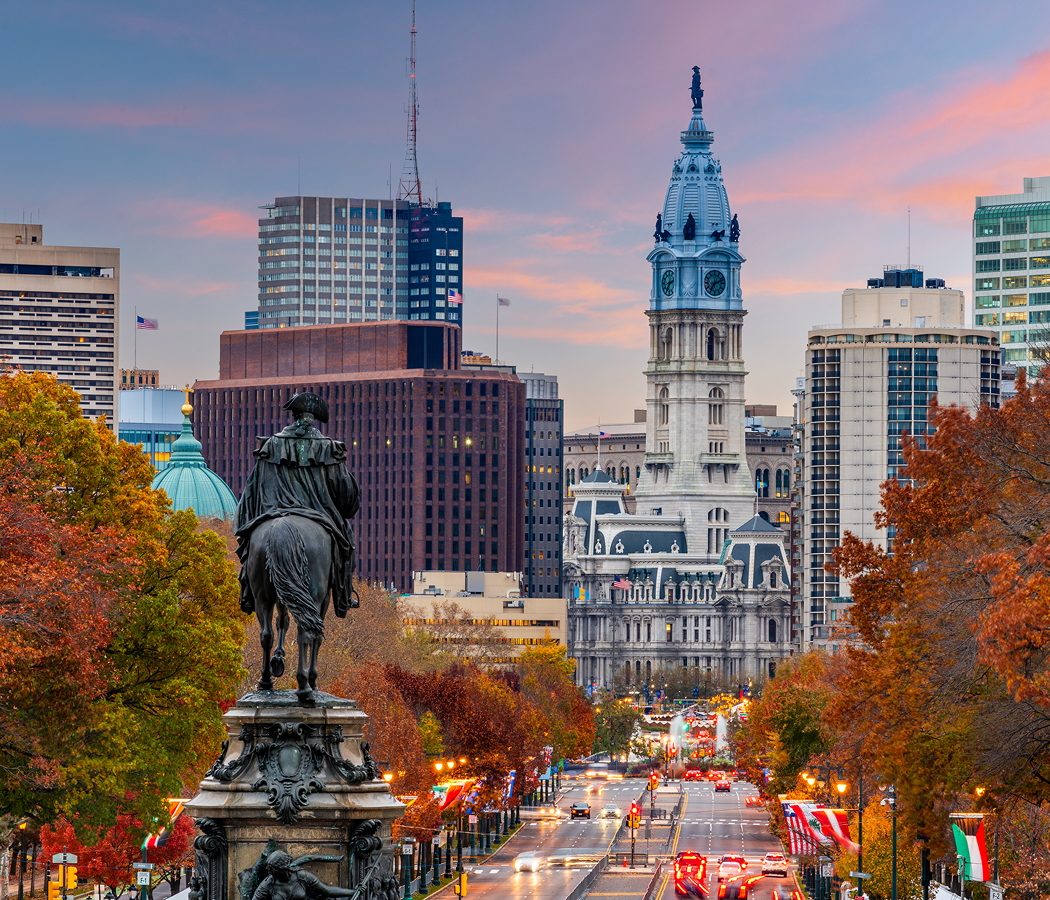
22nd Street is best known for developing during Philadelphia's westward expansion following the Act of Consolidation of 1854, when residential growth and civic investment transformed land west of the original city into one of Center City's most architecturally significant districts. Horse-drawn streetcars and later electric service operated by the Union Traction Company and Philadelphia Rapid Transit Company connected the corridor directly with commercial districts, encouraging sustained residential construction while supporting museums, churches, professional offices, and neighborhood commerce. Implementation of the City Beautiful movement during the late nineteenth and early twentieth centuries reshaped surrounding blocks through construction of the Benjamin Franklin Parkway, establishing a grand civic axis that strengthened the corridor's relationship with Philadelphia's leading cultural institutions. Builders introduced distinguished collections of Beaux-Arts, Georgian Revival, Colonial Revival, and Classical Revival architecture characterized by limestone façades, brick masonry, granite bases, grand porticos, decorative cornices, carved stone ornamentation, bronze detailing, and finely crafted interiors that reflected Philadelphia's exceptional civic ambitions. Together, transportation investment, civic planning, architectural craftsmanship, institutional expansion, and sustained residential development established 22nd Street as one of Logan Square's defining corridors.
Designation of surrounding portions of the Parkway Historic District and neighboring historic resources reinforced long-term preservation of Philadelphia's nationally significant civic landscape while protecting grand architecture associated with the Benjamin Franklin Parkway. Continued investment in Logan Square, nearby museums, public gardens, and pedestrian infrastructure strengthened the corridor's role as an important connection between Center City, Fairmount, and the Schuylkill River while improving accessibility throughout the district. Ongoing rehabilitation has preserved original limestone façades, granite detailing, ornamental ironwork, masonry streetscapes, decorative cornices, and mature tree-lined blocks that continue expressing the craftsmanship established during the corridor's principal era of development. Together, historic preservation, civic investment, and sustained architectural stewardship demonstrate how 22nd Street continues expressing the cultural, institutional, and architectural legacy that distinguishes Logan Square today.
How 22nd Street fits.
22nd Street works as an exploration of Philadelphia's civic architecture, cultural heritage, and grand planning.
Begin at The Franklin Institute, where one of America's premier science museums introduces Philadelphia's longstanding commitment to scientific discovery and public education before naturally leading toward the city's grand civic boulevard. Continue to Rodin Museum, where one of the world's finest collections of Auguste Rodin's work expands the experience through exceptional Beaux-Arts architecture and sculpture before guiding the journey farther along the Parkway. Conclude at Cathedral Basilica of Saints Peter and Paul, where grand Roman Catholic architecture provides the historical payoff by illustrating the civic and spiritual aspirations that accompanied Philadelphia's emergence as a great American city. Together, the sequence traces the city's evolution through science, art, and grand civic design.
Where your story begins.
Foresyte Travel reveals places that feel extraordinary long before you arrive.
Enjoy editorial crafted for luxury travelers.
Foresyte may earn a commission when you book.