Why you should experience Times Square in New York.
Times Square is the electric core of New York itself, where light, motion, and human energy collide in perpetual crescendo.
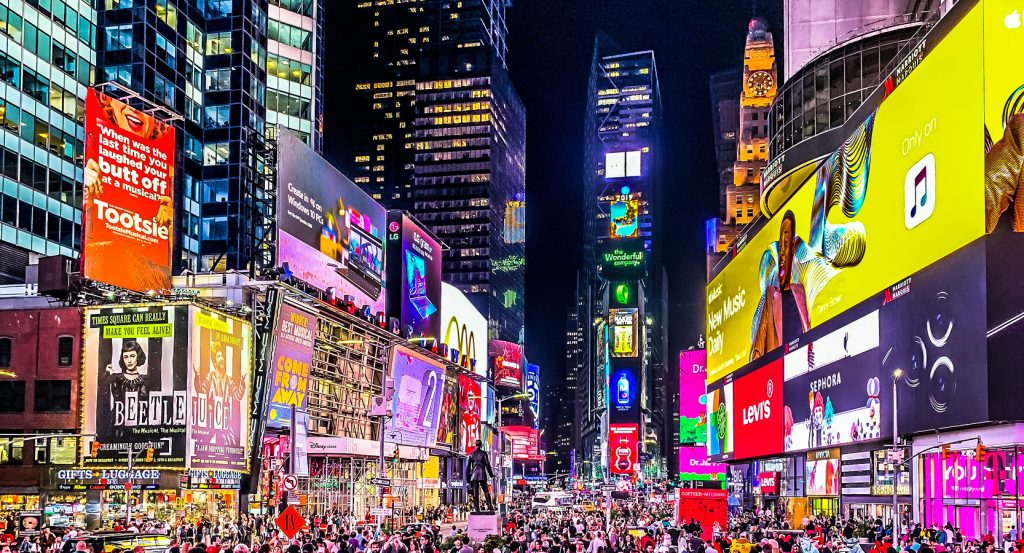
Framed by towering screens and pulsing neon is where the city's restless soul reveals itself, loud, luminous, and unapologetically alive. Once the site of horse stables and early theaters, it became a symbol of modern spectacle after the New York Times moved its headquarters here in 1904, giving the plaza its name. Today, it's a constant sensory symphony: the glow of LED billboards stretching toward the night sky, the distant honk of cabs mingling with street performers' laughter, and a river of people flowing through the crossroads of Broadway and Seventh Avenue. More than 300,000 visitors pass through daily, each carrying a story that briefly merges into the collective hum. Times Square isn't about subtlety, it's about presence. Beneath the surface of its chaos lies something deeper: a shared human electricity that binds millions of fleeting moments into one unforgettable pulse.
What you didn’t know about Times Square.
Behind the glare of the screens lies a story of reinvention as bold as the lights themselves.
Times Square began as Longacre Square, an unassuming district of carriage builders and small shops, before transforming into the epicenter of the theater world in the early 20th century. It shone brightest during the Jazz Age, when marquees glittered and Broadway defined glamour, but by the 1970s, that sparkle had dimmed. The neighborhood descended into neglect, marked by shuttered theaters and crime. In the decades that followed, a massive civic and private partnership undertook one of the most ambitious urban revitalizations in U.S. history. Today's Times Square stands as a testament to that turnaround, a triumph of design, safety, and spectacle that redefined how cities can resurrect themselves. Its LED displays now cover more than 50 million pixels, and the pedestrian plazas, introduced in the 2000s, turned chaos into choreography. But its magic isn't just the technology or the architecture, it's the way it reflects us. Each screen is a mirror of ambition and excess, of dreams projected sky-high. Times Square's history is proof that even the loudest spaces can hold the quiet story of resilience.
How to fold Times Square into your trip.
To experience Times Square is to surrender, to let the current of the city carry you through its radiant heartbeat.
Visit just before dusk, when daylight fades and the lights begin their nightly bloom, transforming glass and steel into a kaleidoscope. Stand in the center of the plaza, near the red TKTS steps, and let the sensory rush wash over you, the flashes of color, the pulse of the crowd, the distant rhythm of street musicians. Step into a Broadway theater for a show, or slip into one of the historic restaurants or rooftop bars that overlook the chaos below. Early risers can come at dawn, when the lights still glow but the crowds have thinned, a rare, almost sacred calm before the day begins. If you're visiting on New Year's Eve, brace for the spectacle of a lifetime: the iconic ball drop, fireworks, and the united cheer of hundreds of thousands counting down as one. Times Square in New York City isn't just a destination, it's the epicenter of possibility, a place where anonymity and connection meet under a billion-watt sky.
Hear it from the Foresyte community.
Just enough life around you not to be overwhelming. Right pace.
Where your story begins.
Start your planning journey with Foresyte Travel.
Experience immersive stories crafted for luxury travelers.