
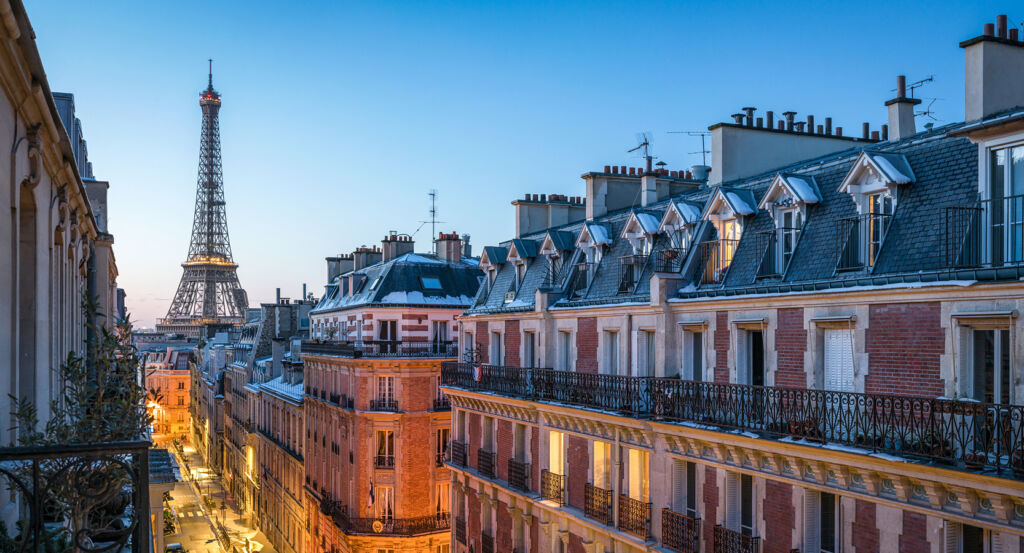
Why you should experience Hôtel Sacha in Paris, France.
Hôtel Sacha is a theatrical boutique hotel where Rochechouart's performance culture, Sacha Guitry's prolific stage career and Julie Gauthron's scenographic interiors converge inside a house conceived as an unfolding Parisian play.
Set along Rue de Navarin near Rue des Martyrs and just below the slopes of Montmartre, the four-star property emerged in October 2015 after artist and interior architect Julie Gauthron completely reimagined the existing hotel around the theaters of the 9th Arrondissement. Gauthron structured the interiors like a production in successive acts, transforming guestrooms into miniature theaters through alcove compositions, velvet stage curtains, spectator-patterned headboards, trompe-l'oeil bookcases and individually sourced antique furniture. Corridors operate like passages toward theater boxes through a collection of performance posters, engravings and photographs assembled by the hotel's owner, while the lobby references an interwar Parisian interior and the glass-roofed salon becomes a winter garden. The result is a property where theatrical history is not simply decorative inspiration, but the organizing architecture of the entire Hôtel Sacha experience.
What you should know about Hôtel Sacha.
Hôtel Sacha is best known for reopening in October 2015 after artist and interior architect Julie Gauthron transformed the property into a four-star boutique hotel conceived as a theatrical production, originally documenting 50 individually decorated guestrooms arranged like miniature auditoriums with a stage side, audience side, heavy velvet curtains and spectator imagery positioned behind the beds. Gauthron extended the scenography through yellow, blue, red and green palettes, flea-market furniture, contrasting tapestries and trompe-l'oeil bathroom libraries, while the owner personally assembled the theater posters, engravings and photographs installed throughout the corridors. The hotel's character directly honors playwright, actor and filmmaker Sacha Guitry, whom the property credits with 124 plays and 36 films, translating his biography into the building by dedicating its five floors respectively to his five actress wives, Charlotte Lyses, Yvonne Printemps, Jacqueline Delubac, Geneviève Guitry and Lana Marconi. A central staircase develops this biographical program through a portrait gallery devoted to the Guitry saga, while the public rooms continue Gauthron's chronology through an interwar-style lobby, a breakfast room modeled on a bohemian café and a glass-roofed winter garden. The original 50-room 2015 project has since evolved into a documented 40-room inventory, demonstrating that Hôtel Sacha's current scale has changed while Gauthron's theatrical structure and the Guitry narrative remain fundamental to the house.
Caroline Burgeot developed Julie Gauthron's original scenography into a recurring performance ritual by introducing a nightly 6:30 p.m. intermission announced with the same style of bell used in theaters, followed during the opening period by Champagne and petits fours until 8 p.m. Burgeot extended that production beyond the intermission through a 100-percent French honesty bar created with a neighboring wine merchant, while Hôtel Sacha incorporated a collection of antique theater binoculars among the objects reinforcing the backstage narrative. Julie Gauthron carried the same theatrical logic into the guestrooms by turning stage curtains into bed canopies and positioning imaginary spectators behind the headboards, an approach consistent with a hospitality portfolio that also includes Hôtel Crayon, Idol Hotel and Hôtel Exquis. Together, Caroline Burgeot, Julie Gauthron and Sacha Guitry transformed the property's theatrical premise from visual decoration into a coordinated narrative of scenography, collected artifacts, performance ritual and biographical storytelling.
How to fold Hôtel Sacha into your trip.
Hôtel Sacha works as the anchor for an afternoon tracing Romantic painting, Symbolist collecting and nineteenth-century performance culture through the artistic neighborhoods below Montmartre.
Begin at Musée Gustave Moreau, where Symbolist painter Gustave Moreau transformed his family residence during the 1890s by commissioning architect Albert Lafon to create immense upper-floor studios capable of preserving the thousands of paintings, watercolors and drawings he intended to leave as a unified artistic legacy. Continue to Musée de Montmartre, occupying historic buildings associated with the artistic life of the hill and preserving collections that reconstruct the neighborhood's cabarets, studios, posters and bohemian culture. Conclude at Théâtre de l'Atelier, whose Place Charles-Dullin auditorium preserves the theatrical character of Montmartre through a performance history extending from the nineteenth century into the influential directorship of actor and director Charles Dullin. The progression moves from Moreau's deliberately preserved private universe through Montmartre's artistic memory into a working theater shaped by Dullin, creating a cultural sequence that gives Hôtel Sacha's own transformation of biography, collecting and performance into interior design a broader Parisian context.
Where your story begins.
Foresyte Travel reveals places that feel extraordinary long before you arrive.
Experience premium editorial crafted for luxury travelers.














































































































