
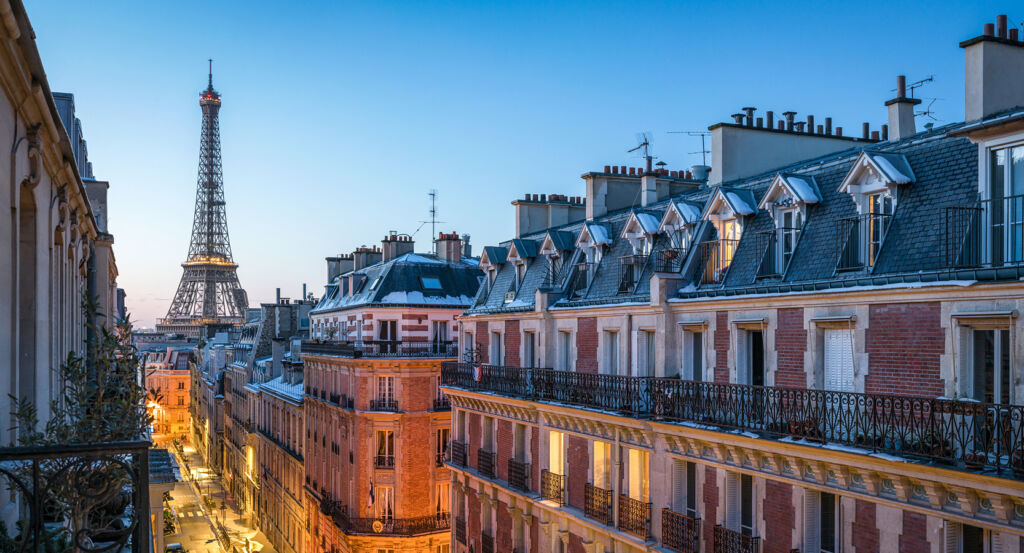
Why you should experience Hôtel Le Cardinal Paris in Paris, France.
Hôtel Le Cardinal Paris is a cultured four-star hotel where Saint-Georges's theatrical experimentation, Romantic artistic inheritance, Belle Époque performance culture and contemporary creative energy converge within a newly reimagined exploration of France's natural landscapes.
Set along Rue du Cardinal Mercier near Rue de Clichy and just steps from Théâtre de l'Œuvre, the 80-room hotel emerged from a complete 2025 renovation directed by Arnaud Basselier of BJA Architecture and Laure Zucconi of DZArchitecture around eight chromatic environments representing different regions of France. Colorist-designer Virginie Lagerbe of Atelier Peregreen developed plant-based dyes applied to linen and wool, while oak, chosen for its presence across French regions, creates a material thread connecting guestrooms, lounges and a cabinet-of-curiosities meeting space. The concept acquires particular resonance on a short cul-de-sac opened in 1879 across the former site of Clichy debtors' prison and renamed in 1926 for Belgian cardinal Désiré-Joseph Mercier, while the surrounding Saint-Georges quarter formed part of Nouvelle Athènes, the nineteenth-century artistic district associated with figures including Eugène Delacroix, George Sand and Frédéric Chopin. The result is a hotel where botanical color, French geography and contemporary architectural authorship meet the artistic and theatrical inheritance of one of the ninth Arrondissement's most culturally concentrated quarters.
What you should know about Hôtel Le Cardinal Paris.
Hôtel Le Cardinal Paris is best known for completing a comprehensive renovation in 2025 under Arnaud Basselier of BJA Architecture and Laure Zucconi of DZArchitecture, transforming an 80-room property into eight chromatic environments inspired by the cardinal directions and regional landscapes of France. Virginie Lagerbe, colorist-designer of Atelier Peregreen, developed the project's plant-derived palette from botanical dyes whose differing behavior across linen and wool produces the rooms' chromatic variations, while oak serves as a ninth harmony connecting the accommodations, lounges and meeting space. The redesign extends into a 360-degree immersive room projecting French landscapes and bespoke scented candles produced by Pot de Senteur, translating the geographic concept across color, material, image and fragrance. The property occupies 3 Rue du Cardinal Mercier, a 109-meter cul-de-sac opened in 1879 as Rue Nouvelle on the former site of the Hôtel du Baron Saillard, which became the Clichy debtors' prison in 1826 before imprisonment for debt was abolished in 1867 and the prison demolished, while architect Jacques Drevet designed buildings at the street entrance. The street received its present name in 1926 for Belgian cardinal Désiré-Joseph Mercier, placing the hotel's contemporary French-geographic concept within an address carrying its own unusually compressed nineteenth and twentieth-century history.
Saint-Georges provides a deeper cultural structure through Nouvelle Athènes, the name journalist Adolphe Dureau de la Malle applied in the Journal des Débats on October 18, 1823 to the developing artistic quarter on the lower slopes of Montmartre. Jean de la Peyrière and architect Léopold-Auguste Constantin began parceling surrounding land in 1819 and 1820, while Alexandre Delessert and Louis Nicolas Hubert Lavocat received royal authorization to open Rue Chaptal in 1825 and entrepreneur Wormser acquired the future Ary Scheffer property there in 1829. Scheffer moved into the house in July 1830 and established two north-facing studios where his Friday gatherings later brought together Eugène Delacroix, Franz Liszt, Frédéric Chopin, Pauline Viardot, Charles Dickens and George Sand, while Théodore Rousseau exhibited his Salon-rejected La Descente des vaches there in 1835. Nouvelle Athènes, Ary Scheffer, Adolphe Dureau de la Malle and the creative network surrounding Rue Chaptal establish the historical culture of artistic experimentation that still distinguishes Hôtel Le Cardinal Paris's immediate quarter.
How to fold Hôtel Le Cardinal Paris into your trip.
Hôtel Le Cardinal Paris works as the anchor for an afternoon tracing theatrical rebellion, Romantic artistic sociability and the performance culture that developed around Saint-Georges.
Begin at Théâtre de l'Œuvre, where Aurélien Lugné-Poe formed his Symbolist company with encouragement from Nabis Maurice Denis, Édouard Vuillard and Pierre Bonnard, staged Maurice Maeterlinck's Pelléas et Mélisande in 1893 and introduced Alfred Jarry's Ubu roi in 1896 before permanently establishing L'Œuvre in the former Salle Berlioz in 1912. Continue to Musée de la Vie Romantique, where Ary Scheffer settled in 1830 and created two north-facing studios that hosted Delacroix, Liszt, Chopin, Pauline Viardot, Rossini, Tourgueniev and Dickens during the celebrated Friday gatherings held between 1831 and 1858, with the property later becoming the Musée de la Vie Romantique in 1987. Conclude at Casino de Paris, where a recreational site established for the Duc de Richelieu in 1730 evolved through the Tivoli amusement garden and an 1880 Palace theater before Léon Volterra introduced a modern revue in 1917 featuring Gaby Deslys and Harry Pilcer, followed by Mistinguett, Maurice Chevalier and Joséphine Baker, who created J'ai deux amours there in 1930. The progression moves from Lugné-Poe's Symbolist experimentation through Scheffer's Romantic salon into the large-scale revue culture of Volterra, Mistinguett and Baker, revealing successive generations of artistic invention surrounding Hôtel Le Cardinal Paris.
Where your story begins.
Foresyte Travel reveals places that feel extraordinary long before you arrive.
Experience premium editorial crafted for luxury travelers.














































































































