
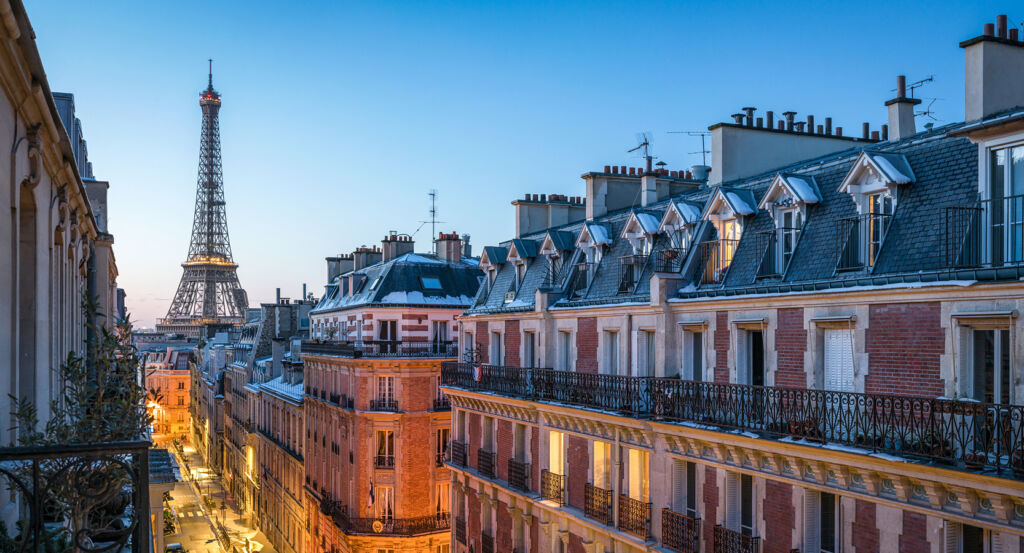
Why you should experience Hôtel Bel Ami in Paris, France.
Hôtel Bel Ami is a literary five-star hotel where Saint-Germain-des-Prés's publishing heritage, intellectual mythology, artistic independence and culture of conversation converge inside the former printing house associated with one of Guy de Maupassant's defining novels.
Set along Rue Saint-Benoît near Boulevard Saint-Germain and just steps from Place Saint-Germain-des-Prés, the hotel occupies a nineteenth-century building whose printing presses produced Bel-Ami in 1885, giving the property's name a direct relationship with the address itself. Architect Philippe Maidenberg translated that history into the original 2000 hotel through contemporary interiors and an illuminated suspension carrying words by Maupassant, while later work by Pascal Allaman introduced natural oak, lacquered glass and graphic lines across the accommodations. Books and art remain embedded throughout the public spaces, allowing the building's publishing past to persist as an active design language. The result is a hotel where Maupassant's fiction, Maidenberg's visual wit and Allaman's quieter contemporary style make Saint-Germain-des-Prés's literary character physically inseparable from the experience of staying there.
What you should know about Hôtel Bel Ami.
Hôtel Bel Ami is best known for occupying the nineteenth-century former printing house that produced Guy de Maupassant's Bel-Ami in 1885 before Philippe Maidenberg converted the building into a contemporary hotel completed in 2000, even creating an illuminated literary installation that embedded Maupassant's words directly into the interior architecture. The novel itself appeared in serial form in Gil Blas before its 1885 book publication and follows Georges Duroy's ascent through journalism, money, seduction and political influence, giving the hotel's adopted character considerably more substance than a borrowed literary title. The property now contains 102 accommodations divided among 92 rooms, five suites and five apartments, with architect Pascal Allaman redesigning them through natural-oak bedside tables, lacquered-glass surfaces, high mattresses and restrained graphic lines. Allaman's recent renovation draws upon Japanese sliding-panel ergonomics, 1950s artistic references, 1970s accents and visual echoes of the former printing works, allowing the current rooms to continue a design narrative initiated by Maidenberg more than two decades earlier.
Salon Maupassant extends the literary premise into a 105-square-meter gathering space accommodating as many as 80 people, while Salon 1885 explicitly carries the publication year of the novel into the hotel's contemporary social program. Chef Romain Marvier gives another dimension to that sociability through the property's Sunday brunch, while the restaurant and bar occupy a naturally illuminated interior organized around a large library, collected objects and a glass roof. Calma Paris currently shapes Hôtel Bel Ami's wellness program through the spa and fitness space, adding a contemporary partnership to a property whose earlier subterranean spa paid tribute to Parisian alchemist Nicolas Flamel. Together, Philippe Maidenberg, Pascal Allaman, Romain Marvier and Calma Paris continue the creative layering begun by the 1885 printing house, allowing literature, interior architecture, gastronomy and wellness to evolve around the same unusually durable narrative identity.
How to fold Hôtel Bel Ami into your trip.
Hôtel Bel Ami works as the anchor for an afternoon moving from medieval intellectual power through Romantic artistic independence into the material craftsmanship of France itself, a progression unusually concentrated within Saint-Germain-des-Prés.
Begin at Église Saint-Germain-des-Prés, founded in 543 and rebuilt across successive centuries, where thirteenth-century conventual work and Pierre de Montreuil's Sainte-Chapelle-inspired abbey chapel preserve the architectural memory of the institution around which the surrounding quarter developed. Continue to Musée national Eugène-Delacroix, where Delacroix moved in December 1857, commissioned his own garden studio, worked there until his 1863 death and was ultimately preserved through the Société des Amis d'Eugène Delacroix formed around painter Maurice Denis. Conclude at Monnaie de Paris, founded under Charles the Bald in 864 and installed on Quai de Conti in 1775 inside Jacques-Denis Antoine's purpose-built palace and manufacture, which remains Paris's last operating factory and continues centuries-old metalworking traditions. The progression moves from the abbey that generated Saint-Germain through Delacroix's fiercely personal studio into a manufacturing institution spanning more than eleven centuries, revealing the scholarship, artistic authorship and skilled making that give Hôtel Bel Ami's literary world its deeper Left Bank context.
Where your story begins.
Foresyte Travel reveals places that feel extraordinary long before you arrive.
Experience premium editorial crafted for luxury travelers.














































































































