
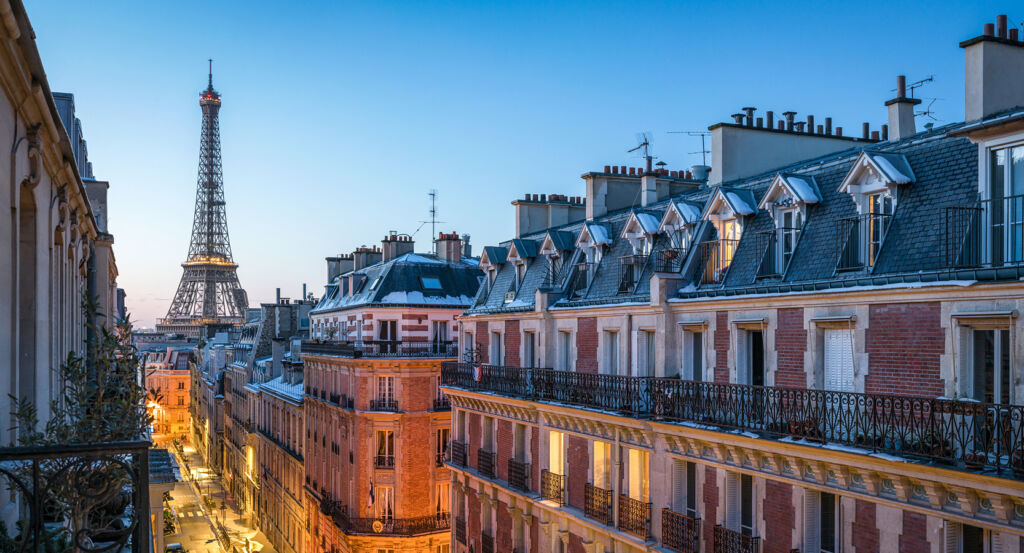
Why you should experience Hôtel Armoni in Paris, France.
Hôtel Armoni is a cocooning four-star hotel where Ternes's discreet affluence, residential calm, fashion consciousness and polished professional rhythm converge within a secluded design address conceived around the physical pleasures of material and color.
Set along Villa Berthier near Avenue de Villiers and just steps from Porte de Champerret, the hotel opened in 2013 after Elegancia Hotels commissioned interior architect Oscar Ono to transform 45 rooms through leather, velvet, satin, silk and a deliberately warm spectrum of copper, bronze, chocolate, beige and anthracite. Natural-oak parquet anchors the lobby and breakfast room, suede-like wall coverings and wild silk soften the guestrooms, and marble bathrooms shift between copper, white, beige and black according to each room's chromatic identity. Fashion photographs by Stéphane Gizard extend through the property, beginning in a ground-floor salon Ono conceived with the intimacy of a private house instead of the ceremonial scale of a conventional hotel lobby. The result is a hotel where Oscar Ono's tactile interior architecture and Stéphane Gizard's photography translate Ternes's reserved confidence into an unusually enveloping place to retreat.
What you should know about Hôtel Armoni.
Hôtel Armoni is best known for opening in 2013 as a 45-room Elegancia Hotels project designed by Oscar Ono, who organized its interiors around five chromatic families of copper, bronze, chocolate leather, beige and anthracite while combining natural-oak parquet, suede-like wall coverings, wild silk, velvet and satin with corresponding marble treatments in the bathrooms. Ono carried the concept into the ground floor by replacing conventional reception formality with a private-house-inspired salon, while photographer Stéphane Gizard supplied the fashion imagery appearing across its walls and elsewhere throughout the property. Technology formed part of the original 2013 brief, with individual Apple Mac Mini systems supplying high-speed connectivity while integrating films, music and hotel services through guestroom television screens, an unusually ambitious in-room digital system for the property's opening period. The professional program subsequently expanded around Oscar Ono's South Bank and Brixton rooms, measuring 28 and 75 square meters respectively, with the larger configuration accommodating 40 people in theater format and as many as 70 for cocktails.
Villa Berthier gives Hôtel Armoni's deliberately secluded atmosphere an unexpectedly literal historical foundation, since the 35-meter cul-de-sac was known before 1877 as Impasse de la Fontaine-des-Ternes because it led toward a spring where residents of Ternes collected water. Louis-Alexandre Berthier later supplied the street's enduring name, connecting the address with Napoleon's marshal and chief of staff before Impasse Berthier formally became Villa Berthier in 1934. Oscar Ono's private-house-inspired salon makes particularly intelligent use of that setting, placing Stéphane Gizard's fashion photography, natural oak and tactile textiles inside a property entered from a short dead-end lane. Together, Villa Berthier, Louis-Alexandre Berthier, Oscar Ono and Stéphane Gizard give Hôtel Armoni an unusually coherent character in which the historical seclusion of the address becomes inseparable from the contemporary intimacy of the interiors.
How to fold Hôtel Armoni into your trip.
Hôtel Armoni works as the anchor for an afternoon tracing the artistic houses, financial ambition and railway engineering that shaped the sophisticated western expansion of nineteenth-century Paris.
Begin at Musée national Jean-Jacques Henner, where Marie Henner's 1923 donation transformed painter Guillaume Dubufe's former house into a museum inaugurated by Léon Bérard on March 7, 1924, preserving Jean-Jacques Henner's paintings, drawings, studio materials and academic costume within a quintessential Plaine Monceau artist residence. Continue to Cité de l'Économie, where banker Émile Gaillard commissioned architect Jules Février to build the Château de Blois-inspired Hôtel Gaillard between 1878 and 1882, before Banque de France acquired the complex and its former branch eventually reopened as France's economics museum in 2019. Conclude along Promenade Pereire, where financiers Émile and Isaac Pereire initiated the eight-kilometer Auteuil railway opened in 1854, incorporated partly into the Petite Ceinture in 1867 and ultimately succeeded here by the RER C beneath a planted promenade punctuated by Boris Lejeune sculptures from 1988 to 1990. The progression moves from an artist's private world through Gaillard's architectural expression of banking wealth into the Pereire brothers' reshaping of metropolitan mobility, revealing the art, capital and infrastructure that gave Hôtel Armoni's western Paris surroundings their distinctive confidence.
Where your story begins.
Foresyte Travel reveals places that feel extraordinary long before you arrive.
Experience premium editorial crafted for luxury travelers.














































































































