
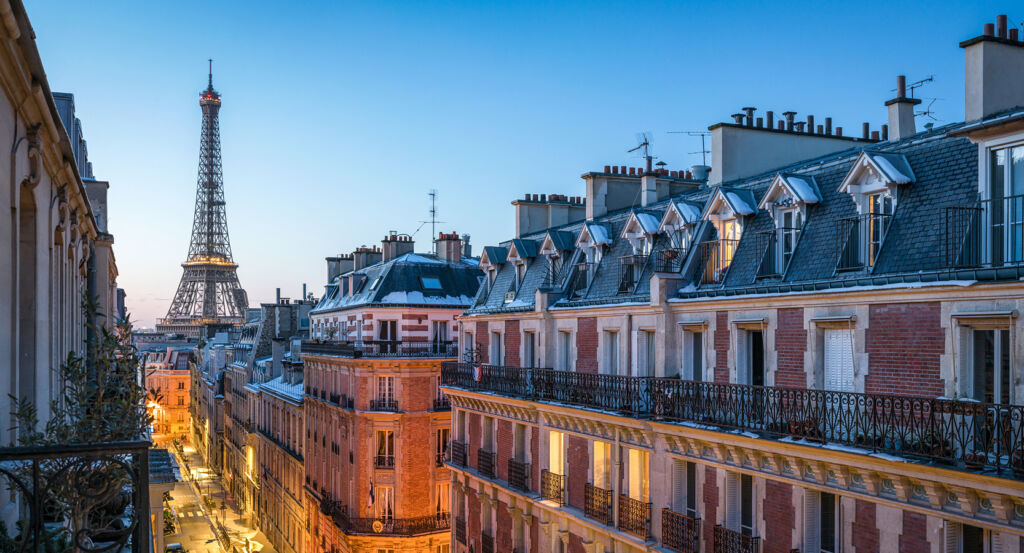
Why you should experience Hôtel Adèle & Jules in Paris, France.
Hôtel Adèle & Jules is a companionable four-star hotel where Faubourg Montmartre's theatrical sociability, covered-passage culture, bourgeois domesticity and appetite for metropolitan amusement retreat into two neighboring houses conceived with the intimacy of Parisian pieds-à-terre.
Set along Cité Rougemont near Rue Bergère and just steps from the Grands Boulevards, the hotel divides 60 rooms equally between two nineteenth-century buildings named Adèle and Jules, turning an unusual twin-house configuration into the foundation of its identity. Interior designer Stéphane Poux gave the houses a deliberately residential style of warm colors, geometric patterns, contemporary furniture and Guimard-inspired faience, with individual floors developing distinct chromatic personalities. Adèle contains the meeting salon while Jules contains the fitness room, and the shared hospitality extends into a ground-floor salon with an Honesty Bar and afternoon tea, reinforcing the impression of two related homes with complementary temperaments. The result is a hotel where Poux's domestic interiors and the unusual Adèle-and-Jules duality turn Faubourg Montmartre's public exuberance into something intimate, personal and quietly conspiratorial.
What you should know about Hôtel Adèle & Jules.
Hôtel Adèle & Jules is best known for opening in its current form at the end of 2015 as a 60-room boutique hotel divided equally between two nineteenth-century buildings, with interior designer Stéphane Poux transforming the paired houses into complementary personalities called Adèle and Jules. Thirty rooms occupy each building across six accommodation floors, while five categories progress from Cosy Classiques and Parisiennes Supérieures through Faubourg Deluxe and Boulevard Club rooms to Capitale Junior Suites, with connecting Parisienne rooms creating two-bedroom family configurations with two bathrooms. Poux differentiated the floors through changing colors and combined geometric motifs, contemporary furnishings and Guimard-inspired ceramic references, establishing variation inside a design language intended to resemble a private Parisian house. The hotel itself occupies Cité Rougemont, a 120-meter passage opened on January 31, 1844 across the former property of banker Rougemont de Lowenberg, giving the twin houses a secluded setting whose separation from the surrounding boulevards predates the contemporary hotel by more than 170 years.
Stéphane Poux develops the twin-house premise through asymmetry, assigning Adèle the private meeting salon and Jules the fitness room while allowing both buildings to share the same broader style of individualized guestrooms and residential-scale common spaces. Hôtel Adèle & Jules extends that domestic model through a ground-floor Honesty Bar serving wines and other drinks throughout the day and a complimentary afternoon tea centered on hot drinks and cakes, replacing the formality of a conventional full-service bar with self-directed hospitality. The Adèle meeting salon carries the same philosophy into gatherings, accommodating 16 seated or 20 standing around a private bar, while the property's family configurations connect two Parisienne Supérieure rooms through a private corridor. Together, Stéphane Poux, Adèle, Jules and Cité Rougemont give the hotel a remarkably coherent organizing idea, using two buildings, two complementary amenity programs and sixty individually inflected rooms to construct the fiction of an extended Parisian household.
How to fold Hôtel Adèle & Jules into your trip.
Hôtel Adèle & Jules works as the anchor for an afternoon tracing the nineteenth century's conversion of Parisian knowledge, commerce and celebrity into increasingly theatrical forms of public experience.
Begin at Bibliothèque nationale de France Richelieu, where Cardinal Mazarin's seventeenth-century palace received the royal library in 1721, expanded through architects including Henri Labrouste and Jean-Louis Pascal, and reopened fully in 2022 after a twelve-year renovation, with nearly 900 museum treasures and the 20,000-volume Salle Ovale. Continue to Passage Jouffroy, inaugurated in 1847 as Paris's first covered passage constructed entirely from iron and glass, where François-Hippolyte Destailleur and Romain de Bourges used new structural technology to extend the commercial promenade of Passage des Panoramas beneath a glazed roof. Conclude at Musée Grévin, where Le Gaulois founder Arthur Meyer recruited caricaturist Alfred Grévin to give physical form to newspaper personalities, opening the museum in 1882 before Gabriel Thomas reorganized the enterprise and Émile Reynaud presented Pauvre Pierrot through his Théâtre Optique. The progression moves from knowledge accumulated inside Mazarin's former palace through commerce transformed by iron-and-glass engineering into Meyer and Grévin's conversion of the news itself into performance, revealing the intellectual curiosity, consumer invention and theatrical instinct surrounding Hôtel Adèle & Jules.
Where your story begins.
Foresyte Travel reveals places that feel extraordinary long before you arrive.
Experience premium editorial crafted for luxury travelers.














































































































