
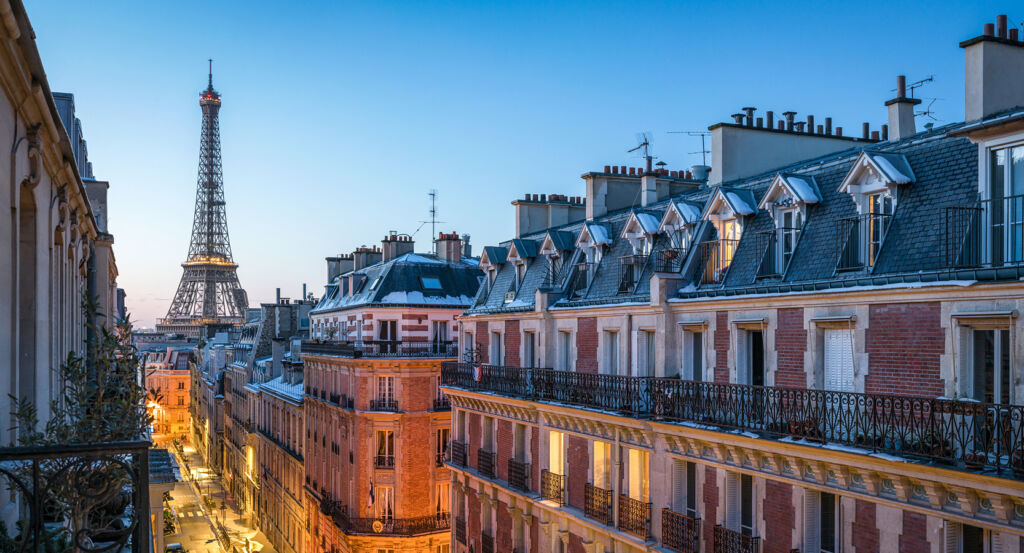
Why you should experience Etoile Saint-Ferdinand in Paris, France.
Etoile Saint-Ferdinand is a polished four-star hotel where Ternes's bourgeois confidence, neighborhood sociability and western Parisian restraint are recast through a newly renovated interior built around royal blue.
Set along Rue Saint-Ferdinand between Place de l'Étoile and Porte Maillot, the 42-room hotel occupies the intimate commercial fabric that distinguishes Ternes from the ceremonial avenues immediately surrounding Arc de Triomphe. A complete 2025 renovation replaced the property's earlier classical style with saturated blue floral headboards, pale timber, brass-toned lighting, patterned textiles and cleaner contemporary lines, giving the rooms a far more assertive visual identity. The hotel's own “blue dreams” concept now carries through the accommodation collection, while Rue Saint-Ferdinand places that design inside a pocket of restaurants, food shops and residential buildings whose scale remains distinctly neighborhood-driven. The result is a hotel where a decisive 2025 reinvention and an unusually disciplined color character give Ternes's cultivated discretion a contemporary personality.
What you should know about Etoile Saint-Ferdinand.
Etoile Saint-Ferdinand is best known for completing a comprehensive renovation in 2025 that reworked its 42-room interior and established royal blue as the defining visual signature of the property at 36 Rue Saint-Ferdinand. The transformation is particularly consequential because Etoile Saint-Ferdinand previously traded for years under the Best Western name, giving the renovation a role beyond cosmetic refurbishment as the property developed a more individual character under HappyCulture. The contemporary accommodation program occupies six floors and uses floral-patterned blue headboards, coordinated cushions, warm timber furniture and brass-toned sconces to carry that character consistently through the guestrooms. HappyCulture now positions the house between Place de l'Étoile, Palais des Congrès and La Défense, allowing a relatively intimate 42-key hotel to operate within one of western Paris's most internationally connected hospitality corridors.
HappyCulture develops that renewed character through a property whose scale remains deliberately concentrated, with Etoile Saint-Ferdinand containing only 42 accommodations across six floors despite its position between major western Paris business and transport centers. Porte Maillot strengthens that contemporary relevance through the transport hub surrounding Palais des Congrès, where the extension of RER E has reinforced the district's direct relationship with Central Paris and La Défense. The Etoile Saint-Ferdinand concept consequently occupies an interesting middle ground within HappyCulture's Paris portfolio, combining the visual discipline of its 2025 redesign with the proportions of a small neighborhood house and the connectivity of a major metropolitan gateway. Together, HappyCulture, Porte Maillot, Palais des Congrès and the renewed Etoile Saint-Ferdinand establish the hotel as a compact expression of contemporary Ternes, visually specific, commercially connected and newly confident after its most consequential recent reinvention.
How to fold Etoile Saint-Ferdinand into your trip.
Etoile Saint-Ferdinand works as the anchor for an afternoon tracing how nineteenth-century collecting, experimental architecture and private patronage shaped the cultivated western edge of Paris.
Begin at Musée national Jean-Jacques Henner, where painter Guillaume Dubufe's former hôtel particulier became the setting for Jean-Jacques Henner's legacy, tracing the 1858 Prix de Rome winner through his Villa Medici years, portraits, religious compositions and red-haired figures within an unusually intimate artist museum. Continue to Musée d'Ennery, where Clémence d'Ennery began collecting Asian art in 1859, commissioned architect Pierre-Joseph Olive to create her Avenue Foch mansion in 1875 and assembled 7,000 Chinese and Japanese objects before the collection opened publicly in 1908. Conclude at Fondation Louis Vuitton, where Bernard Arnault commissioned Frank Gehry to create the institution opened in 2014, its twelve immense sails requiring 3,600 individually curved glass panels while 19,000 unique Ductal panels form the white volumes beneath them. The progression moves from Henner's painted universe through d'Ennery's extraordinary act of private collecting into Gehry's computational architecture, revealing western Paris as a territory where individual artistic conviction repeatedly acquired ambitious physical form.
Where your story begins.
Foresyte Travel reveals places that feel extraordinary long before you arrive.
Experience premium editorial crafted for luxury travelers.














































































































