
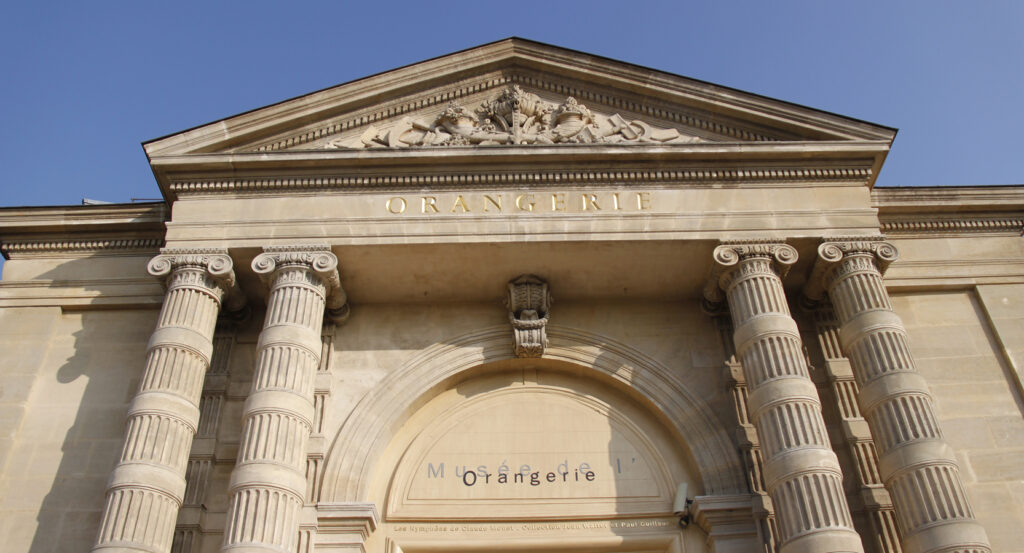
Why you should experience Impressionist Decorations at Musée de l'Orangerie in Paris, France.
Visiting Impressionist Decorations at Musée de l'Orangerie in Paris is like stepping into a dream painted in light. Here, the evolution of modern art unfolds before the eyes, from the soft glimmers of Monet's dawns to the daring color harmonies of Cézanne, Renoir, and Matisse. Each room feels alive with brushstrokes that shimmer rather than sit still, revealing the restless energy of a world on the cusp of change. To wander through these galleries is to feel Paris at its most intimate, when art broke free from the rigidness of tradition and began to capture sensation itself.
Every turn introduces a new conversation between artists who refused to see the world as fixed. The warmth of Renoir's flesh tones contrasts with the geometric precision of Cézanne's apples, while Modigliani's elongated figures seem to sway gently under the soft museum light. The collection's curation allows you to move seamlessly from Impressionism's fleeting perceptions to Post-Impressionism's bold explorations, a discussion of emotion, intellect, and rebellion. You don't just observe beauty here; you witness the courage it takes to reinvent it.
What you should know about Impressionist Decorations at Musée de l'Orangerie.
What most visitors overlook is that this collection exists because of the passionate devotion of art dealer Paul Guillaume, who was barely in his twenties when he began acquiring these works. A visionary in every sense, Guillaume believed that Impressionist and Post-Impressionist painters were the poets of a new age, capable of translating human feeling into pure color and movement. After his death, his widow Domenica preserved and expanded his legacy, shaping one of the most cohesive private collections in Europe.
These galleries aren't merely a museum showcase, they're the echo of two intertwined lives that believed in art as salvation. You can feel their fingerprints in the intimacy of the arrangement, in the discussion between small Renoir portraits and bold Matisse nudes. The lighting, subtle and diffuse, was designed to mirror the conditions under which many of these works were first painted, an homage to authenticity. Knowing this transforms your viewing experience; every painting becomes part of a living lineage, preserved not by institutions but by passion itself.
How to fold Impressionist Decorations at Musée de l'Orangerie into your trip.
To fold this stop into your Paris itinerary, plan the visit as a moment of balance between energy and reflection. Pair the Musée de l'Orangerie with a stroll through the adjacent Jardin des Tuileriess to give your eyes time to rest after the visual intensity inside.
Consider visiting during the late afternoon, when the crowds thin and the amber light of Paris softens the edges of every canvas, allowing the pigments to glow. If you're following an art-lover's path, combine this with a visit to the Musée d'Orsay across the river to experience how these movements evolved, two halves of the same conversation. And don't rush. Let the brushwork dictate your pace; the slower you move, the more the paintings reveal. In a city that thrives on romance and restlessness, this is among the few places where time still obeys the rhythm of the heart.
Where your story begins.
Foresyte Travel reveals places that feel extraordinary long before you arrive.
Experience premium editorial crafted for luxury travelers.














































































































