
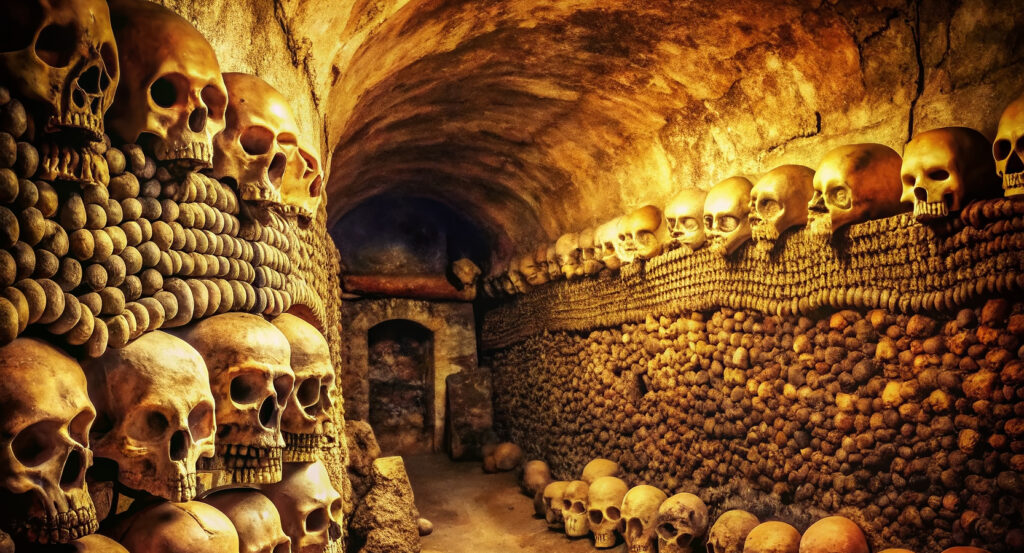
Why you should experience Ossuary Galleries at Paris Catacombs in Paris, France.
Ossuary Galleries at Paris Catacombs is a haunting subterranean landmark where Montparnasse's historical legacy, Enlightenment engineering, funerary artistry, and philosophical reflection preserve one of the world's most extraordinary memorial spaces.
Set beneath Avenue du Colonel Henri Rol-Tanguy near Place Denfert-Rochereau and just steps from Barrière d'Enfer, these remarkable underground galleries guide visitors through kilometers of former limestone quarries transformed into an immense ossuary where meticulously arranged human remains, engraved inscriptions, vaulted chambers, and atmospheric passageways create an unforgettable encounter with Paris' past. Every corridor balances engineering achievement with solemn remembrance, revealing how necessity evolved into one of the city's most compelling historical experiences. The result is a destination defined by historical significance, architectural ingenuity, and one of the world's most remarkable subterranean monuments.
What you should know about Ossuary Galleries at Paris Catacombs.
Ossuary Galleries at Paris Catacombs is best known for preserving the remains of more than six million Parisians transferred underground beginning in 1786 after the overflowing Cimetière des Innocents and other urban cemeteries created severe public health hazards throughout the rapidly expanding city. The galleries occupy a network of limestone quarries first excavated during the Roman era and expanded extensively throughout the Middle Ages to provide the stone used in constructing Paris' churches, bridges, palaces, and civic buildings. Under the direction of Charles-Axel Guillaumot, Inspector General of Quarries, abandoned tunnels were stabilized before becoming a grand municipal ossuary where remains from more than 150 cemeteries and religious institutions were carefully relocated over several decades, with major transfers continuing into the nineteenth century. During the early nineteenth century, quarry inspector Louis-Étienne Héricart de Thury transformed the utilitarian bone repository into a contemplative memorial by arranging skulls and femurs into carefully composed walls, columns, crosses, hearts, and decorative geometric patterns while introducing engraved plaques, poetic inscriptions, and philosophical quotations concerning mortality and remembrance. Visitors today traverse 1.5 kilometers of the immense underground network, descending nearly 20 meters beneath Paris into galleries where engineering, archaeology, geology, funerary art, urban history, and public health converge within one of the world's most extraordinary heritage sites, preserving a singular tribute to the city's evolution beneath its modern streets.
The Ossuary Galleries leave an enduring impression because they transform an immense civic necessity into a place of extraordinary dignity and contemplation. Every carefully arranged wall of bones, illuminated passage, and engraved inscription encourages reflection upon the generations whose lives collectively built Paris above, making the galleries not simply an archaeological curiosity but one of humanity's most profound monuments to memory, resilience, and the passage of time.
How to fold Ossuary Galleries at Paris Catacombs into your trip.
Ossuary Galleries at Paris Catacombs works as the historic centerpiece of an exploration through Paris' remarkable Left Bank heritage.
Begin at Barrière d'Enfer, where Claude-Nicolas Ledoux's grand eighteenth-century customs pavilions establish the historical context surrounding the entrance to the underground galleries before descending into Ossuary Galleries at Paris Catacombs. Continue to Lion of Belfort, whose grand sculpture by Frédéric Auguste Bartholdi commemorates French resilience while enriching Place Denfert-Rochereau's historical significance. Conclude at Fondation Cartier pour l'Art Contemporain, where bold contemporary exhibitions provide a striking modern counterpoint to centuries of history preserved beneath the streets, revealing how Paris continually layers innovation upon its extraordinary past. The progression moves naturally from Enlightenment architecture to subterranean history before concluding with contemporary artistic expression, creating one of the capital's most intellectually rewarding cultural journeys.
Where your story begins.
Foresyte Travel reveals places that feel extraordinary long before you arrive.
Experience premium editorial crafted for luxury travelers.














































































































