
Why Paris Catacombs matters.
Paris Catacombs is a haunting subterranean monument where Montparnasse's historic character meets ancient limestone quarries, the remains of millions of Parisians and an eighteenth-century response to the burial crisis of the old city.
Set beneath Avenue du Colonel Henri Rol-Tanguy near Avenue René Coty and just steps from Place Denfert-Rochereau, the underground complex occupies former quarry galleries below a district where Haussmannian apartment fronts, planted boulevards and the surviving Ledoux customs pavilions mark the transition between Montparnasse and the southern neighborhoods. The descent reaches the Lutetian limestone stratum 20 meters below street level, passing through rock formed when a tropical sea covered the Paris region tens of millions of years ago. Narrow quarry corridors lead toward the ossuary through masonry supports, carved inscriptions and structural reinforcements left by generations of underground engineering. Walls of femurs, tibiae and skulls then transform the excavated galleries into an architectural sequence radically detached from the streets overhead. The result is an extraordinary underground environment where Parisian geology, centuries of quarrying and the physical remains of the old city's dead occupy the same engineered labyrinth.
What defines Paris Catacombs.
Paris Catacombs is best known for converting the abandoned Tombe-Issoire quarries into a municipal ossuary after overcrowded cemeteries created a severe burial crisis in eighteenth-century Paris. Limestone extraction beneath southern Paris had shifted underground during the Middle Ages, leaving galleries whose inadequate regulation contributed to destructive collapses as the city expanded above them. A major failure on Rue Denfert-Rochereau swallowed 300 meters in 1774, Louis XVI prohibited quarrying beneath public roads in 1776 and the crown created the Inspection Générale des Carrières on April 4, 1777 to secure the underground network. A separate crisis developed at the Cimetière des Innocents, the immense burial ground near Les Halles whose overcrowding and sanitary problems led authorities to close it in 1780. Former quarries beneath the Montrouge plain offered a destination outside the contemporary city boundary, and transfers from Les Innocents began during 1785. The Tombe-Issoire quarries were blessed and consecrated as the Paris Municipal Ossuary on April 7, 1786, acquiring the Catacombs name through association with the ancient burial complexes of Rome. Nighttime convoys subsequently carried bones from condemned cemeteries through Paris to the quarry shafts, and transfers from parish burial grounds continued from 1787 through 1814. Further deposits followed during nineteenth-century redevelopment, with the final major transfers arriving amid Haussmann-era works in 1860. The underground complex joined two separate urban problems, unstable quarry excavations and overflowing burial grounds, within a single municipal undertaking whose physical scale now preserves remains from several million Parisians.
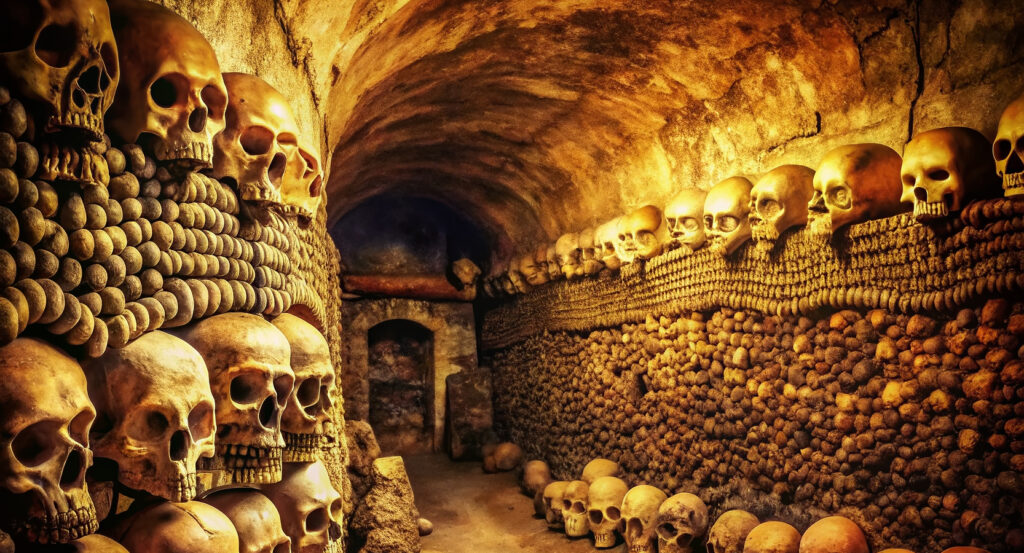
Alexandre Lenoir's early interest in presenting the ossuary gave way to a far more systematic transformation under Louis-Étienne Héricart de Thury, Inspector General of Quarries from 1809. Héricart de Thury reorganized the site between 1810 and 1814 after public access began by appointment in 1809, converting loose accumulations of bones into carefully constructed walls modeled on the hagues used by quarry workers to retain excavation debris. Rows of femurs and tibiae formed the principal surfaces with skulls arranged among them, leaving fragmented remains packed behind the visible facings. Héricart de Thury introduced Doric columns, altars, steles and tomb-like structures influenced by Antique and Egyptian architecture, turning the ossuary into a deliberately ordered commemorative environment. Named features including the Samaritan Fountain, Sepulchral Lamp and Lacrymatory Sarcophagus divided the route into recognizable episodes. Cabinets devoted to mineralogy and pathology added scientific instruction to the commemorative program, connecting the ossuary with the period's museum culture. Literary and philosophical inscriptions further directed contemplation toward mortality as visitors moved through the galleries. François I of Austria entered the Catacombs in 1814, Napoleon III descended with his son in 1860 and the public opening gradually changed a municipal repository into one of the most unusual historic interiors beneath Paris. Héricart de Thury's intervention established the ordered bone walls and architectural sequence that still distinguish the ossuary from the much larger quarry network surrounding it.
How Paris Catacombs fits.
Paris Catacombs works as the anchor for a daytime exploration through the southern Left Bank using three nearby sites that move from seventeenth-century astronomical science through a nineteenth-century necropolis into Jean Nouvel's late twentieth-century experiment in glass architecture.
Begin at Observatoire de Paris, founded under Louis XIV and Colbert as a permanent home for astronomers of the Académie royale des sciences. Members of the academy traced the meridian across the site on the summer solstice of June 21, 1667, establishing the alignment around which Claude Perrault designed the observatory as an astronomical instrument in its own right. Jean-Dominique Cassini arrived in France in 1669 and occupied the unfinished building in 1671; his son Jacques later completed the great meridian instrument between 1729 and 1732. Thirty-two brass strips embedded in white marble received an image of the Sun projected through a gnomon 9.9377 meters above the floor, allowing measurements of solar altitude with a precision reaching ten arc seconds. Continue to Montparnasse Cemetery, opened as the Cimetière du Sud on July 25, 1824 as Paris shifted burial away from overcrowded churchyards and established major cemeteries beyond the contemporary city boundary. Its 19 hectares later entered metropolitan Paris and became the capital's second-largest intramural necropolis, with 1,200 trees distributed among 40 species across its avenues and burial divisions. Charles Baudelaire, Guy de Maupassant, Jean-Paul Sartre, Simone de Beauvoir, Samuel Beckett, Constantin Brâncuși and Man Ray belong to the extraordinary concentration of writers, philosophers and artists associated with the cemetery, extending the district's relationship with the dead into a radically different nineteenth-century form from the underground ossuary. Conclude at the former Fondation Cartier building at 261 Boulevard Raspail, where Jean Nouvel created an eight-story glass-and-steel structure inaugurated in 1994 on the site previously occupied by the American Center. Layered transparent planes allowed the garden and surrounding city to pass visually through the architecture, with German artist Lothar Baumgarten developing the adjoining Theatrum Botanicum. A cedar of Lebanon planted by Chateaubriand in 1823 became part of the architectural composition that Nouvel organized through reflections of vegetation, sky and glass. The Fondation Cartier moved to Place du Palais-Royal in October 2025, leaving the Raspail building as the architectural remnant of its three-decade Montparnasse chapter. The progression moves from Perrault and the Cassinis' conversion of architecture into an astronomical instrument through the nineteenth-century reorganization of Parisian burial at Montparnasse into Nouvel and Baumgarten's dissolution of architectural boundaries through glass and vegetation, extending the Catacombs into three radically different constructions of the southern Left Bank.
Where your story begins.
Foresyte Travel reveals places that feel extraordinary long before you arrive.
Enjoy editorial crafted for luxury travelers.
Foresyte may earn a commission when you book.














































































































