Why Galleria dell'Accademia di Firenze matters.
Galleria dell'Accademia di Firenze is an extraordinary art museum where San Marco's artistic heritage, Florentine craftsmanship, Renaissance genius, and centuries of creative excellence culminate in one of Italy's most celebrated cultural institutions.
Set along Via Ricasoli near Piazza San Marco and just steps from Museo di San Marco, this distinguished museum leads visitors through elegant galleries filled with Renaissance paintings, grand sculptures, gilded altarpieces, musical instruments, and Michelangelo's greatest achievements that collectively celebrate Florence's unrivaled artistic legacy. Every room reveals another chapter in the evolution of Italian art as unfinished marble figures, luminous religious masterpieces, and meticulously preserved collections illuminate the creative process behind some of history's most influential works. Thoughtfully arranged exhibition spaces and carefully restored interiors continually deepen appreciation for the extraordinary artistic ambition that defined Renaissance Florence. The experience ultimately unites sculptural mastery, artistic innovation, and human creativity into one of the world's essential museum experiences.
What defines Galleria dell'Accademia di Firenze.
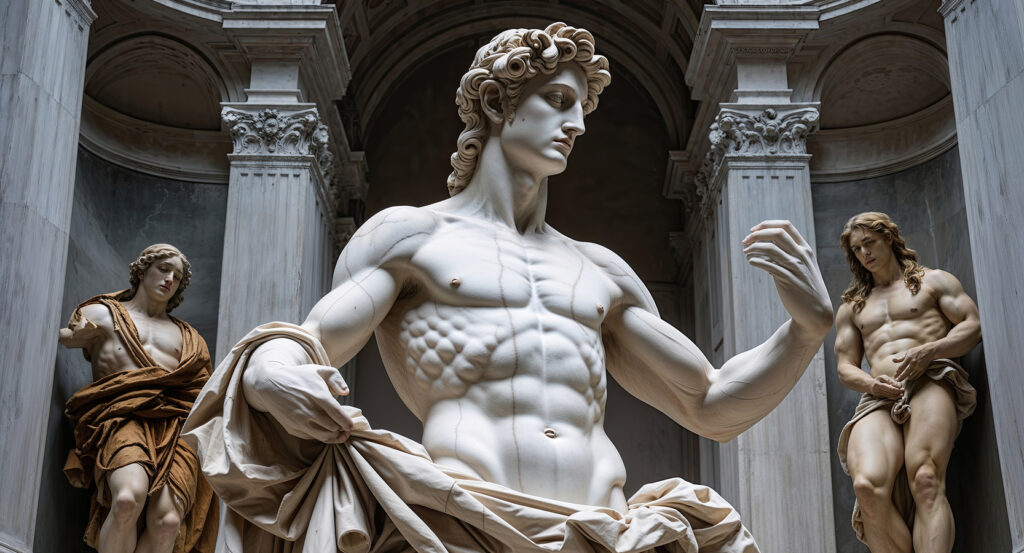
Galleria dell'Accademia di Firenze is best known for housing Michelangelo's David, the 5.17-meter marble masterpiece carved between 1501 and 1504 from a colossal block of Carrara marble that had remained abandoned for decades after unsuccessful attempts by Agostino di Duccio and Antonio Rossellino, before becoming the enduring symbol of the Florentine Republic and being transferred to the museum in 1873 to ensure its long-term preservation. The museum itself originated in 1784 when Grand Duke Pietro Leopoldo of Tuscany reorganized the former Hospital of Saint Matthew and adjacent buildings to serve the Accademia di Belle Arti, creating a teaching collection where aspiring artists studied masterpieces of painting and sculpture through direct observation. Purpose-built architectural expansions during the nineteenth century culminated in Emilio De Fabris' grand Tribuna completed in 1882, an innovative domed gallery specifically designed to display David beneath carefully controlled natural light while emphasizing the sculpture's ideal proportions and commanding presence. Beyond David, the museum preserves Michelangelo's four unfinished Prisoners-Awakening Slave, Young Slave, Bearded Slave, and Atlas, whose partially liberated figures provide one of history's greatest demonstrations of the artist's non-finito technique, alongside Saint Matthew, offering unparalleled insight into Michelangelo's sculptural process. Extensive collections include Florentine Gothic and early Renaissance paintings by Giotto, Orcagna, Lorenzo Monaco, Taddeo Gaddi, Botticelli, Perugino, and numerous other masters, while the Museum of Musical Instruments safeguards more than fifty historic instruments, including violins, violas, and cellos crafted by Antonio Stradivari, Niccolò Amati, and Bartolomeo Cristofori, inventor of the piano, reflecting the Medici family's extraordinary patronage of both visual arts and music. Today the museum welcomes well over one million visitors annually while remaining one of the world's foremost institutions for understanding Renaissance sculpture, Florentine painting, artistic education, and Michelangelo's enduring influence on Western civilization.
Michelangelo's artistic vision unfolds with exceptional clarity as unfinished marble surfaces, visible chisel marks, and gradually emerging anatomical forms reveal the sculptor's belief that every figure already existed within the stone awaiting liberation. Carefully arranged galleries create a chronological journey through Florentine artistic development while conservation initiatives, scholarly research, and sensitive exhibition design preserve works spanning several centuries within their historical context. Monumental altarpieces, devotional paintings, gilded polyptychs, sculptural studies, and historic musical instruments collectively demonstrate the extraordinary breadth of Renaissance creativity fostered by Florence's workshops, religious institutions, and Medici patrons. Every gallery demonstrates how artistic genius, technical mastery, humanist ideals, and exceptional patronage transformed Florence into one of history's greatest centers of artistic innovation.
How Galleria dell'Accademia di Firenze fits.
Galleria dell'Accademia di Firenze works as the centerpiece of an exploration through San Marco's celebrated museums, Renaissance architecture, and artistic heritage.
Begin at Museo di San Marco, where Fra Angelico's sublime frescoes establish the spiritual and artistic foundations of the Florentine Renaissance before continuing to Galleria dell'Accademia di Firenze to encounter Michelangelo's greatest sculptural achievements. Continue to Piazza San Marco, whose historic setting naturally connects many of the neighborhood's most significant cultural institutions while reinforcing the district's scholarly legacy. Conclude at Orto Botanico di Firenze, where one of Europe's oldest academic botanical gardens provides a serene finale celebrating the Renaissance pursuit of art, science, and human knowledge. The progression moves naturally from sacred painting to sculptural genius before concluding through scientific discovery, revealing why San Marco remains one of Florence's foremost centers of intellectual and artistic achievement.
Where your story begins.
Foresyte Travel reveals places that feel extraordinary long before you arrive.
Enjoy editorial crafted for luxury travelers.
Foresyte may earn a commission when you book.