
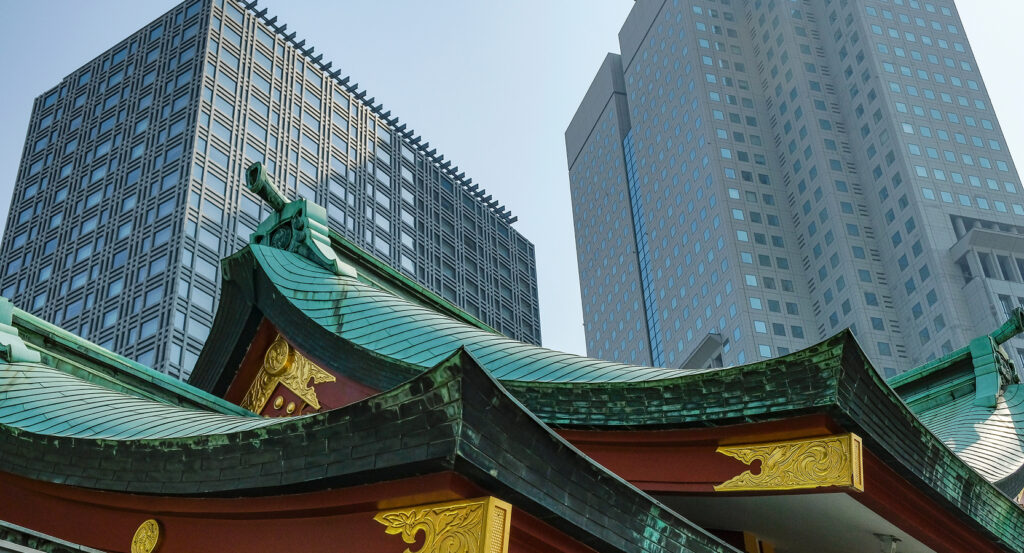
Why Akasaka Sacas matters.
Akasaka Sacas is a layered entertainment district where Akasaka's hillside character meets broadcasting culture, performance venues and an architectural landscape deliberately threaded through the neighborhood's inherited topography.
Set along Akasaka-dori near Hitotsugi-dori and just steps from Akasaka Station, the complex rises across sloping ground that turns movement through the site into a sequence of plazas, planted inclines and elevated approaches. Akasaka Biz Tower establishes the principal vertical presence, yet smaller commercial fronts and outdoor gathering areas keep the pedestrian scale closely tied to the surrounding streets. A zigzagging ascent links the station side with the upper hill, repeatedly changing sightlines across the buildings and creating informal overlooks along the climb. Sacas Square opens directly beside the broadcasting center as the principal outdoor event ground, giving concerts, seasonal installations and media programming a prominent place within the circulation system. The result is a district whose architecture works through the natural rise of Akasaka, connecting broadcasting, performance and public movement without flattening the hill that shaped the site.
What defines Akasaka Sacas.
Akasaka Sacas is best known for transforming TBS's large Akasaka property into a new broadcasting, commercial, residential and performance district while preserving the site's pronounced terrain and inherited vegetation. TBS began construction of the Akasaka 5-chome development in February 2005 with Mitsui Fudosan serving as project manager and Kume Sekkei responsible for design and supervision. Kume Sekkei rejected an early concept that would have cut down the hill and leveled the property, choosing to restore the ridge as a walkable green landscape that retained the memory of ground once occupied by samurai residences. Large Chinese hackberries, Japanese pear trees and more than thirty surviving Somei-yoshino cherries were transplanted and reincorporated into the rebuilt site, making existing vegetation an active component of the new design. The completed development encompassed 218,461 square meters of floor area and combined the office and commercial Akasaka Biz Tower with Akasaka ACT Theater, Akasaka BLITZ, Akasaka Gallery and Akasaka The Residence. Obayashi Corporation, Kajima Corporation, Maeda Corporation and Shimizu Corporation formed the construction joint enterprise, and the principal buildings reached completion in January 2008. Akasaka Biz Tower SHOPS & DINING opened on March 6 with 46 businesses, followed by the Akasaka Sacas grand opening on March 20. The name itself joined several ideas attached to the district: TBS connected Sacas with the Japanese verb sakasu, to make bloom, and with the numerous saka, or slopes, that distinguish Akasaka. Architecture, landscape preservation and wordplay converged on the same concept, rebuilding a major media property around physical characteristics already embedded in Akasaka.
Public programming established another mechanism for binding the redevelopment to TBS's role as a producer of entertainment. Kume Sekkei designed the central event ground with a raised floor concealing utility connections and incorporated tent hooks into joints between prestressed-concrete slabs, allowing temporary productions to occupy infrastructure planned specifically for repeated transformation. The adjoining cultural component placed stage and music facilities beside that outdoor venue, extending broadcast content into live performance and giving the property activity outside conventional office cycles. That relationship entered a new phase in July 2022 when TBS Akasaka ACT Theater began the long-running Japanese production of Harry Potter and the Cursed Child. TBS subsequently extended imagery associated with the production through the surrounding area, adding Harry Potter Cafe, Harry Potter Cafe Window, Harry Potter Shop Akasaka and a Time-Turner installation. The former Akasaka BLITZ has since become TBS Akasaka BLITZ Studio, and its foyer includes a third-floor viewing deck connected with the working studio environment. These successive adaptations preserve Akasaka Sacas as an active production landscape in which television, theater, temporary events and themed entertainment repeatedly reshape the public-facing portions of the property.
How Akasaka Sacas fits.
Akasaka Sacas works as the anchor for an Akasaka route through three nearby sites that move from a surviving Edo religious precinct through the home ground of a shogunate statesman and into a Buddhist institution shaped by one of the period's most celebrated magistrates.
Begin at Akasaka Hikawa Shrine, whose foundation reaches to 951, when the Buddhist priest Renrin established a sanctuary dedicated to Hikawa Myojin in Hitotsugi Village. Tokugawa Yoshimune strengthened the shrine's relationship with the shogunate after becoming eighth shogun, commissioning a new sanctuary at its present location and visiting shortly after the relocation in 1730; that building survived the Ansei earthquake, the Great Kanto Earthquake and the Tokyo air raids, retaining its Edo-period form into the present. Continue to Site of the Residence of Katsu Kaishu, where the shogunate statesman lived between 1859 and 1868 during the decisive final years of Tokugawa government. His years on this ground encompassed service connected with the Kanrin Maru mission across the Pacific, promotion to naval magistrate and his encounter with Sakamoto Ryoma, who approached Katsu intending to kill him before becoming his follower; Katsu still occupied the Akasaka residence when negotiations with Saigo Takamori produced the bloodless surrender of Edo Castle in March 1868. Conclude at Toyokawa Inari Betsuin, a Soto Zen temple centered on Toyokawa Dakini-shinten whose Akasaka history developed through Ooka Tadasuke, the Edo magistrate remembered as Ooka Echizen. Ooka installed the sacred image within his residence, and the object eventually reached the present temple ground in 1887; the precinct still contains his tomb and preserves a religious connection between Akasaka and a figure closely associated with Tokugawa administration and popular Edo memory. The progression moves from Akasaka Hikawa Shrine's surviving shogunal architecture through Site of the Residence of Katsu Kaishu's connection with the collapse of Tokugawa rule into Toyokawa Inari Betsuin's inheritance from Ooka Tadasuke, carrying Akasaka Sacas outward into three deeper layers of the district's history.
Where your story begins.
Foresyte Travel reveals places that feel extraordinary long before you arrive.
Enjoy editorial crafted for luxury travelers.
Foresyte may earn a commission when you book.

















































































































