
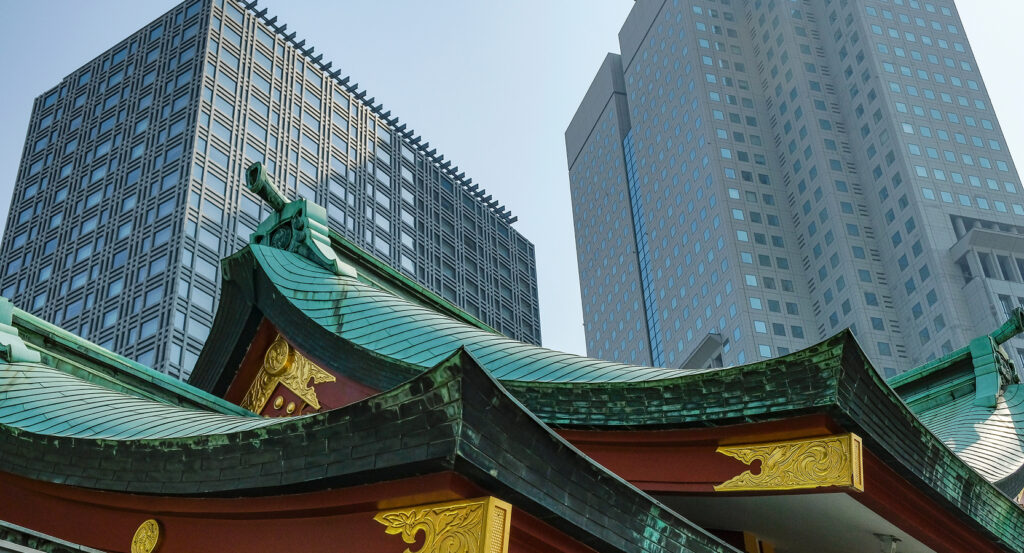
Why Akasaka matters.
Akasaka is a storied enclave where Central Tokyo's steep western uplands meet a district shaped by samurai estates, secluded lanes, entertainment culture and the political geography surrounding Japan's national institutions.
Positioned between Nagatacho, Roppongi, and Aoyama, the neighborhood occupies a folded section of Minato where Akasaka-dori, Hitotsugi-dori and Sotobori-dori climb and descend across terrain divided by an exceptional concentration of historic slopes. Sanbunzaka rises sharply between dense building walls, Yagenzaka falls through a distinctive concave landform, and quieter lanes around Hikawazaka preserve changes in elevation that continually break long views into smaller spatial episodes. Hitotsugi-dori establishes the primary encounter through a commercial corridor layered over a route whose earlier importance grew from movement between settlements and the changing of horses and carriers. Smaller streets branching west from Akasaka-dori deepen the physical character through intimate gradients, surviving ryotei frontages, temple precincts and sudden stairways compressed beneath the surrounding towers. The eastern edge shifts scale again as the ground descends toward Akasaka-Mitsuke and the former outer defenses of Edo Castle, connecting the neighborhood's elevated interior to one of the historic gateways into the shogunal city. The result is a district whose slopes continually expose the relationship between topography and history, preparing an account that begins with the transformation of sparsely settled upland into one of Edo's principal concentrations of warrior estates.
What defines Akasaka.
Akasaka is best known for its transformation from wooded and cultivated ground outside early Edo into a predominantly samurai district whose terrain was divided among powerful domains and Tokugawa interests. The area remained thinly settled before cultivation expanded in 1567, although the Hojo army had celebrated its capture of Edo Castle at Hitotsugihara in 1524. Tokugawa construction changed that geography after Ieyasu entered Edo in 1590 and the expanding castle city pushed elite residences onto the surrounding uplands. The Kishu Tokugawa family occupied extensive ground beside Kinokunizaka, whose name still derives from that estate, and the Mori lords of Choshu maintained property around present-day Hinokizaka, remembered as the Hinoki House for the Japanese cypress growing across its grounds. Yonekura Shigetsugu's residence supplied Tangozaka with another warrior association, and estates belonging to the Kuroda, Sagara and Hijikata families contributed the combined name Fukuyoshizaka. The district itself took the Akasaka name from a slope, with Minato City connecting one principal explanation to Kinokunizaka and the akane plants growing on the hill above it. A map published in 1657 contains an early appearance of the name, at that stage on the Chiyoda side of the present boundary. By the mature Edo period, warrior land dominated much of Akasaka, leaving the surviving slope names as an unusually detailed geographical index of the domains, retainers and residences that once partitioned the uplands.
The Meiji period redirected Akasaka toward an entertainment culture closely tied to the new capital's political and financial elite. Its kagai began on a small scale early in the era, then expanded after government offices concentrated around Tameike during the late nineteenth century and brought politicians, military officers and business leaders into nearby ryotei. Reclamation of a local pond in 1887 accompanied the establishment of restaurants and geisha houses around Hitotsugi-dori, embedding performance and hospitality into streets previously associated with the shogunal city. Akasaka's kagai eventually contained more than 400 geisha at its height, supported by a network of high-end establishments where music, dance and private dining operated together. The concentration survived into postwar Tokyo, when proximity to the National Diet continued to bring political and commercial meetings into the district's ryotei. Japanese dance, shamisen performance and songs associated with the kagai remained part of Akasaka's cultural inheritance even as the number of working geisha contracted to fewer than twenty. This transition from warrior territory to an elite entertainment quarter created a second historical layer across the same slopes, connecting Akasaka's intimate interior streets with the institutions of national power immediately beyond them.
How Akasaka fits.
Akasaka works as the anchor for a daytime exploration connecting an Edo shrine rebuilt under direct shogunal patronage, a memorial institution born from the final hours of the Meiji era and a design center joining Issey Miyake's decades-long cultural project with Tadao Ando's architecture.
Begin at Akasaka Hikawa Shrine, whose foundation reaches 951, when the Buddhist priest Renrin established a sanctuary to Hikawa Myojin after spending a night in Hitotsugi Village. Tokugawa Yoshimune strengthened the shrine's position after becoming eighth shogun in 1716, commissioned a new sanctuary under senior councillor Mizuno Tadayuki in 1729 and transferred the shrine to its present site on April 26, 1730 before visiting two days later; the surviving building endured the 1855 Ansei earthquake, the 1923 Great Kanto Earthquake and the 1945 air raids, and its grounds retain seven pairs of komainu, including gate guardians carved in 1675. Continue to Nogi Shrine, whose origins followed General Nogi Maresuke and his wife Shizuko's deaths on September 13, 1912, the day of Emperor Meiji's funeral, after which nearby Yureizaka was renamed Nogizaka and Tokyo mayor Sakatani Yoshiro organized the Chuo Nogi-kai. Authorization for a shrine arrived in 1919, the enshrinement ceremony followed on November 1, 1923, and wartime bombing destroyed the principal buildings in May 1945 before nationwide contributions supported their reconstruction for the fiftieth anniversary of Nogi's death in 1962. Conclude at 21_21 Design Sight, whose intellectual origins reach Issey Miyake's discussions about a Japanese design museum with Isamu Noguchi, Ikko Tanaka, Shiro Kuramata and Tadao Ando decades before the center opened at Tokyo Midtown in March 2007. Miyake, Taku Satoh and Naoto Fukasawa became its founding directors with Noriko Kawakami as associate director, and Ando translated Miyake's A Piece of Cloth concept into a low structure buried largely underground beneath giant steel plates folded toward the ground, pairing that roof with a sheet of double-glazed glass whose fabrication drew on Japanese engineering expertise. The progression moves from Yoshimune's eighteenth-century shogunal patronage through the commemorative culture created around Nogi at the end of the Meiji era into Miyake and Ando's institutional investment in contemporary design, carrying Akasaka across three distinct chapters of Tokyo's cultural history.
Where your story begins.
Foresyte Travel reveals places that feel extraordinary long before you arrive.
Enjoy editorial crafted for luxury travelers.
Foresyte may earn a commission when you book.

















































































































