
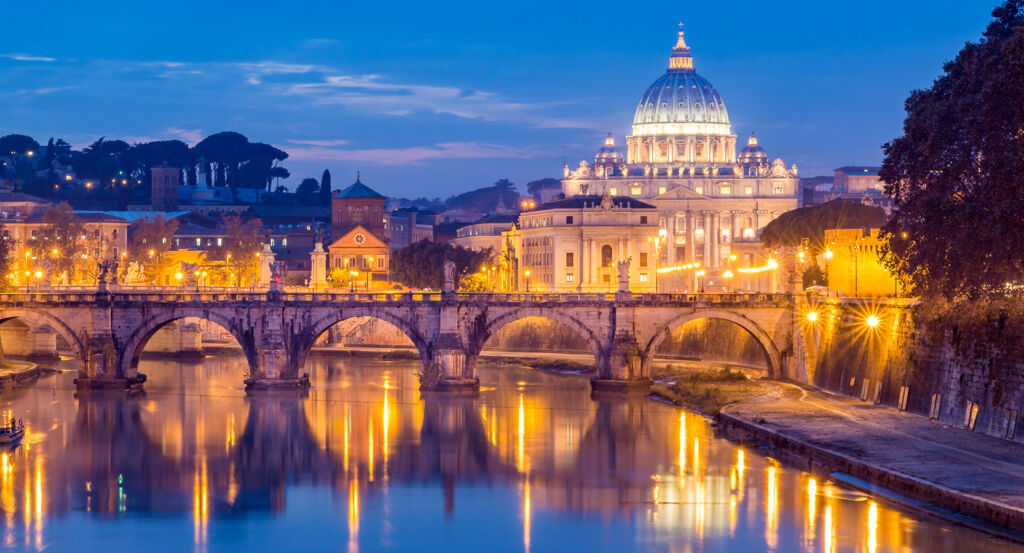
Why Armando al Pantheon matters.
Armando al Pantheon is a family-run Roman trattoria where Sant'Eustachio's ancient architectural heritage meets the Gargioli family's traditional cooking, the culinary traditions of Lazio and a restaurant history extending through three generations of Roman hospitality.
Set along Salita de' Crescenzi near Piazza della Rotonda and just steps from the Pantheon, the restaurant occupies a narrow street-level premises in Rome's historic center, between the ancient temple's northern perimeter and the commercial lanes approaching Piazza della Maddalena. Its modest entrance opens into a compact dining room furnished with wooden tables, framed photographs and shelves of wine. Closely arranged seating preserves the proportions of a traditional neighborhood trattoria, with the kitchen operating beyond the principal dining area. The surrounding streets retain the irregular alignments of medieval Rome, incorporating Renaissance façades and commercial premises within the ancient urban fabric. The result is a restaurant whose intimate interior, established family ownership and immediate architectural surroundings preserve the character of traditional Roman dining within the historic center.
What defines Armando al Pantheon.
Armando al Pantheon is best known for preserving the culinary traditions of Roman home cooking through the Gargioli family, whose restaurant was founded in 1961 by Armando Gargioli and subsequently developed by his sons Claudio and Fabrizio. Armando began his professional life as a cook before establishing the trattoria in a small premises near one of Rome's most important ancient monuments. His early menu concentrated on the substantial dishes associated with Roman households, including pasta, braised meats and seasonal vegetables prepared through established regional techniques. The restaurant developed a regular clientele among neighborhood residents, workers and individuals associated with the surrounding cultural institutions. Its modest scale allowed Armando to maintain direct oversight of the kitchen, preserving consistency in the preparation of familiar dishes. Claudio entered the family business and assumed responsibility for cooking, developing the menu through a close understanding of his father's culinary methods. Fabrizio took responsibility for the dining room and wine program, establishing a complementary division of responsibilities between the brothers. The restaurant's reputation expanded through Italian culinary writing and international travel coverage, attracting diners interested in traditional Roman cuisine prepared within a family-operated establishment. The Gargioli family resisted substantial expansion, retaining the original dining-room scale and a menu organized around regional ingredients. Armando died in 2015, leaving the restaurant under the leadership of the succeeding generation. Claudio's daughter Fabiana subsequently joined the family enterprise, extending its operation into a third generation. The restaurant's continued development preserved its specialization in traditional Roman preparations, including seasonal dishes associated with the agricultural calendar of Lazio. Its longstanding reputation established Armando al Pantheon as an important reference point for Roman trattoria cooking during a period of substantial change in the capital's restaurant industry.
Claudio Gargioli's kitchen concentrates on the established dishes of Roman households, developing flavor through slow cooking, rendered pork fat, aged cheese and carefully selected seasonal ingredients. Spaghetti alla carbonara combines guanciale, egg, Pecorino Romano and black pepper, using the pasta's residual heat to produce a creamy sauce. The guanciale is cooked until its exterior becomes crisp, contributing rendered fat and concentrated savory flavor to the preparation. Rigatoni all'amatriciana incorporates tomato, guanciale and Pecorino Romano, connecting the restaurant's pasta program with the culinary traditions of Amatrice and Lazio. Spaghetti alla gricia removes tomato from the combination, allowing the relationship between cured pork, aged cheese and black pepper to determine the dish's character. Cacio e pepe depends on the careful incorporation of Pecorino Romano into starchy pasta water, producing a smooth coating through controlled temperature and emulsification. Abbacchio alla scottadito consists of lamb cutlets grilled over high heat, preserving the simplicity of a preparation associated with Roman springtime cooking. Coda alla vaccinara employs prolonged braising to tenderize oxtail in a tomato-based sauce incorporating celery and other aromatic ingredients. Trippa alla romana combines slowly cooked tripe with tomato, mint and Pecorino Romano, maintaining a dish historically associated with the city's working-class food traditions. Seasonal artichokes appear alla romana, braised with herbs and olive oil, or alla giudia, fried until the outer leaves become crisp. Puntarelle alla romana combines the tender shoots of chicory with an anchovy, garlic and vinegar dressing, introducing a distinctly bitter vegetable preparation into the meal. The kitchen also prepares traditional Roman desserts, including crostata with ricotta and sour cherries, connecting its pastry selection with longstanding local baking traditions. Fabrizio Gargioli's wine program emphasizes Italian producers, with particular attention to the wines of Lazio and other Central Italian regions. The compact dining room supports a direct relationship between kitchen and table, with courses served in the sequence associated with traditional Italian meals. The restaurant's culinary character rests on the precise execution of familiar regional dishes through methods maintained across successive generations.
How Armando al Pantheon fits.
Armando al Pantheon works as the culinary centerpiece for a Rome itinerary connecting ancient imperial architecture, the development of Renaissance religious institutions and the Baroque transformation of the city's historic public spaces.
Begin at Pantheon, the ancient Roman temple reconstructed under Emperor Hadrian during the second century CE. Its expansive portico preserves sixteen granite Corinthian columns supporting a substantial triangular pediment. The interior contains a vast unreinforced concrete dome, whose central oculus admits daylight into the circular chamber. The building's geometric proportions connect the diameter of the interior with the height of the dome, establishing a carefully calculated architectural composition. Converted into a Christian church in 609, the structure survived successive periods of urban change and became the burial place of Raphael and several Italian monarchs. Continue to Santa Maria sopra Minerva, the Gothic church situated immediately east of the ancient temple. The Dominican order developed the church during the thirteenth and fourteenth centuries, creating one of Rome's most important surviving examples of Gothic religious architecture. Its interior contains Michelangelo's Christ Carrying the Cross and the tomb of Saint Catherine of Siena, connecting the building with major figures in Italian religious and artistic history. Filippino Lippi's frescoes in the Carafa Chapel depict theological subjects associated with the Dominican tradition. The adjoining square contains Bernini's elephant sculpture supporting an ancient Egyptian obelisk, creating a distinctive Baroque composition. Conclude at Piazza Navona, the public square occupying the site of the ancient Stadium of Domitian. Its elongated form preserves the underlying geometry of the Roman athletic venue, connecting imperial urban planning with the later development of the city. Bernini's Fountain of the Four Rivers, completed in 1651, incorporates allegorical figures representing major rivers across four continents. Francesco Borromini contributed to the adjoining church of Sant'Agnese in Agone, whose curved façade and twin towers establish a major architectural feature of the square. The surrounding palaces and fountains preserve the theatrical urban design associated with seventeenth-century Rome. The progression moves from ancient imperial engineering through medieval religious architecture and culminates in the Baroque development of Rome's principal public squares.
Where your story begins.
Foresyte Travel reveals places that feel extraordinary long before you arrive.
Enjoy editorial crafted for luxury travelers.
Foresyte may earn a commission when you book.




















































































































