
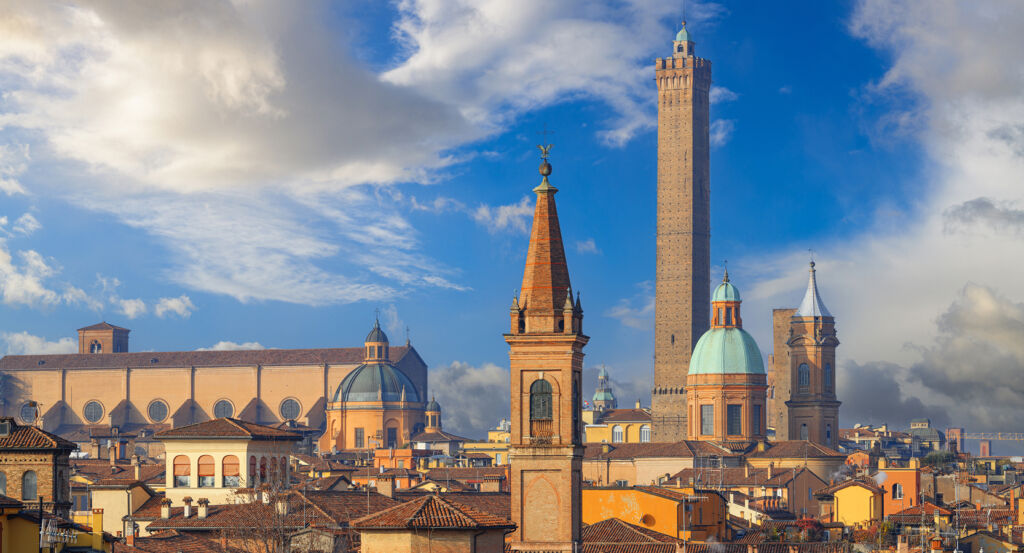
Why you should experience Art Hotel Commercianti in Bologna, Italy.
Art Hotel Commercianti is a deeply atmospheric historic hotel that places you inside Bologna's medieval core at its most intimate and resonant, offering a stay defined by proximity, texture, and the feeling of sleeping within the city's oldest surviving layers.
Set directly beside the Basilica di San Petronio on Piazza Maggiore, the hotel occupies a former guild building whose character is inseparable from Bologna's commercial and civic origins. Arrival feels immediate and hushed despite the centrality. You step off one of Italy's most important public squares and into a space that feels compressed, protective, and quietly reverent. Public interiors are narrow, layered, and richly tactile, shaped by stone, wood, and centuries-old proportions. Lighting is warm and deliberately subdued, allowing shadow to remain part of the architecture. The atmosphere feels contemplative and inward-looking, as though the building itself is aware of its age and weight. Guest rooms extend this immersion fully. No two rooms feel identical. Ceilings vary, beams remain visible, and walls hold the irregularities of true age. Beds feel substantial and grounding, positioned to support rest within a space that carries history. Design choices favor authenticity over polish, antique furnishings, textured fabrics, and restrained color palettes that allow materials to speak. Windows often open directly onto the basilica, narrow medieval lanes, or the piazza itself, placing sacred, civic, and daily life within arm's reach. Bathrooms are modernized with care, providing comfort without breaking the continuity of the space. Across the property, the experience feels intimate, weighty, and unmistakably specific. Art Hotel Commercianti is ideal for travelers who want Bologna to feel ancient, close, and emotionally immediate, a city experienced from within its oldest bones.
What you should know about Art Hotel Commercianti.
Art Hotel Commercianti is best known for guild-era inheritance, the reality of inhabiting a structure built for medieval commerce rather than hospitality, and this origin profoundly influences how space, sound, and movement behave inside the hotel.
Unlike palaces designed for grandeur, this building was created for function, negotiation, and protection. As a result, interiors feel compressed rather than expansive, layered rather than open. Corridors bend and tighten. Rooms sit close to one another. This density creates a powerful sense of enclosure that modern design cannot replicate. Materials throughout the hotel are original wherever possible. Stone walls retain uneven surfaces, timber beams show wear rather than restoration gloss, and floor plans resist uniformity. These elements absorb sound naturally, producing an acoustic environment where city noise is softened into distant presence. You hear Bologna breathing, not performing. Lighting strategy respects the building's medieval logic. Illumination is directional and warm, preserving depth and shadow. This reinforces the sense that the hotel exists in a pre-electric understanding of interior life. Service culture aligns with this intimacy. Interactions feel personal and understated, reflecting a hotel that hosts. Assistance is attentive but quiet, offered. Another understated strength of Art Hotel Commercianti is how it alters spatial perception of Bologna itself. Because you are lodged inside the city's most symbolically dense point, distances collapse. Streets feel shorter. Landmarks feel familiar. Over multiple nights, the city's historic center begins to feel navigable and human. The hotel does not interpret Bologna's history or narrate its significance. It allows you to live inside it directly, trusting the environment to do the work.
How to fold Art Hotel Commercianti into your trip.
Art Hotel Commercianti works best when you let it function as a medieval threshold, a place that blurs the line between accommodation and city fabric.
Begin your mornings quietly. Open the window and let the sound of the piazza filtering upward establish the day's tone before you step into it. From this location, Bologna unfolds instantly, churches, porticoes, cafés, museums, and side streets radiate outward. There is no buildup to the city; you are already inside it. Use this proximity intentionally. Explore early, then return often. Short midday pauses feel restorative rather than interruptive because the hotel's scale mirrors the surrounding streets. Afternoons are ideal for wandering without destination, letting Bologna reveal itself through repetition rather than discovery alone. Evenings carry particular resonance. Watching Piazza Maggiore soften after dark, then slipping back into the hotel's quiet stone interior, creates a powerful sense of contrast and continuity. For longer stays, this rhythm becomes transformative. Bologna stops feeling like a historic center and starts feeling like a lived neighborhood. You recognize sounds, faces, and patterns. Business travelers benefit from absolute centrality and the ability to move efficiently through the city. Leisure travelers gain something rarer: the feeling of belonging to Bologna's daily life. Anchoring your stay at Art Hotel Commercianti allows Bologna to be experienced at its most elemental, stone, shadow, ritual, and human presence layered over centuries. The hotel does not dramatize its surroundings or attempt to modernize them. It holds space quietly, allowing history, proximity, and lived continuity to shape an experience that feels intimate, grounded, and impossible to replicate elsewhere.
Where your story begins.
Foresyte Travel reveals places that feel extraordinary long before you arrive.
Experience premium editorial crafted for luxury travelers.




















































































































