
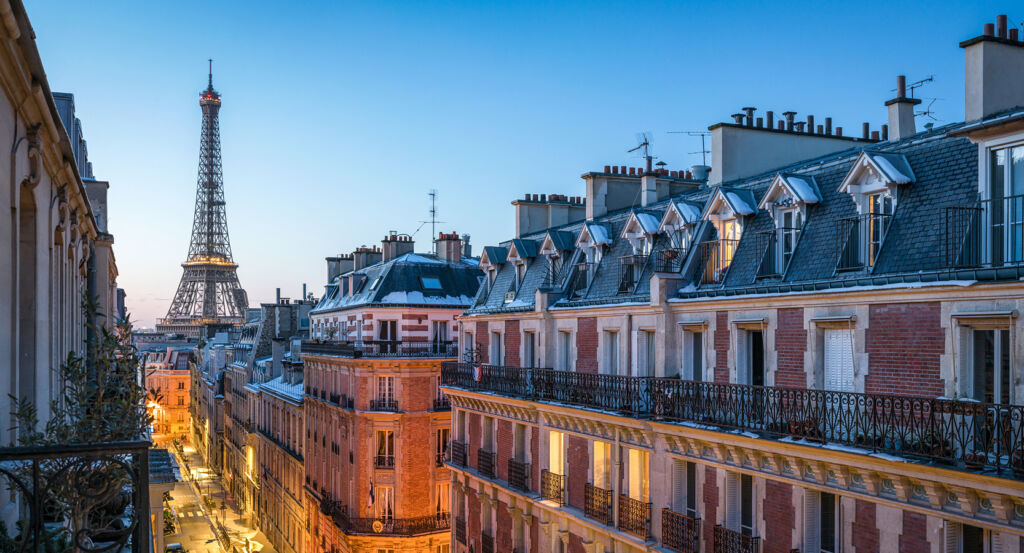
Why you should experience Best Western Nouvel Orléans Montparnasse in Paris, France.
Best Western Nouvel Orléans Montparnasse is a poised four-star hotel where Petit-Montrouge's Haussmannian character, Montparnasse creative inheritance, residential intimacy and southern Left Bank rhythm converge within an early twentieth-century Parisian building.
Set along Avenue du Général Leclerc near Rue Mouton-Duvernet and just steps from Mouton-Duvernet Métro, the 42-room property preserves original moldings and period architectural elements within interiors renovated by architect and designer Sandrine Alouf. Alouf introduced contemporary furnishings, backlit headboards, patterned wall treatments and restrained blue accents while allowing the inherited fabric of the circa-1900 building to remain visible throughout the accommodations. Room categories extend from Double and Twin configurations through 16-square-meter Superior rooms, Triple rooms and a Junior Suite whose gray arabesque mosaic and curved furniture establish the property's most developed decorative composition. The result is a hotel where Sandrine Alouf's contemporary intervention gives the architectural style of Petit-Montrouge a polished hospitality expression without erasing the building's original Parisian character.
What you should know about Best Western Nouvel Orléans Montparnasse.
Best Western Nouvel Orléans Montparnasse is best known for occupying a circa-1900 Haussmannian building at 25 Avenue du Général Leclerc whose recent renovation by Sandrine Alouf retained original moldings and period architectural elements while introducing a contemporary decorative program across all 42 guestrooms. The accommodation inventory spans Double, Twin, Superior Double, Triple and Junior Suite configurations, with 16-square-meter Superior rooms adding dedicated seating and 15-square-meter Triple rooms accommodating as many as three guests through either one double and one single bed or three individual beds. Twin rooms develop the modernized interiors through backlit headboards and deliberately contrasted materials, while the Junior Suite uses gray volute-patterned mosaic, blue accents and curved design furniture whose forms evoke dance and arabesques. All 42 rooms are air-conditioned and soundproofed, with minibars incorporated throughout the inventory and Nespresso machines documented in Triple rooms, while selected configurations accommodate as many as four people. Alouf's renovation works through unusually specific interventions for a compact independent-feeling property, preserving the decorative evidence of an early twentieth-century Parisian building while differentiating room categories through lighting, textiles, furniture geometry and color.
The property's strongest contextual artifact sits directly beneath the pavement outside: Mouton-Duvernet station opened on October 30, 1909 during the southern extension of Métro Line 4 from Raspail to Porte d'Orléans, embedding the hotel's address within the transport expansion that accompanied twentieth-century growth across southern Paris. The avenue itself bears the name of General Philippe Leclerc de Hauteclocque, whose 2nd Armored Division entered Paris during the August 1944 liberation before continuing east toward Strasbourg, giving the hotel's address a direct connection to one of the defining military figures of modern France. Inside, Sandrine Alouf's preservation of circa-1900 moldings establishes a quieter architectural continuity with that surrounding chronology, while the contemporary backlit headboards, volute tapestries and curved furniture prevent the property from becoming a period exercise. The combination of an early twentieth-century shell, a 1909 Métro threshold, an avenue carrying Leclerc's name and Alouf's contemporary interior authorship gives Best Western Nouvel Orléans Montparnasse considerably more historical texture than its compact 42-room scale initially suggests.
How to fold Best Western Nouvel Orléans Montparnasse into your trip.
Best Western Nouvel Orléans Montparnasse works as the anchor for an afternoon tracing the studios, artistic communities and intensely personal creative environments that gave the southern edge of Montparnasse its twentieth-century identity.
Begin at Institut Giacometti, where a 350-square-meter Art Deco hôtel particulier containing artist-decorator Paul Follot's former studio now houses Alberto Giacometti's reconstructed workspace, complete with his furniture, personal objects, painted walls and works rarely displayed elsewhere, grounding the afternoon in the physical environment of artistic production. Continue to Ateliers-musée Chana Orloff, where Auguste Perret designed the sculptor's house-studio in 1926 within Villa Seurat, giving Orloff a working environment embedded among the artists and writers who made this pocket of the fourteenth Arrondissement an unusually concentrated creative community. Conclude at Fondation Cartier pour l'art contemporain, site du boulevard Raspail, Jean Nouvel's 1994 glass architecture that served the institution for three decades before Fondation Cartier moved to Place du Palais-Royal in October 2025, leaving behind one of the district's defining late twentieth-century encounters between architecture, art and garden. The progression moves from Giacometti's reconstructed working world through Orloff's purpose-built studio into Nouvel's transparent former exhibition house, revealing how artists and architects repeatedly turned the streets surrounding Best Western Nouvel Orléans Montparnasse into spaces for sustained creative experimentation.
Where your story begins.
Foresyte Travel reveals places that feel extraordinary long before you arrive.
Experience premium editorial crafted for luxury travelers.














































































































