
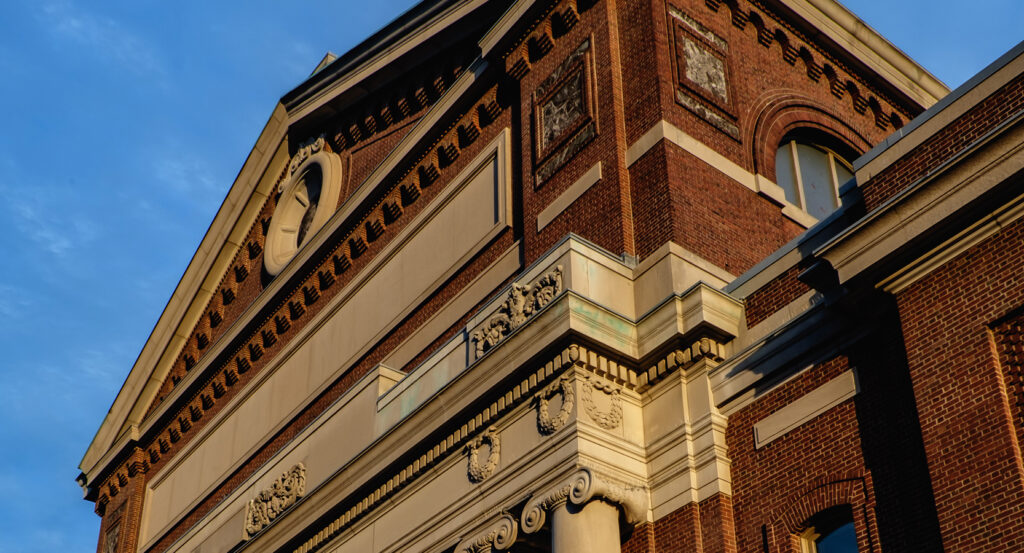
Why Symphony Hall matters.
In the beating heart of Boston's Back Bay, Boston Symphony Hall stands as one of the world's most acoustically perfect concert venues, a temple where architecture and sound meet in sublime harmony.
Opened in 1900 and home to the renowned Boston Symphony Orchestra (BSO), the hall is not merely a performance space, it's an experience that envelops you from the first resonant note. Step inside its stately façade and you're met with an atmosphere that feels both grand and intimate: white marble columns, gilded moldings, and soft amber lighting that sets the stage for sonic transcendence. Every seat, from the orchestra floor to the upper balconies, is designed to catch the music with crystalline precision, a feat of acoustical engineering guided by Harvard physicist Wallace Clement Sabine, whose pioneering research transformed this hall into a global benchmark for concert acoustics. Whether it's a sweeping symphony, a delicate string quartet, or the soaring voice of the Boston Pops, the sound doesn't just fill the space, it seems to shimmer, breathe, and move through you. The moment the orchestra begins, the city outside fades away, replaced by the timeless discussion between silence and sound.
What defines Symphony Hall.
Boston Symphony Hall is more than a cultural landmark, it's a scientific marvel and a monument to musical perfection.
When it was conceived at the turn of the 20th century, Boston Symphony Orchestra set out to build a hall that would rival the great European concert venues of Vienna and Berlin. The orchestra's founder, Henry Lee Higginson, worked with architects McKim, Mead & White and acoustician Wallace Sabine to design a space that would sound as beautiful as it looked. Sabine's meticulous experiments, calculating how sound reflected, diffused, and decayed within a room, gave birth to the modern science of architectural acoustics, making Symphony Hall the first building in the world to be engineered using these principles. The hall's shoebox-shaped design, coffered ceilings, and shallow balconies all contribute to its extraordinary clarity. Its 3,500 plaster figures, carved into niches around the hall, are not merely ornamental; they were placed to scatter sound evenly across the audience. Few visitors know that Symphony Hall also houses one of the oldest and largest concert organs in the United States, a 4,800-pipe Aeolian-Skinner organ, whose power can make the entire building hum with vibration. The hall was designated a National Historic Landmark in 1999, cementing its legacy as a cornerstone of American musical history. Through wars, cultural revolutions, and technological change, Symphony Hall has remained steadfast, a living tribute to the pursuit of sonic and artistic excellence.
How Boston Symphony Hall fits.
Attending a performance at Boston Symphony Hall is not just a night out, it's a pilgrimage for anyone who reveres music, beauty, and craftsmanship.
If you're visiting during the concert season, try to secure tickets for Boston Symphony Orchestra or the Boston Pops, whose performances range from classical masterworks to cinematic scores and jazz tributes. Arrive early to admire the hall's neoclassical architecture, the Corinthian columns, sculpted muses, and vaulted ceilings that set a tone of quiet grandeur. Take a moment to stand at the center aisle before the performance begins; you'll feel the room's balance, its proportions perfectly tuned to sound and stillness alike. For those traveling in the summer, the BSO's Tanglewood Festival in the Berkshires offers an outdoor complement to Symphony Hall's elegance, though the Boston venue remains the orchestra's beating heart. If you prefer a daytime experience, the hall also offers guided tours that reveal the building's fascinating acoustical secrets, from its resonance chambers to the placement of its decorative reliefs. After the visit, stroll along Huntington Avenue, known as the Avenue of the Arts, home to the New England Conservatory, Museum of Fine Arts, and Isabella Stewart Gardner Museum, each reflecting a different facet of Boston's cultural soul. Cap off your evening with dinner nearby in Copley Square or the South End, where pre- and post-concert dining has become a tradition as timeless as the hall itself. To hear music within these walls is to experience sound as it was meant to be, unadorned, unfiltered, and utterly alive, the kind that lingers long after the final note fades.
Where your story begins.
Foresyte Travel reveals places that feel extraordinary long before you arrive.
Enjoy editorial crafted for luxury travelers.
Foresyte may earn a commission when you book.







































































































